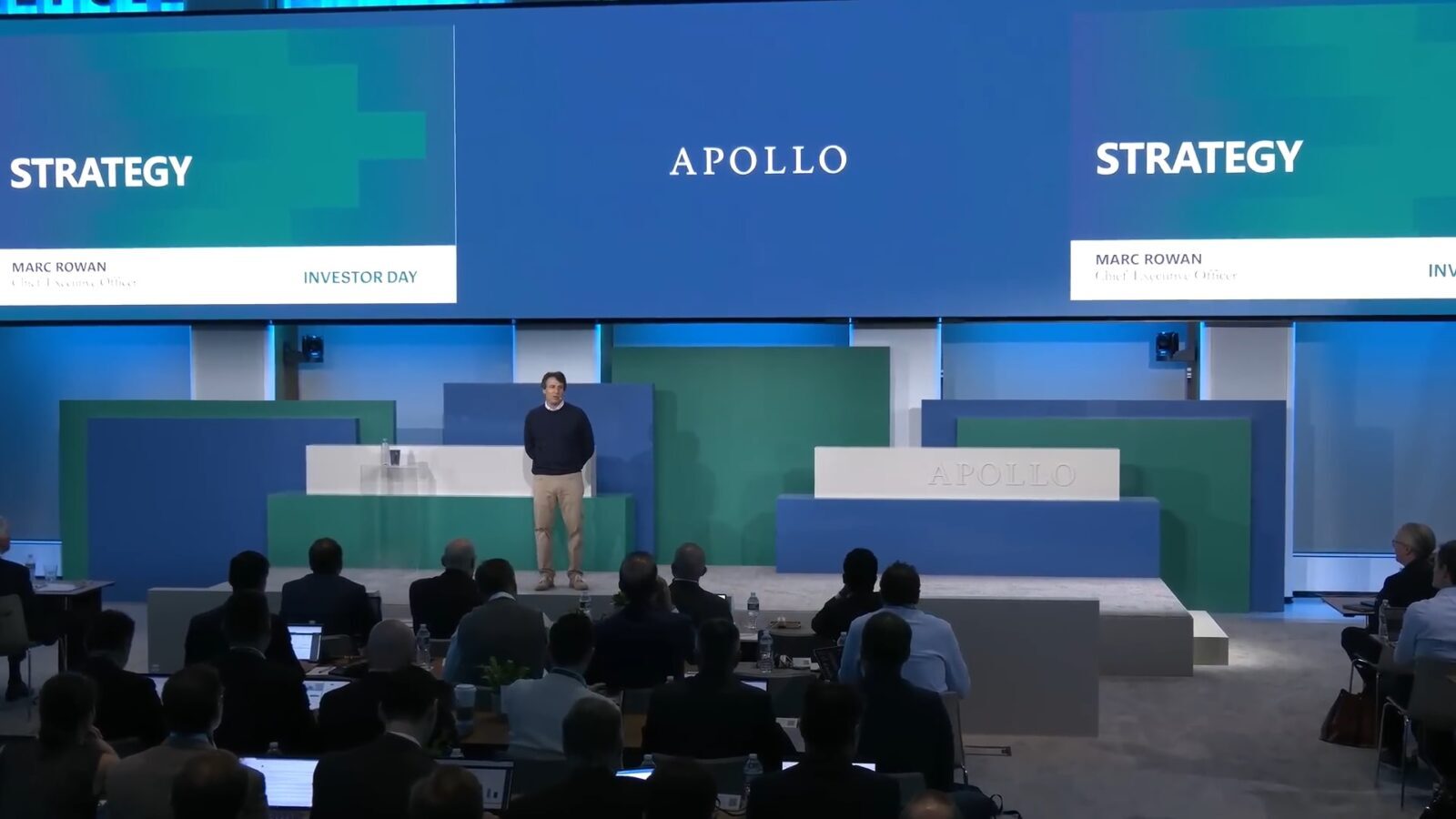
Apollo Global Management is reportedly closing in on a $3.4 billion financing package that would put a vast pool of Nvidia chips at the disposal of Elon Musk’s xAI, underscoring how capital markets are racing to keep up with the hardware demands of cutting edge models. The prospective deal would deepen Apollo’s role as one of the most aggressive private lenders in artificial intelligence infrastructure and give xAI a way to scale without tying up its own balance sheet in silicon.
At stake is not just another funding round but a template for how the next wave of AI companies might secure the compute they need in a world where Nvidia hardware is scarce, expensive and strategically vital. By pairing a giant credit line with a leasing structure, Apollo and xAI are testing whether Wall Street can turn GPUs into a distinct asset class, one that can be financed, securitized and recycled across multiple tenants.
The structure of Apollo’s $3.4 billion chip bet
The core of the prospective arrangement is a loan of exactly $3.4 billion that Apollo Global Management would extend to a vehicle dedicated to acquiring Nvidia hardware for xAI. Rather than xAI buying the chips outright, Apollo and its affiliates would control the capital stack, while xAI commits to long term leases that help amortize the cost of the GPUs over time. Reporting indicates that Apollo Global Management could grant the $3.4 billion loan to an entity that then purchases Nvidia clusters for AI model training, effectively separating ownership of the chips from their operational use.
This structure builds on Apollo’s broader push into private credit and asset based financing, where it lends against tangible collateral rather than just corporate cash flows. In this case, the collateral is racks of Nvidia accelerators that can be redeployed to other customers if xAI’s needs change or if the company stumbles. The deal has been framed as part of a larger trend in which leasing chips and compute infrastructure has emerged as a crucial mechanism for funding AI build outs, with Financing models explicitly designed to spread the risk of rapid hardware obsolescence.
Why leasing beats owning in the AI chip race
For xAI, the appeal of this arrangement is straightforward: access to state of the art Nvidia clusters at scale without having to commit billions of dollars of its own capital to hardware that may be eclipsed by the next generation of chips within a few years. Leasing lets the company treat compute as an operating expense rather than a massive up front investment, which is particularly important for a business whose monthly cash burn is already substantial. Earlier reporting on Apollo’s activity in this space notes that the private equity group has provided $3 billion in financing to purchase NVIDIA chips for lease to xAI, with the structure designed to match the company’s projected usage and revenue ramp, and that Private capital is being funneled into a chip leasing vehicle targeting xAI specifically.
From Apollo’s perspective, leasing also offers a way to turn GPUs into yield generating assets that can be refinanced, syndicated or even securitized over time. Instead of a one off loan tied to a single corporate borrower, the firm can build a diversified portfolio of leases backed by Nvidia hardware, with xAI as a cornerstone tenant but not necessarily the only one. The emphasis on Leasing in the reporting around the $3.4 billion package reflects a broader shift in AI infrastructure funding, where lenders prefer structures that let them reallocate compute to other customers if demand patterns change, rather than being locked into a single end user for the life of the chips.
Apollo’s growing role as AI’s private credit engine
The prospective $3.4 billion loan is not Apollo’s first foray into this corner of the market, but it would be one of its largest and most visible. The firm has already committed $3 billion in financing to purchase NVIDIA chips for lease to xAI, and the new package would represent a further deepening of that relationship, effectively doubling down on the thesis that AI compute can be financed like aircraft, railcars or data centers. The reporting describes how Apollo has made a further commitment through a chip leasing vehicle, signaling that it sees long term value in owning the underlying hardware even as individual AI models and companies come and go.
This strategy fits neatly with Apollo’s broader identity as a private equity giant that has increasingly leaned on private credit to generate returns in a higher rate environment. By stepping into a space where traditional banks may be cautious, Apollo can command higher yields while also gaining exposure to one of the most dynamic sectors of the technology economy. The potential $3.4 billion loan to xAI, layered on top of existing commitments, positions Apollo as a central node in the emerging ecosystem of non bank lenders that are quietly powering the AI boom, even as public attention focuses on the headline valuations of model developers.
xAI’s hardware hunger after the SpaceX merger
The timing of the Apollo talks is not accidental, coming as Elon Musk moves to integrate xAI more tightly with his other ventures. Earlier this year, Musk’s SpaceX agreed to take over his artificial intelligence start up, with the goal of unifying some of his major companies under a shared technological and financial umbrella. The merger, which SpaceX outlined on its website, effectively folds xAI into a larger aerospace and satellite communications business that already runs some of the world’s most demanding compute workloads, and reporting on the deal notes that Elon Musk is using the combination to concentrate his AI efforts.
That consolidation raises the stakes for xAI’s hardware strategy, since its models are now expected to serve not just consumer facing products but also internal use cases across the SpaceX ecosystem. Training and deploying large scale models for satellite imagery analysis, autonomous rocket operations or global communications routing all require enormous GPU capacity, and the merged entity will need to balance those needs against the demands of xAI’s own chatbot and developer tools. In that context, securing a dedicated pipeline of Nvidia clusters through Apollo’s financing vehicle is less a luxury than a prerequisite for keeping pace with rivals that already control vast in house data center fleets.
How Nvidia’s dominance shapes the deal
The focus on Nvidia chips in the Apollo package reflects the company’s continued dominance in the market for AI accelerators, particularly for training large language models and other generative systems. While alternative hardware from AMD and specialized startups is gaining traction, the software ecosystem, developer familiarity and performance profile of Nvidia GPUs still make them the default choice for ambitious AI projects. The prospective loan would fund the purchase of Nvidia clusters specifically for AI model training, with Nvidia hardware forming the backbone of the leased infrastructure that xAI would rely on.
Nvidia’s position also helps explain why private lenders are comfortable treating GPUs as collateral, despite the rapid pace of innovation in the sector. The company’s chips tend to hold their value better than most enterprise hardware, in part because demand from cloud providers, research institutions and other AI startups remains intense. If xAI were to reduce its usage or renegotiate its leases, Apollo could in theory reallocate the same Nvidia clusters to other tenants or sell them into secondary markets, limiting its downside. That dynamic is central to the logic of the $3.4 billion loan, which depends on the assumption that Nvidia hardware will remain liquid and desirable for the life of the financing.
Polls, sentiment and the politics of AI capital
Behind the spreadsheets and term sheets, there is a softer but still important dimension to the Apollo xAI talks: how investors, policymakers and the public feel about the concentration of AI power in the hands of a few well financed players. References in the reporting to a poll underscore that market sentiment is being tracked closely, both in terms of enthusiasm for AI as an investment theme and concerns about systemic risk if too much capital chases a narrow set of technologies. In the context of Apollo’s $3.4 billion loan and its earlier $3 billion financing for NVIDIA chips, the poll results help frame whether stakeholders see this as prudent infrastructure building or as a speculative bet that could sour if AI adoption slows.
Political scrutiny is likely to intensify as deals of this size become more common, especially given Elon Musk’s high profile and the strategic importance of AI to national competitiveness. Regulators may not have direct authority over private credit arrangements between Apollo and xAI, but they are watching how such structures influence market concentration, access to compute and the resilience of critical digital infrastructure. For now, the combination of strong investor appetite, favorable poll readings and the perceived inevitability of AI’s growth has created a permissive environment for large scale financing packages like this one. Whether that remains true if there is a downturn in AI valuations or a backlash against the technology is an open question, but it is one that both Apollo and xAI will have to factor into their long term planning.
What the deal signals for the next phase of AI infrastructure
If the Apollo xAI package closes on the reported terms, it will stand as one of the clearest examples yet of how AI infrastructure is being financialized, with GPUs treated as assets that can be leveraged, leased and traded much like aircraft or commercial real estate. I see this as a sign that the AI sector is maturing from a world of equity fueled experimentation into one where debt, collateral and structured finance play a central role. The emphasis on Leasing and asset based Financing in the reporting around the $3.4 billion loan suggests that other private credit firms will follow Apollo’s lead, creating a competitive market for similar deals with rival AI labs and cloud providers.
For AI developers, the message is that access to compute will increasingly depend not just on technical prowess but on the ability to navigate complex capital structures and build relationships with large financial sponsors. For investors, the Apollo xAI talks highlight both the opportunity and the risk of tying returns to a technology that is still evolving rapidly, with hardware cycles, regulatory shifts and competitive dynamics that can change the economics of a deal in a matter of years. As the sector moves into this next phase, the $3.4 billion loan under discussion between Apollo and xAI is likely to be seen as an early template for how Wall Street and Silicon Valley will share the burden of building the physical backbone of artificial intelligence.
More From The Daily Overview
*This article was researched with the help of AI, with human editors creating the final content.

Grant Mercer covers market dynamics, business trends, and the economic forces driving growth across industries. His analysis connects macro movements with real-world implications for investors, entrepreneurs, and professionals. Through his work at The Daily Overview, Grant helps readers understand how markets function and where opportunities may emerge.

