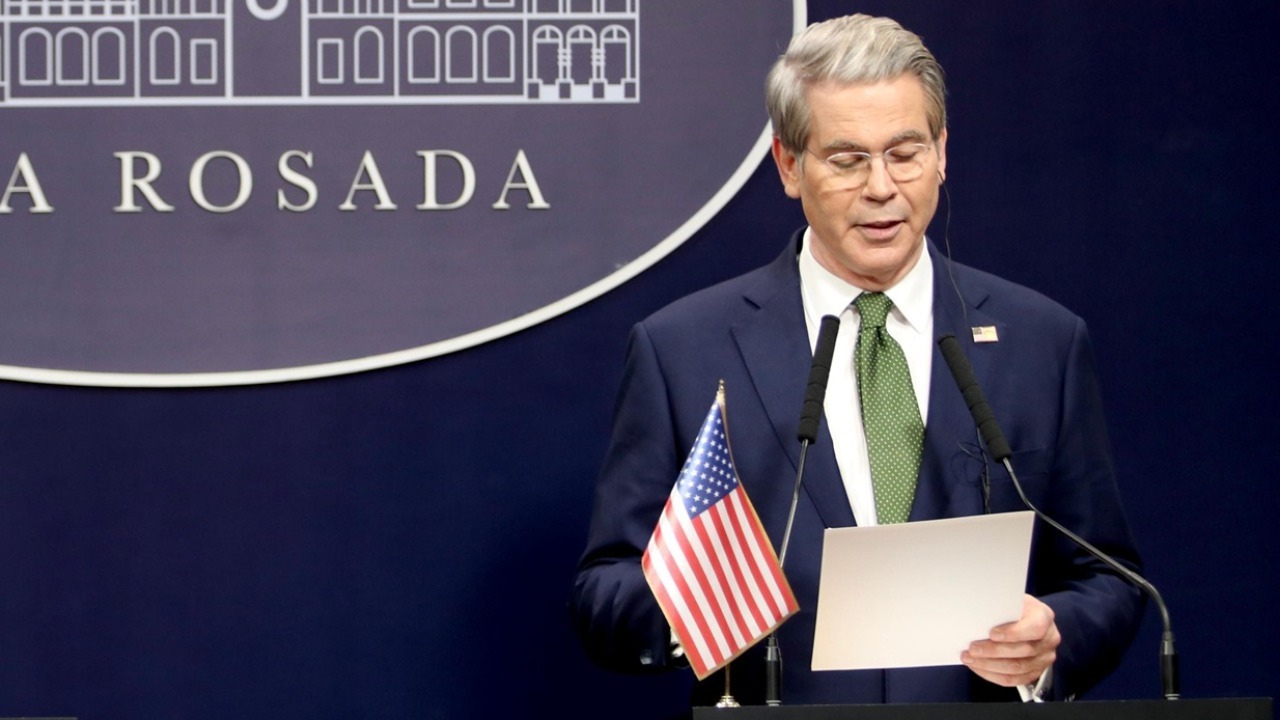
Treasury Secretary Scott Bessent is betting that a once‑fraught trade relationship has quietly turned into a growth engine. He has argued that China has “lived up to” its commitments under President Donald Trump’s trade deal, particularly on agricultural purchases, and that this stability will help power “very strong economic growth” in 2026. His optimism rests on a mix of solid 2025 data, a reported 15% jump in capital spending, and an unusually dense calendar of potential Trump–Xi summits that could lock in what he calls a “very good equilibrium.”
That narrative is striking in a world still conditioned to expect U.S.–China shocks rather than tailwinds. The question now is whether Bessent’s confidence reflects a durable shift in the global trading order or a fragile truce that could be upended by domestic politics, from House Democrats’ push to curb Trump’s tariff authority to lingering skepticism over how deep the economic benefits really run.
From tariff war to “very good equilibrium”
Scott Bessent’s core claim is straightforward: the trade framework negotiated under Trump has moved the U.S. and China from confrontation to what he has described as a “very good equilibrium.” In his telling, Beijing has honored the deal’s purchase commitments, especially in farm goods, easing pressure on U.S. exporters that once bore the brunt of retaliatory tariffs. That is a notable shift from the early tariff war, when soybean growers in Iowa or Illinois were scrambling for alternative buyers and Washington was forced into ad hoc aid packages to keep them afloat.
What makes this equilibrium more plausible is the broader trajectory of China itself, which remains deeply integrated into global supply chains despite decoupling rhetoric. Bessent has framed the current relationship as one where both sides have strong incentives to avoid another spiral of tariffs and counter‑tariffs, because the costs to manufacturers, consumers, and financial markets are now clearer than they were in the first Trump term. That logic underpins his argument that the trade deal is not just holding, but actively supporting U.S. growth.
China “lived up to” the Trump deal, especially on soybeans
Bessent has gone further than most officials by saying outright that China has “lived up to” the trade deal with Trump. In a Fox News interview, he highlighted that Beijing has so far fulfilled its agreed soybean purchases, a critical benchmark because those volumes are easy to track and politically sensitive in U.S. farm states. A separate report on the same remarks underscores that Bessent explicitly linked this compliance to his upbeat 2026 outlook, arguing that reliable Chinese demand has stabilized agricultural exports and farm incomes, which in turn supports rural consumption and investment.
Chinese follow‑through on soybeans does not automatically prove that every other plank of the deal, from energy buys to intellectual property protections, is equally robust. Yet Bessent’s willingness to use such categorical language, repeated across coverage of his comments on Trump, suggests the Treasury has internal data that paints a broadly positive picture. For farmers, the practical effect is simple: fewer sudden cancellations, more predictable cash flow, and a better backdrop for decisions like whether to buy a new John Deere combine or expand storage capacity.
Real‑economy momentum and the 2026 boom thesis
Bessent’s bullishness on 2026 is not built on trade alone. The Treasury has noted that Real activity expanded strongly in 2025, with most Fed officials expecting that expansion to continue this year, supported by solid labor markets and resilient household demand. That backdrop matters because trade gains amplify domestic strength rather than substitute for it. If consumers are already spending and businesses are already hiring, a stable export channel to China can turn a good year into the kind of “very strong economic growth” Bessent is promising.
On top of that, Bessent has pointed to a roughly 15% uptick in capital expenditures as a key driver of the coming boom, a figure he highlighted in a televised segment where Scott Bessent, identified as Treasury Secretary, framed 2026 as a “bountiful year” for the U.S. economy. If that investment is flowing into sectors that are heavily exposed to global trade, such as advanced manufacturing and energy infrastructure, the combination of higher capacity and smoother access to Chinese demand could plausibly add a meaningful lift to GDP growth, even if the exact percentage point contribution remains uncertain.
House Democrats, tariff authority, and the political risk factor
The biggest near‑term threat to Bessent’s equilibrium narrative is not Beijing, but Capitol Hill. Reporting on the tariff debate shows that Bessent Says China is on track even as House Democrats push to force a vote on Trump’s tariff authority. Their goal is to reassert congressional control over trade tools that the White House has wielded aggressively, arguing that unchecked executive power risks both economic volatility and diplomatic escalation. For businesses that have just begun to trust the current rules of the game, the prospect of a legislative showdown injects a new layer of uncertainty.
Another account of the same effort notes that House Democrats Aim to constrain Trump’s ability to impose or lift tariffs unilaterally, a move that could complicate any rapid adjustments Bessent and the president might want to make in response to Chinese behavior. A separate summary of the same dynamic stresses that Bessent, China, House Democrats, and Trump are now locked in a three‑way tug‑of‑war over who ultimately sets the terms of engagement. If Congress succeeds in clipping the president’s tariff powers, the trade deal might become more predictable, but Washington’s leverage over Beijing could also be blunted.
Four Trump–Xi meetings and the summit diplomacy bet
Bessent is not just counting on statutes and spreadsheets; he is also banking on personal diplomacy. At the World Economic Forum Annual Meeting in Davos, Treasury Secretary Scott said the U.S. relationship with China had reached that “very good equilibrium,” and he tied that stability to ongoing high‑level talks. Another detailed account notes that EST time stamps his remarks and underscores that he sees regular leader‑level engagement as central to keeping trade on track.
Separately, Treasury Secretary Scott has said Tuesday that President Donald Trump and Chinese President Xi Jinping may meet as many as four times in 2026, with at least one of those meetings confirmed as having been initiated by Trump. A related summary reiterates that President Donald Trump are expected to use those summits to review implementation of the trade deal and potentially broaden cooperation. If those encounters yield side agreements on technology exports or regulatory coordination, the cumulative effect could be to shave friction out of supply chains in ways that do not grab headlines but do show up in quarterly trade and GDP data.
More From The Daily Overview
*This article was researched with the help of AI, with human editors creating the final content.

Grant Mercer covers market dynamics, business trends, and the economic forces driving growth across industries. His analysis connects macro movements with real-world implications for investors, entrepreneurs, and professionals. Through his work at The Daily Overview, Grant helps readers understand how markets function and where opportunities may emerge.

