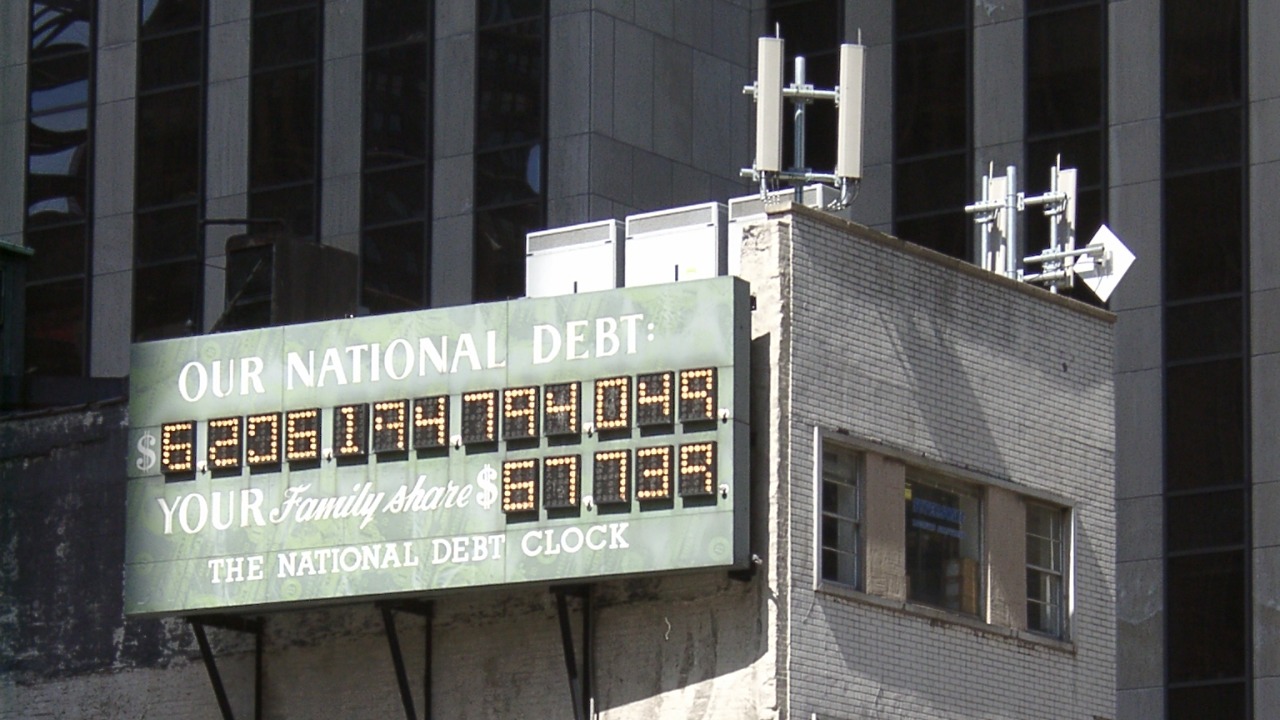
The United States has entered a phase where interest on the national debt is no longer a background line item but a central feature of federal finances. Just two months into the current fiscal year, the government is already spending more than $10 billion every week on interest alone, a pace that reshapes what is politically and economically possible in Washington. I see that shift not as an abstract budget story, but as a concrete reordering of national priorities that will touch everything from retirement benefits to defense.
What makes this moment different is the combination of a very large debt stock and higher interest rates, which together are turning interest payments into one of the fastest growing claims on federal dollars. The numbers now rival, and in some cases threaten to overtake, core programs that voters tend to treat as untouchable, forcing a debate over what the United States can afford when so much money is already spoken for before a single new policy is passed.
Interest has muscled into the top tier of federal spending
In the federal budget, interest costs used to sit quietly behind the big social insurance programs, but that hierarchy is eroding. Net interest has climbed into the third-largest spending slot in the current fiscal year, trailing only Social Security and Medicare. On the government’s own scorecard, Social Security is projected at $1,447 billion, Medicare at $965 billion, and Net Interest at $933 billion, a lineup that puts interest payments in the same league as the country’s core retirement and health guarantees. When I look at those figures, I see a budget where past borrowing is competing head to head with present promises.
The speed of that climb is just as striking as the level. In dollar terms, annual interest costs hit an all-time high of $476 billion in 2022 and have roughly doubled since then as higher rates filter through the Treasury’s rolling schedule of bond issuance. That trajectory points toward interest outlays approaching, and potentially surpassing, $970 billion in the near term, even before any new recession or emergency borrowing. The combination of a large existing debt and a higher average interest rate is what turns a line item into a structural force that shapes every other budget conversation.
$10 billion a week is not a blip, it is the new baseline
When I say the government is spending more than $10 billion a week on interest, I am not describing a one-off spike, but a pattern that has emerged just two months into the fiscal year. Treasury data show that in that short window, the United States has already locked into a weekly interest burn rate above the $10 billion mark, a pace that, if sustained, would push annual net interest close to or beyond the levels now projected. The fact that this threshold was crossed so early in the budget year underlines how quickly higher rates have translated into real cash out the door.
That weekly figure sits on top of a daily reality that is just as stark. On a rolling basis, the federal government is now spending over $2.6 BILLION every single day servicing the National Debtcosting us, a cadence that turns abstract trillions into a constant drain measured in hours and minutes. When EVERY DAY the government must SPEND that much just to stay current on what it already owes, and when those payments are trending higher rather than lower, the room for new initiatives, tax cuts, or emergency responses narrows before any political negotiation even begins.
Higher rates have turned a big debt into a costly one
The underlying math is straightforward: a large stock of debt multiplied by a higher average interest rate produces a much larger annual bill. Analysts now peg the effective interest rate on federal borrowing at about 3.4%, and when I apply that to a debt load on the order of $30 trillion, the implied interest cost is roughly $1 trillion a year. That is in the same ballpark as what the country spends on national defense or Medicare, which means interest is no longer a residual category but a peer to the most politically sensitive parts of the budget.
What makes this shift especially challenging is that interest costs are not discretionary in the way that many other programs are. Congress can trim a grant program or delay a weapons system, but it cannot simply decide to skip a coupon payment without triggering a financial crisis. As the average rate on outstanding debt converges toward that 3.4% level, more of each tax dollar is precommitted to bondholders, leaving less flexibility to respond to new priorities or shocks. That rigidity is what turns rising interest into a constraint on policy rather than just another number in a spreadsheet.
Treasury is already maneuvering in a higher-cost world
Faced with this new interest environment, the Treasury Department has begun to adjust how it manages the existing debt portfolio. Earlier this year, the Treasury Department carried out a second $10 billion bond repurchase in less than two weeks, matching an earlier operation of the same size and signaling a willingness to buy back older, less liquid securities even as overall borrowing continues. Officials confirmed that both buybacks attracted offers across 40 different issues, a sign that investors were eager to trade older holdings back to the government at prevailing prices. I read those moves as an attempt to smooth the maturity profile and improve market functioning at a time when every basis point of interest cost matters.
These repurchases do not change the total debt in a meaningful way, but they do show how actively the government is managing the transition from a low-rate era to a higher-rate one. By swapping out certain bonds and adjusting the mix of short and long maturities, Treasury can modestly influence how quickly higher rates feed into the overall interest bill. The fact that it is conducting $10 billion operations, and doing so IN LESS THAN 2 WEEKS, underscores how large the market is and how incremental even sizable transactions look against the backdrop of a multi-trillion-dollar debt stock.
Rising interest costs are already reshaping political choices
As interest climbs toward parity with major programs, the political stakes become impossible to ignore. When Net Interest is projected at $933 billion in the current fiscal framework, nearly matching Medicare’s $965 billion and closing in on Social Security’s $1,447 billion, every debate over new spending or tax relief has to contend with the fact that a huge share of revenue is already locked up. Lawmakers who want to expand child tax credits, boost defense procurement, or fund new climate programs are effectively competing with bondholders for the same finite pool of dollars.
President Donald Trump and Congress now operate in a world where the cost of servicing past decisions crowds out the space for future ones. The more the government spends on interest, the harder it becomes to stabilize the debt-to-GDP ratio without some combination of higher taxes, slower spending growth, or faster economic expansion. I see the $10 billion-a-week interest tab not just as a warning about fiscal sustainability, but as a live constraint that will shape what Washington can promise, deliver, and ultimately afford in the years ahead.
Supporting sources: Two months into the new fiscal year and the U.S. government …, U.S. Treasury Repeats Historic $10B Debt Buyb… – CoinStats.
More From TheDailyOverview
- Tennessee loses $2.6B megafactory and faces major layoffs
- Retired But Want To Work? Try These 18 Jobs for Seniors That Pay Weekly
- What to do with your pennies after the U.S. stops minting them
- Home Depot CEO warns of a troubling customer trend in stores

Grant Mercer covers market dynamics, business trends, and the economic forces driving growth across industries. His analysis connects macro movements with real-world implications for investors, entrepreneurs, and professionals. Through his work at The Daily Overview, Grant helps readers understand how markets function and where opportunities may emerge.

