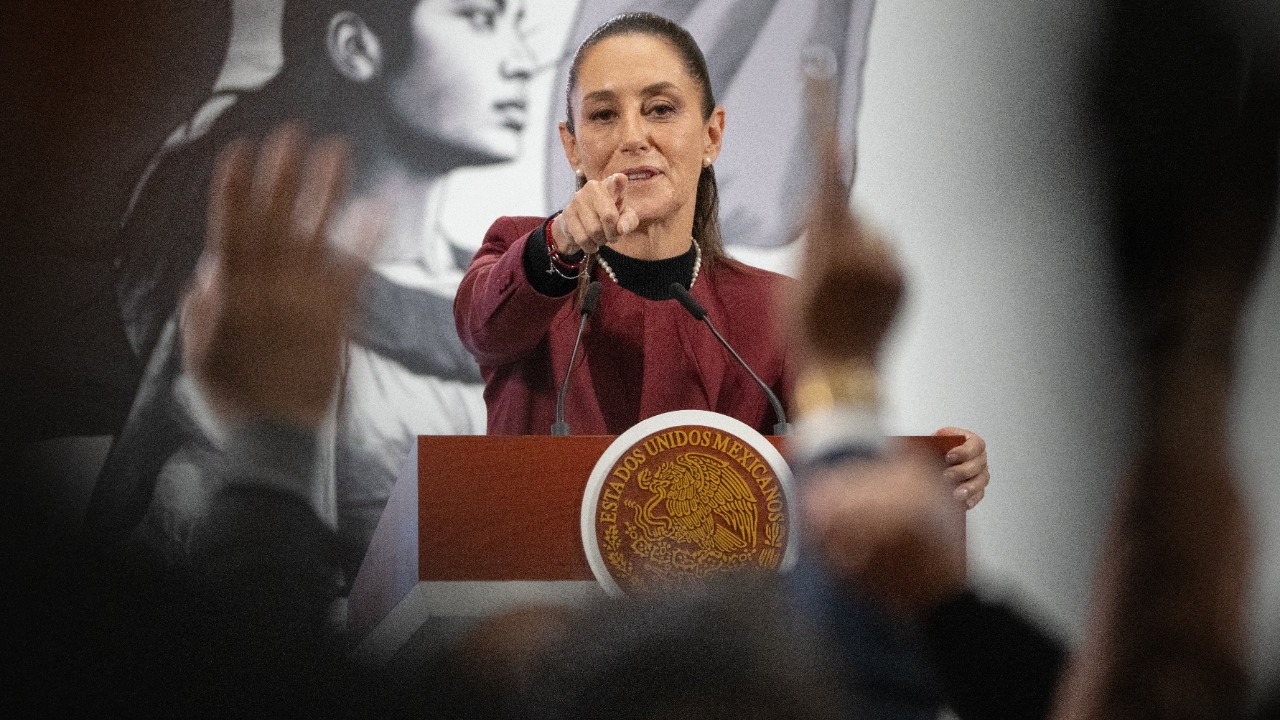
Mexico’s new president is drawing a sharp line against Washington’s latest talk of cross-border force, turning Donald Trump’s renewed threats of military action into a test of sovereignty, history and domestic politics on both sides of the border. Her warning, delivered after Trump again floated the idea of striking cartel targets inside Mexico, signals that any future escalation will meet not quiet diplomacy but a very public pushback.
By rejecting the premise that the United States can unilaterally decide to bomb her country in the name of fighting drugs, she is staking out a doctrine that blends national pride with hard political calculus. The confrontation is already reshaping how Mexicans see their leader, how Americans hear Trump’s security promises and how both governments frame the rules of engagement in the long and often fraught war on cartels.
Sheinbaum’s sharp rebuke and the new red line on sovereignty
Claudia Sheinbaum has chosen to answer Trump’s rhetoric with a mix of historical memory and present-day defiance, making clear that any suggestion of bombing Mexican territory is unacceptable. In public remarks tied to Nov 17, 2025, she rejected what were described as President Shoots Down Trump style threats of bombing her country, treating them not as a policy proposal to be negotiated but as a line that Mexico will not allow the United States to cross. By framing the issue in terms of territorial integrity rather than partisan sparring, she is effectively telling Washington that the debate is not about tactics against cartels, it is about whether Mexico is treated as an equal sovereign state.
Her language has been calibrated to resonate at home as much as abroad, casting Trump’s talk of strikes as an affront to national dignity that no Mexican leader could accept. The fact that these warnings surfaced in mid Nov, just as she is still consolidating her authority, gives them added weight: she is using Trump’s comments to define her presidency’s foreign policy posture from the outset. In doing so, she is signaling to both allies and adversaries that Mexico will not quietly absorb threats of bombing, even when they come from its most powerful neighbor and key security partner.
Invoking the Mexican-American War to frame today’s dispute
To understand why Sheinbaum’s response has struck such a chord, it helps to see how she has anchored it in a much older trauma. In remarks reported on Nov 17, 2025, she explicitly cited the Mexican, American War as she rejected Trump’s cartel strike threats, reminding audiences that the United States once took half of Mexico’s territory and that this history still shapes public sentiment. By invoking that conflict, detailed in coverage of how Sheinbaum cites Mexican-American War, she is not simply offering a history lesson, she is warning that any new U.S. intervention would reopen wounds that have never fully healed.
This historical framing also serves a strategic purpose in the current standoff. By tying Trump’s threats to the legacy of the Mexican, American War, Sheinbaum is making it politically costly for any Mexican politician to appear accommodating to U.S. military action, and she is reminding American audiences that what might sound like a tough-on-crime proposal in Washington can look like a repeat of past aggression in Mexico City. The reference to that nineteenth century conflict, and to the fact that the United States took half of the territory, turns a contemporary security debate into a referendum on whether Washington has truly moved beyond the era of unilateral expansion.
Trump’s intervention talk and Mexico’s categorical refusal
Trump’s latest comments are not a one-off flourish but part of a pattern in which he has repeatedly floated the idea of using U.S. forces inside Mexico to fight cartels. Reporting tied to Nov 17, 2025 notes that he has suggested on several occasions that Washington could offer a United States military intervention in Mexico or simply carry out strikes to stop drugs, a posture captured in coverage that quotes him saying such options have been on the table on several occasions. For Trump, now back in the White House, this rhetoric fits a broader pattern of promising decisive, even unilateral, action against transnational crime, regardless of diplomatic niceties.
Mexico’s response has been unequivocal. On Nov 18, 2025, coverage described how Mexico’s president firmly refuses Trump’s proposal for US military strikes against cartels, underscoring a consistent position against any U.S. intervention on Mexican soil. That firm rejection, detailed in reports that stress Mexico’s stance against any U.S. intervention, is not hedged with conditions or bargaining chips. Instead, it sets a bright red line: cooperation against cartels is welcome, but foreign bombs on Mexican territory are not up for discussion.
Domestic politics: Sheinbaum’s popularity and Trump’s contrast
Sheinbaum’s ability to confront Trump so directly is rooted in a reservoir of domestic support that gives her room to take a hard line. Analysis from Oct 4, 2025 notes that her approval rating, while down from 80% in February, remains high enough to make her one of the most popular leaders in the region. That figure of 80% in February, even after some erosion, gives her political capital to resist external pressure and to frame the confrontation with Washington as a defense of national interests rather than a partisan gambit.
That same analysis highlights the contrast with President Donald Trump, whose rating is described as sharply lower, underscoring how differently the two leaders are perceived at home. While Sheinbaum can lean on broad public backing to reject Trump’s threats, Trump is using the promise of tough action against cartels to shore up his own standing with voters who prioritize border security and crime. The asymmetry is striking: a Mexican president with strong approval facing a U.S. president whose domestic numbers lag, yet who is still willing to threaten strikes in Mexico to project strength.
A clear message from Mexico and the risks of escalation
The confrontation has crystallized in a series of pointed statements that leave little ambiguity about Mexico’s position. Coverage dated Nov 18, 2025 at 11:40 AM EST describes how Sheinbaum sends clear message to Trump in response to threats to bomb Mexico, using blunt language to reject the idea that Washington can dictate security policy across the border. In that account, she not only rebuffs the threats but also reminds audiences that Mexico has already endured a history of territorial loss, a point that reinforces her broader warning to Trump and Mexico alike.
Her message carries at least 40 distinct implications for the bilateral relationship, from security cooperation and intelligence sharing to trade and migration, because it signals that any move toward unilateral U.S. action could trigger a broader diplomatic rupture. By tying today’s dispute to both the Mexican, American War and to contemporary fears of renewed intervention, Sheinbaum is effectively warning that Trump’s threats risk undoing years of painstaking coordination against cartels. The stakes are not abstract: if Washington were to act on talk of bombing, it would not only violate Mexico’s sovereignty but also likely fuel anti-American sentiment, complicate joint operations and hand criminal groups a powerful propaganda tool.
What comes next for U.S.-Mexico security cooperation
Looking ahead, the clash over Trump’s strike threats will shape how both governments approach the shared challenge of cartel violence. Mexico’s categorical refusal to accept any U.S. military intervention means that future cooperation will have to stay within the bounds of intelligence sharing, training and coordinated law enforcement rather than cross-border strikes. The firm stance articulated in mid Nov, including the explicit rejection of bombing proposals and the reminder that the United States once took half of the territory, sets a framework in which any hint of unilateral action will be met with immediate political backlash in Mexico City.
For Washington, that reality forces a choice between symbolic toughness and practical collaboration. Trump can continue to talk about bombing cartels in Mexico to satisfy domestic audiences, but every such threat risks hardening Mexican resistance and narrowing the space for quiet, technical cooperation that actually disrupts trafficking networks. As Sheinbaum leverages both her high approval, once measured at 80%, and the enduring memory of the Mexican, American War, she is betting that a firm defense of sovereignty will not only play well at home but also eventually push the United States to treat Mexico less as a theater for unilateral action and more as a partner whose consent is non-negotiable.
More From TheDailyOverview
- Dave Ramsey warns to stop 401(k) contributions
- 11 night jobs you can do from home (not exciting but steady)
- Small U.S. cities ready to boom next
- 19 things boomers should never sell no matter what

Grant Mercer covers market dynamics, business trends, and the economic forces driving growth across industries. His analysis connects macro movements with real-world implications for investors, entrepreneurs, and professionals. Through his work at The Daily Overview, Grant helps readers understand how markets function and where opportunities may emerge.

