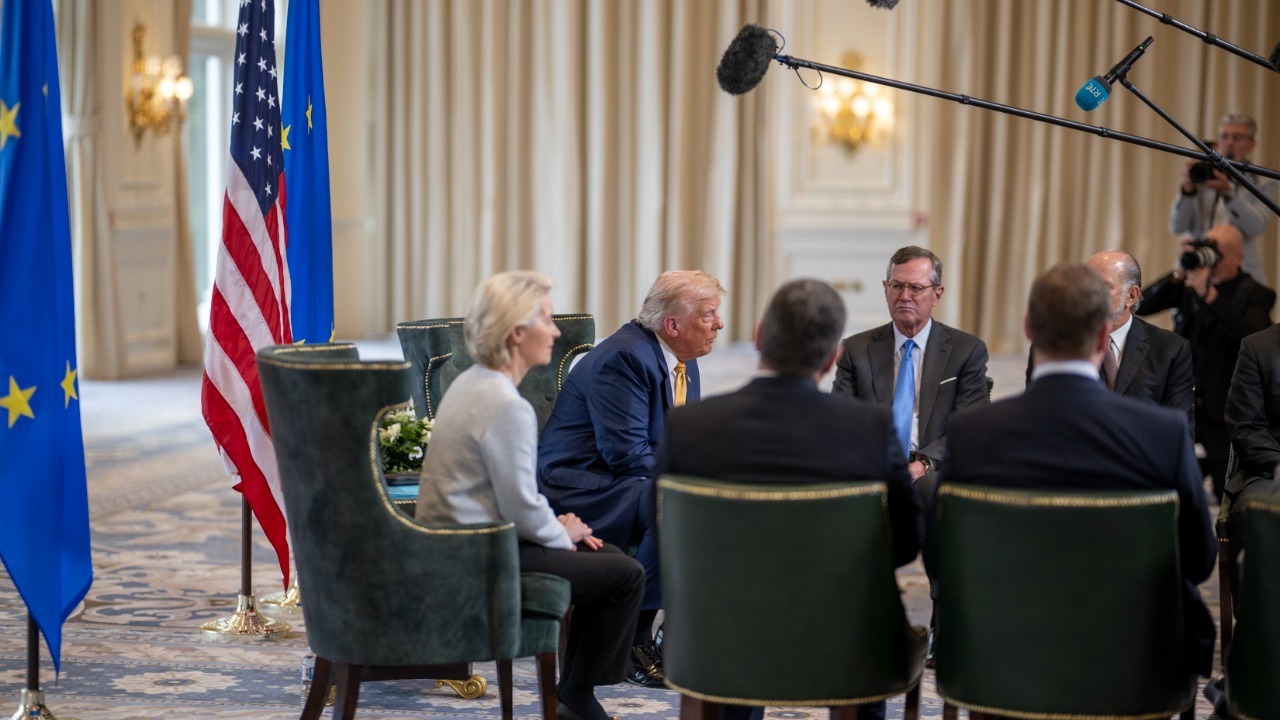
Big Northern European asset owners are quietly redrawing the global investment map. Faced with a surge in geopolitical confrontation centered on the United States, they are trimming exposure, tightening risk limits, and hunting for alternatives that can match American returns without importing American political volatility. The shift is still measured rather than panicked, but it signals that the world’s largest financial market is no longer treated as a default safe harbor.
At the heart of this rethink is a collision between long term fiduciary duty and short term political shock. From tariff threats over Greenland to talk of trade “bazookas” aimed at Silicon Valley, the policy backdrop around President Donald Trump has become a primary input into portfolio strategy rather than background noise. I see that change most clearly in the way Nordic pension chiefs now talk about the United States as a risk factor, not just a growth engine.
Nordic giants move from enthusiasm to caution
Big Northern European investors that once leaned heavily on Wall Street are now recalibrating how much political risk they are willing to tolerate for the sake of higher returns. Several of these funds, managing tens of billions of dollars, have begun to reassess their exposure to U.S. assets as geopolitical tensions mount, shifting from automatic reinvestment into a more selective, scenario driven approach that weighs sanctions, tariffs, and regulatory shocks as core variables. One detailed account of Big Northern European institutions describes how they are scrutinizing everything from U.S. Treasuries to private equity commitments through this new lens.
Nordic pension funds sit at the center of this pivot. Managers responsible for large pools of retirement savings have signaled that they are increasingly cautious about holding U.S. assets, explicitly citing geopolitical tensions as a major concern and exploring a gradual shift away from what has long been the world’s largest financial market. Reporting on Northern European investors highlights how this caution is not about abandoning the United States altogether, but about reducing concentration risk and building in more flexibility to react if political shocks hit valuations.
Policy shocks from Washington to Greenland
The immediate catalyst for this more defensive stance has been a series of policy moves and threats from Washington that investors see as both unpredictable and deeply market relevant. Earlier this year, President Donald Trump used a social media post on Saturday to threaten escalating tariffs on eight Euro area economies in response to tensions over Greenland and its mineral resources, including rare earths, turning a territorial dispute into a direct trade risk for European exporters. Analysts dissecting What happened? in that episode have underlined how quickly presidential rhetoric can morph into concrete tariff schedules that hit earnings and cross border capital flows.
For long term investors, the concern is not one isolated threat but a pattern of unilateral decisions that can reprice sectors overnight. The Eurasia Group and GZERO Media have gone so far as to frame the United States itself as a central source of global political risk, with a flagship report co written by Ian Bremmer, the president and founder of Eurasia Group and GZERO Media, and Cliff Kupchan, chairman of the firm, arguing that the president’s unilateralist instincts are intact and likely to keep generating market moving surprises. That assessment of top risks has filtered directly into risk committees in Northern Europe, where boards are asking whether their U.S. allocations still reflect an appropriate balance between return and political hazard.
From “principal source of risk” to portfolio rebalancing
That macro diagnosis has been reinforced in broadcast discussions that put U.S. politics at the center of global market anxiety. In one widely cited segment, Gera walked through a fresh top risks report and described how eurasia had unveiled its view of the United States as the principal source of global risk in 2026, highlighting the potential for domestic political turmoil to spill over into trade, technology controls, and financial sanctions. The framing in that Gera interview has resonated with European allocators who now see U.S. exposure not just as a bet on growth and innovation, but as a concentrated wager on one country’s institutional resilience.
Inside investment committees, that narrative is translating into concrete allocation changes rather than abstract worry. One detailed survey of large funds noted that, while U.S. policy uncertainty is a risk factor for asset valuations, the funds said they would not withdraw capital for political reasons alone, instead choosing to trim positions at the margin and diversify into other developed markets and private assets. Executives overseeing about $61 billion of pension assets stressed that the United States remains an investable market, but that they are no longer comfortable treating it as a risk free anchor, a stance captured in reporting that begins with the word While and runs through their reasoning.
Europe’s “bazooka” and the tech shock risk
As Washington leans into tariffs and territorial brinkmanship, Brussels is preparing its own arsenal, and that escalation loop is another reason Northern European investors are trimming U.S. bets. Analysts warn that, in response to U.S. tariff and territorial threats, Europe has loaded its trade bazooka, with the potential to target digital services, data flows, and competition rules in ways that could make Silicon Valley the first casualty of a transatlantic economic war. The prospect of a European Europe wide response that hits U.S. technology champions directly is forcing portfolio managers to stress test their exposure to the Nasdaq and to high growth private tech valuations that depend on open access to European consumers.
The risk is not confined to headline grabbing platform companies. A broader tightening of trade and regulatory conditions could ripple through supply chains, cloud infrastructure, and even the financing conditions for start ups that rely on cross border venture capital. Some strategists argue that China could be the winner if a prolonged spat between Washington and Brussels pushes European regulators and corporates to deepen ties with Asian platforms instead of U.S. ones, a scenario that would further complicate the calculus for Northern European funds that have historically overweighted American tech. That is why I hear more questions about whether concentrated bets on Silicon Valley still make sense in a world where trade policy can turn into a weapon overnight.
Searching for alternatives in a riskier world
Even as they trim U.S. holdings, Northern European investors are not retreating from global markets. Instead, they are scanning for other liquid, scalable destinations that can absorb large allocations without amplifying geopolitical risk. Commentators tracking cross border flows note that the U.S. Stock Market remains one of the largest and most liquid in the world, and that it still features prominently on lists of Popular Foreign Stock Markets for European savers, but they also point out that rising geopolitical tensions and financial risks are nudging major European investors to look harder at opportunities in foreign markets beyond the United States. That dual reality is captured in a social media post that explicitly references Popular Foreign Stock and highlights how The US still dominates, even as diversification gathers pace.
At the same time, macro strategists are warning that 2026 will be defined by a trio of forces that complicate any simple rotation away from America. They argue that this year started much as 2025 had ended, with stock markets continuing their strong run, but that investors now need to watch three factors in particular: the impact of artificial intelligence on productivity and earnings, the intensification of geopolitics, and the build up of credit stress after years of cheap money. That framework, laid out in a note that begins with the word Jan and observes that just as the New Year celebrations ended, markets were already refocusing on trade tariffs and political risk, has become a reference point for allocators trying to balance opportunity and danger. It is why I hear more Nordic CIOs talk about geopolitics and credit in the same breath as AI when they explain their reduced enthusiasm for U.S. risk assets.
More From TheDailyOverview
*This article was researched with the help of AI, with human editors creating the final content.

Grant Mercer covers market dynamics, business trends, and the economic forces driving growth across industries. His analysis connects macro movements with real-world implications for investors, entrepreneurs, and professionals. Through his work at The Daily Overview, Grant helps readers understand how markets function and where opportunities may emerge.

