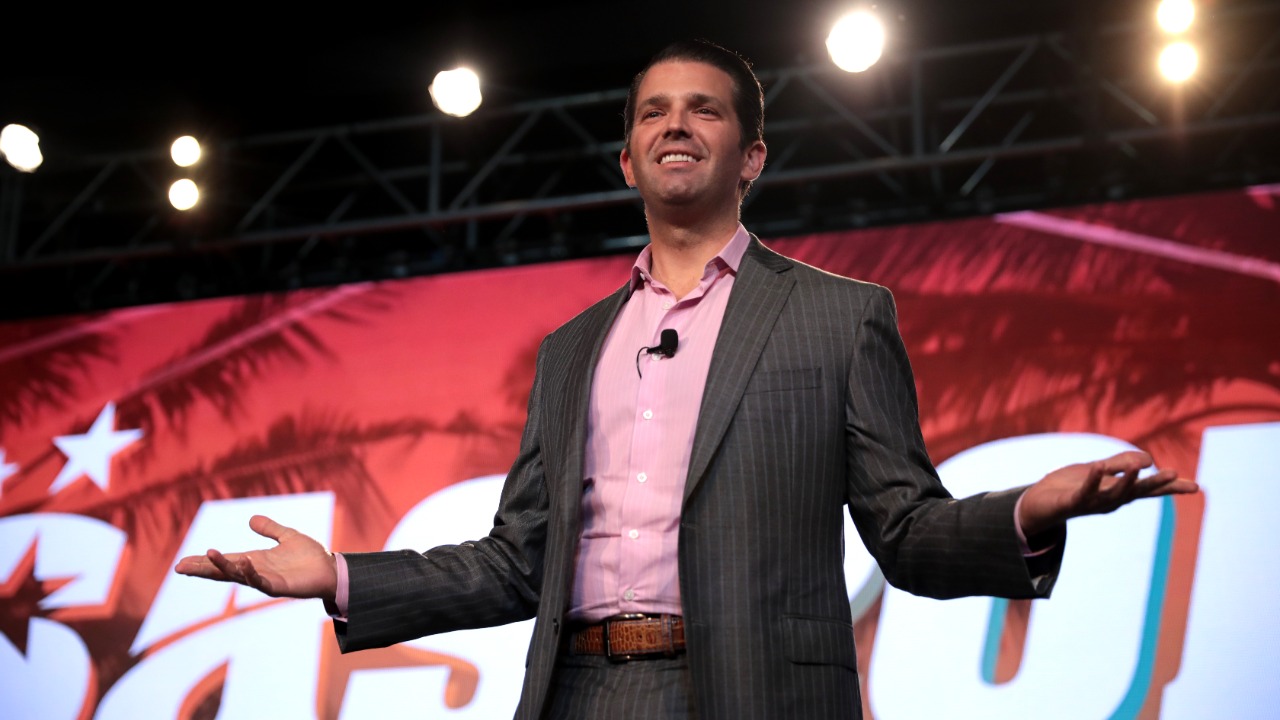
Donald Trump turned a grim hypothetical into a punchline when he suggested his eldest son would rather disappear into the wilderness than stand at his memorial. The president framed the imagined snub as a kind of backhanded compliment, casting Donald Trump Jr. as an adventurer who would choose the jungle over a front-row seat at his father’s final send-off. The remark landed at the intersection of family drama, political theater and Trump’s long-running habit of turning even mortality into a story about loyalty and image.
The offhand joke that became a character study
Trump’s line about his son preferring the jungle to a funeral was not just a stray wisecrack, it was a window into how he publicly narrates his own family. In his telling, Donald Trump Jr. is the kind of man who would be halfway around the world, chasing wildlife and adrenaline, when the president “kicks the bucket,” and would not rush home to mourn. Trump described this imagined choice as almost inevitable, painting his son as someone who would “rather be in the jungle” than standing in black at a somber ceremony, a framing that turned a father’s death into a test of a son’s priorities and personality, and that he delivered with the same casual bravado he often brings to campaign riffs about his children.
That narrative was reinforced when he expanded on the idea, predicting that when the moment came his son would be off on some remote adventure instead of at his side. In recounting the scenario, he leaned into the contrast between a solemn memorial and a rugged expedition, suggesting that Don Jr. would choose the latter without hesitation and even joking that his son might be at the “bottom of the totem pole” in terms of who would actually show up. The story, relayed as part of a broader bit about his family and mortality, echoed through coverage that highlighted how he predicts Don Jr. would rather be in the jungle than mourning when the president “kicks the bucket.”
“Trump, 79, Admits His Own Son Wouldn’t Want to Attend His Memorial”
Trump did not just float the idea as a hypothetical, he embraced it as a kind of confession about his family dynamic. At one point he explicitly acknowledged that his eldest son might not even want to attend his memorial, presenting the scenario with a mix of mock resignation and pride. The framing was blunt: “Trump, 79, Admits His Own Son Wouldn’t Want to Attend His Memorial,” a line that captured both his age and his willingness to turn filial distance into a punchline. By stressing that he is 79, he underscored that the question of legacy is no longer abstract, yet he still chose to treat the prospect of his own funeral as material for a crowd-pleasing story rather than a moment of vulnerability.
In that same vein, he cast the imagined absence not as a betrayal but as proof that his son is wired for adventure and distraction, someone who might be halfway across the globe when the family gathers to remember the patriarch. He folded the idea into a broader narrative about his children’s lives and choices, suggesting that Don Jr.’s priorities might not align with the traditional script of dutiful mourning. Coverage of his remarks highlighted how Trump, 79, admits his own son would not want to attend his memorial, a formulation that captured both the personal sting and the theatrical way he chose to present it.
A “terrible Christmas story” told with a grin
Trump himself seemed to recognize how darkly comic his anecdote sounded, especially as the holidays approach. He acknowledged that spinning a tale about his son skipping his funeral was, in his own words, “a terrible Christmas story” to share, yet he immediately added that it was “a hell of a” story anyway. That tension, between the macabre and the entertaining, is central to how he framed the moment: he was willing to lean into the morbidity because it gave him a vivid way to talk about his family, his age and his sense of humor in one sweep. By labeling it a Christmas story, he also underscored the dissonance between seasonal sentimentality and his preference for edgy, self-referential anecdotes.
He wrapped the remark into a broader riff that touched on his fascination with the natural world and the kind of perilous situations that make for gripping tales. Trump described being drawn to accounts of people lost in the wild or facing extreme conditions, and he used that fascination as a bridge to imagine his son off in some remote landscape when the news of his death breaks. In that telling, the jungle is not just a location but a symbol of escape and intensity, the opposite of a hushed memorial hall. Reports on his comments noted how Trump called it a terrible Christmas story even as he insisted it was too good not to share, underscoring his instinct to turn even mortality into narrative spectacle.
From wildlife fascination to family punchline
Trump’s jungle line did not come out of nowhere, it grew out of a story he had been telling about survival and the natural world. He said he was “fascinated” by wildlife stories, particularly accounts of people who find themselves trapped or injured far from help, and he used one such ordeal as a springboard for his comments about Don Jr. In that setup, the jungle becomes a stage for human resilience and danger, the kind of place where a person might be clinging to life or clawing their way back from disaster. By the time he pivoted to his son, the audience had already been primed to picture dense forests, lurking animals and the thin line between life and death.
Within that frame, Trump imagined his son not as a victim but as a willing participant in that wilderness drama, someone who would choose to be out there rather than in a pew at a memorial. He tied the anecdote to a physician’s account of a man named Jones, whose ordeal in the wild he recounted with relish, then used that story as a foil for his own family narrative. The result was a layered bit in which he moved from admiring survival tales to joking that his son would be off chasing similar experiences when the president’s time comes. Coverage of his remarks emphasized how he was claiming to be fascinated by wildlife stories and by Jones as he segued into the prediction about what Don Jr. would do when he “kicks the bucket.”
What the joke reveals about Trump’s view of loyalty
For all its humor, Trump’s prediction about his son’s absence from his memorial fits a familiar pattern in how he talks about loyalty. He often measures people, including his own children, by how visibly and vocally they support him, and he is quick to praise or needle them in public based on that standard. By suggesting that Don Jr. might skip his funeral for the jungle, he was both teasing his son and subtly reinforcing the idea that even family members are characters in the larger story of his life, subject to commentary and grading. The joke works, in his telling, because it plays off the expectation that a son should be front and center at such a moment, and then flips that expectation into a sign of rugged independence.
At the same time, the anecdote underscores how Trump prefers to keep emotional stakes at arm’s length. Rather than dwell on the sadness of a memorial or the possibility of estrangement, he recasts the scenario as a kind of adventure story in which his own death is just another plot point. That approach allows him to talk about aging, legacy and family tension without ever fully conceding vulnerability. In turning his son’s hypothetical absence into a laugh line about jungles and totem poles, he once again showed how he uses humor and spectacle to manage the most intimate questions of loyalty, grief and what it will mean when the president finally “kicks the bucket.”
More From TheDailyOverview

Cole Whitaker focuses on the fundamentals of money management, helping readers make smarter decisions around income, spending, saving, and long-term financial stability. His writing emphasizes clarity, discipline, and practical systems that work in real life. At The Daily Overview, Cole breaks down personal finance topics into straightforward guidance readers can apply immediately.

