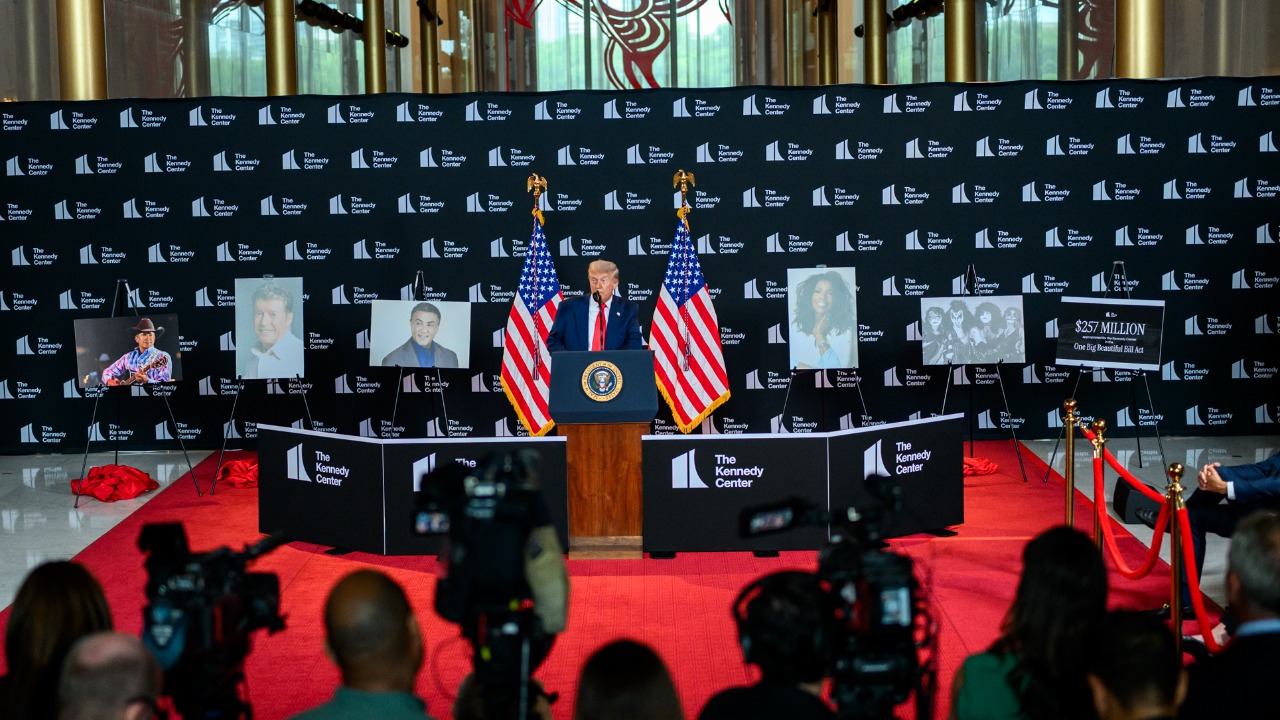
The Kennedy Center has long functioned as the symbolic main stage for American performing arts, a place where prestige bookings help sustain careers and regional institutions alike. President Donald Trump’s decision to shutter the complex for years of “rebuilding” now threatens to turn that national hub into a construction site, leaving artists and arts workers across the country facing a prolonged period of uncertainty. The move follows months of political fights, a controversial renaming, and a wave of cancellations that have already shaken confidence in the institution’s future.
What is being framed as a renovation plan risks becoming something closer to a cultural freeze. With performances canceled into 2028 and no detailed transition strategy in public view, the shutdown could strand performers, technicians, and smaller companies that rely on the Kennedy Center’s visibility and touring ecosystem to survive.
The decision to close, and the politics behind it
President Donald Trump has said he will close the Kennedy Center until 2028 for renovations, presenting the move as a necessary overhaul of a tired building rather than a retreat in the face of artistic revolt. In interviews and statements, Trump has described a multi‑year construction project that would leave the steel of the complex “fully exposed” while promising that he is “not ripping it down,” a vision echoed in coverage of the planned rebuild of the Potomac River landmark. He has framed the closure as the path to a “world class bastion of arts,” even as the timeline stretches across most of his current term and beyond.
The political context is impossible to separate from the construction narrative. Trump was named chair of the Kennedy Center’s board in February 2025, and within a year the board voted to rename the building the “Trump Kennedy Center,” a change he publicly celebrated after the Kennedy Center Board decision. The White House later touted that renaming, with the White House casting it as a sign of institutional unity even as the backlash intensified. Trump has insisted that the closure is about “Construction, Revitalization, and Complete Rebuilding” of what he now calls The Trump Kennedy Center, language he used in a formal determination that the shutdown would be temporary but transformative for the Facility.
Artists’ revolt and a cascade of cancellations
The closure announcement did not emerge in a vacuum, it followed a steady drumbeat of artists walking away from the venue. Since Trump’s takeover of the Kennedy Center, several high‑profile artists and shows have canceled appearances, including the Broadway production cited in reports that track how the Broadway pipeline into Washington has been disrupted. Leading performing arts groups have pulled out, among them composer Philip Glass, who announced he would no longer appear at the capital’s leading performing arts venue, a decision that underscored how even long‑time collaborators were turning away from the Kennedy Center.
The renaming fight accelerated that exodus. Before the board’s vote to rename the performing arts center after him, Trump frequently joked about calling it “the Trump Kennedy Cen,” a running line that became reality once he secured the chairmanship of the Kennedy Center. After the change, more artists pulled out of shows, citing discomfort with the politicization of a space that had been dedicated to John F. Kennedy’s legacy, a trend documented in coverage of the Before and after of the name vote. Video segments with titles like “Trump Shuts Kennedy Center | America’s Cultural Icon Closed for Years | Artists Revolt” captured the mood, with one widely shared clip describing how Artists Revolt had become a shorthand for the broader backlash.
Inside the “rebuild” plan and the information vacuum
Trump’s allies describe the shutdown as a bold reset that will leave the steel “fully exposed” and the building reimagined as a more modern complex, but the public details are thin. Coverage of the plan notes that since Trump’s takeover, the leadership has floated ideas for a complete rebuilding of the Kennedy Center, with Trump promising that the result will be a “world class bastion of arts” and that the steel structure will be a visible design feature. An art‑world report on the closure described how this announcement followed a host of changes made since Trump returned to office, including the departure of several high‑profile figures who had served as artistic advisers at large to the Kennedy Center.
What is missing is a clear operational roadmap for the years between now and 2028. Reports on Trump’s plans note that neither Trump nor Kennedy Center President Ric Grenell have provided detailed evidence for the scope, cost, or timeline of the project, even as they talk about a shutdown “amid artist cancellations and backlash” and insist that new plans are already “fully in place” for the Kennedy Center. A live news briefing on Trump’s presidency captured the confusion, with one critic saying “This man has destroyed the place” and accusing him of running it into the ground financially while simultaneously making the historic renovations “more comprehensive,” a quote that appeared in a running account of Trump news.
The artists left in limbo
Even as big names pulled out, a significant number of events remained on the calendar when Trump announced the closure, leaving performers who had not joined the boycott suddenly unsure whether their shows would ever reach the stage. One detailed account described “the performers left in limbo,” noting that despite the recent surge in cancellations, contracts were still in place for touring companies, orchestras, and community groups that had built seasons around the Despite the shutdown. For those artists, the issue is not just symbolism but lost income, travel costs, and the collapse of carefully sequenced tours that use Washington as a marquee stop.
The cancellations also ripple outward to regional institutions that depend on the Kennedy Center’s imprimatur. When President Donald Trump was named chairman of the board almost a year ago, in February 2025, arts groups initially hoped that the increased political attention might translate into more funding and national exposure for the When President Donald era. Instead, the wave of withdrawals cataloged in public radio reporting has left smaller companies scrambling to replace lost co‑productions and residencies. A separate live news feed on Trump’s presidency noted that the Kennedy Center, on the bank of the Potomac River in Washington, had already seen its schedule hollowed out before the closure announcement, with the The Kennedy Center already operating below its traditional capacity.
Public backlash, donor pressure, and what comes next
The political and cultural firestorm around the shutdown has only intensified since Trump’s announcement. One widely circulated video described how a “political and cultural firestorm is erupting” after President Donald Trump ordered a two‑year closure of the Kennedy Center, calling it “Amer”ica’s cultural icon and questioning the lack of public evidence for the necessity of such a sweeping move. Another segment framed the story as “Trump Shuts Kennedy Center | America’s Cultural Icon Closed for Years | Artists Revolt,” underscoring how the phrase “Cultural Icon Closed for Years” has become shorthand for the sense that the American arts establishment is being sidelined. A separate YouTube clip, promoted with the line “Trump SHUTS DOWN Kennedy Center | Democrats Call It …,” highlighted partisan outrage and noted that no public evidence had been offered to support the administration’s claims about structural urgency at the American venue.
More From TheDailyOverview

Grant Mercer covers market dynamics, business trends, and the economic forces driving growth across industries. His analysis connects macro movements with real-world implications for investors, entrepreneurs, and professionals. Through his work at The Daily Overview, Grant helps readers understand how markets function and where opportunities may emerge.

