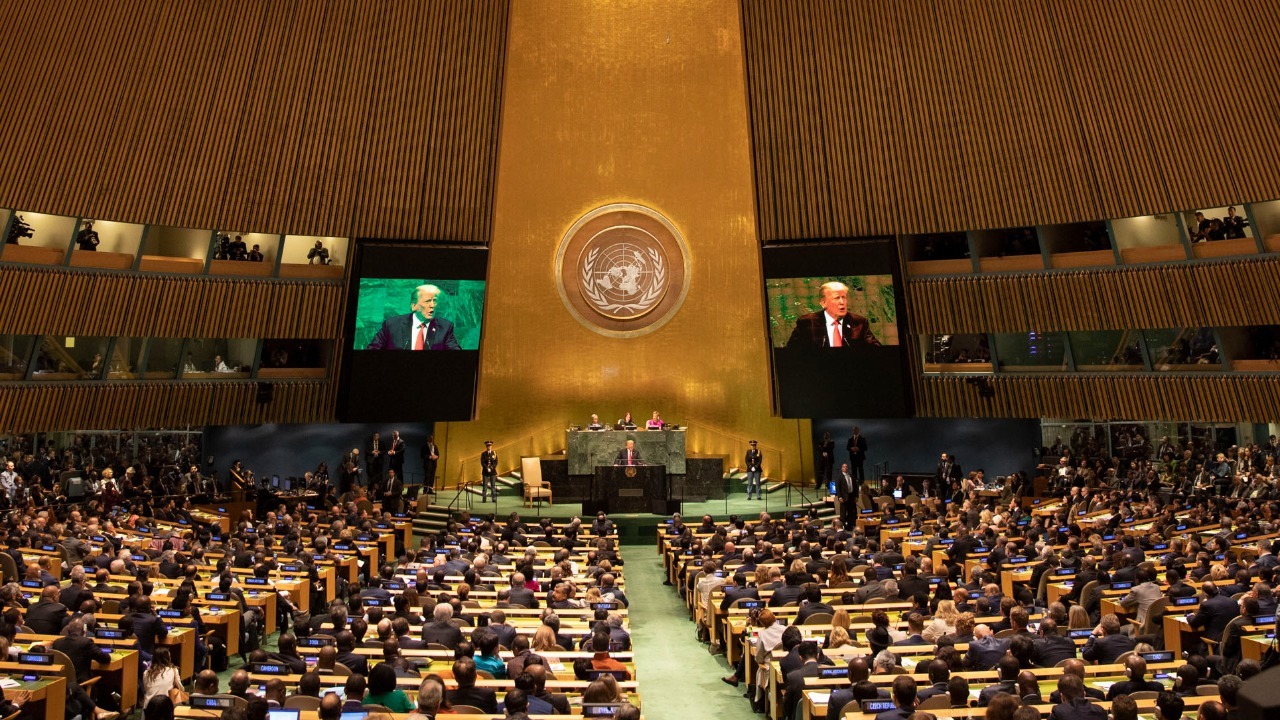
President Donald Trump sold his Board of Peace as a bold new way to rebuild Gaza and reset global diplomacy, a made-for-television structure with himself at the top and grateful allies lining up beneath. Instead, the project has stumbled into public skepticism, diplomatic resistance and moral dissonance with the humanitarian catastrophe it is supposed to address. What was pitched as a transformative peace architecture already looks like a fragile construct straining under its own contradictions.
The gap between the grandiose branding and the messy reality is now impossible to ignore. While Trump talks about remaking international institutions and presiding over Gaza’s future, key partners are balking at the terms, critics are warning of “Orwell on steroids,” and the people whose lives hang in the balance are shivering in tents and unfinished shelters.
From Gaza blueprint to global vanity project
The Board of Peace began as the capstone of Trump’s Gaza plan, a tiered system in which an Executive Committee would handle day‑to‑day reconstruction while a higher council, chaired by Trump himself, would sit above it. Reporting on phase two of the Gaza framework describes how the Executive Committee is supposed to manage implementation, with the Board of Peace, led by Trump and including the current British Prime Minister, positioned as the ultimate authority. On paper, it is a hierarchy designed to centralize power in Washington while giving a handful of allies a formal role in Gaza’s future.
As the idea evolved, the Gaza‑focused council morphed into something far more sweeping. In JERUSALEM, officials described how The Board of Peace, led by President Donald Trump, was originally imagined as a small circle of world leaders but has since been expanded into a larger body with a draft charter and rules for permanent membership. That evolution, detailed in accounts of Board of Peace, reflects Trump’s instinct to turn a regional reconstruction mechanism into a stage for global status and leverage.
The billion‑dollar buy‑in that spooked allies
If the structure raised eyebrows, the price tag has triggered outright alarm. Trump is demanding that nations pay $1 billion for permanent membership of the board, a condition described by people familiar with the matter and attributed to Trump after it was first reported by Bloomberg. That billion‑dollar buy‑in is not a voluntary donation but a ticket to influence, effectively turning a supposed peace institution into a pay‑to‑play club whose founding principle is cash, not consensus.
The reaction from seasoned diplomats has been scathing. Richard Haass, a former adviser in the George W. Bush administration, captured the mood when he asked, “What is going on here?” and joked that he could see paying a billion dollars not to be part of this, a line that underscored how toxic some see the association. His “Orwell on steroids” warning about the Board of Peace, relayed in coverage of What he views as its doublespeak, points to a deeper concern that the project is less about peace than about branding power and extracting money from anxious governments.
Diplomatic cold shoulder from Europe and beyond
For a body that depends on heavyweight participation to look legitimate, early signals from key capitals are troubling. France does not plan to join the Board of Peace “at this stage” despite receiving an invitation, according to a French official close to the presidency who stressed that Paris is instead focused on mobilizing $1 billion to rebuild the strip. That stance, outlined in reporting on how France is weighing its options, suggests that even friendly governments see more value in direct reconstruction funding than in buying a seat at Trump’s table.
Others are hedging or using the invitation as leverage. Accounts of the membership list describe how The Board of Peace, led by President Donald Trump, has been pitched to a mix of Western and non‑Western leaders, with some, including Russia, signaling interest in an invite according to the Kremlin. In parallel, critics in Europe and the Middle East have seized on commentary that describes Donald Trump’s “board of peace,” now set to rule Gaza, as an “appalling neocolonialist project,” a phrase used in a column that traces how, In the sleepy Oxfordshire village of Sutton Courtenay, local history is being invoked to warn against imperial experiments. That critique, embedded in analysis of Donald Trump and Gaza, reinforces the sense that the board is struggling to win moral as well as political backing.
“Might” replace the UN, but cannot meet basic needs
Trump has not helped his case by inflating the board’s ambitions even further. In remarks earlier this week, President Donald Trump suggested that his Board of Peace “might” replace the United Nations, a claim that instantly raised questions about whether he sees the body as a parallel world organization under American chairmanship. That suggestion, reported in coverage of President Donald Trump and the United Nations, compounds concerns that the project is less a pragmatic tool for Gaza than a vehicle for Trump’s long‑standing hostility to multilateral institutions.
The rhetoric looks even more detached when set against conditions on the ground. While leaders debate charters and membership fees, a baby has died from cold in Gaza as leaders meet to discuss Trump’s Board of Peace, a stark detail that illustrates how the humanitarian clock is ticking faster than the diplomatic one. The International Committee of the Red Cross has warned that recent biting cold and rainfall in Gaza are “ultimately a threat to survival,” a judgment that highlights how little comfort grand institutional schemes offer to families huddling under plastic sheets. That reality is captured in reporting on International Committee of and Gaza, which makes clear that the board’s meetings are being overshadowed by the immediate struggle to keep people alive.
A fragile architecture facing hard limits
Even within Trump’s own blueprint, the Board of Peace sits atop a structure riddled with unresolved questions. Analysts examining phase two of the Gaza plan have noted that, Finally, above the Executive Committee will be the Board of Peace, with Trump as its chairman, and that there remain many reasons for pessimism about whether this layered system can function in a war‑scarred territory. The description of how Trump and the British Prime Minister would preside over this arrangement underscores the risk that political rivalries, legal disputes and local mistrust will clog the machinery long before it delivers concrete results.
At the same time, the board’s membership saga continues to unfold in JERUSALEM and other capitals, with The Board of Peace, led by President Donald Trump, still trying to lock in who will sit around the table and on what terms. Reports from JERUSALEM describe draft rules for permanent membership that have already had to be tweaked as governments push back against the billion‑dollar demand and the perception of neocolonial control over Gaza. For now, the Board of Peace looks less like a stable new pillar of international order and more like a contested experiment, one that is colliding with the hard limits of money, legitimacy and the urgent needs of people it has yet to help.
More From The Daily Overview
*This article was researched with the help of AI, with human editors creating the final content.

Grant Mercer covers market dynamics, business trends, and the economic forces driving growth across industries. His analysis connects macro movements with real-world implications for investors, entrepreneurs, and professionals. Through his work at The Daily Overview, Grant helps readers understand how markets function and where opportunities may emerge.

