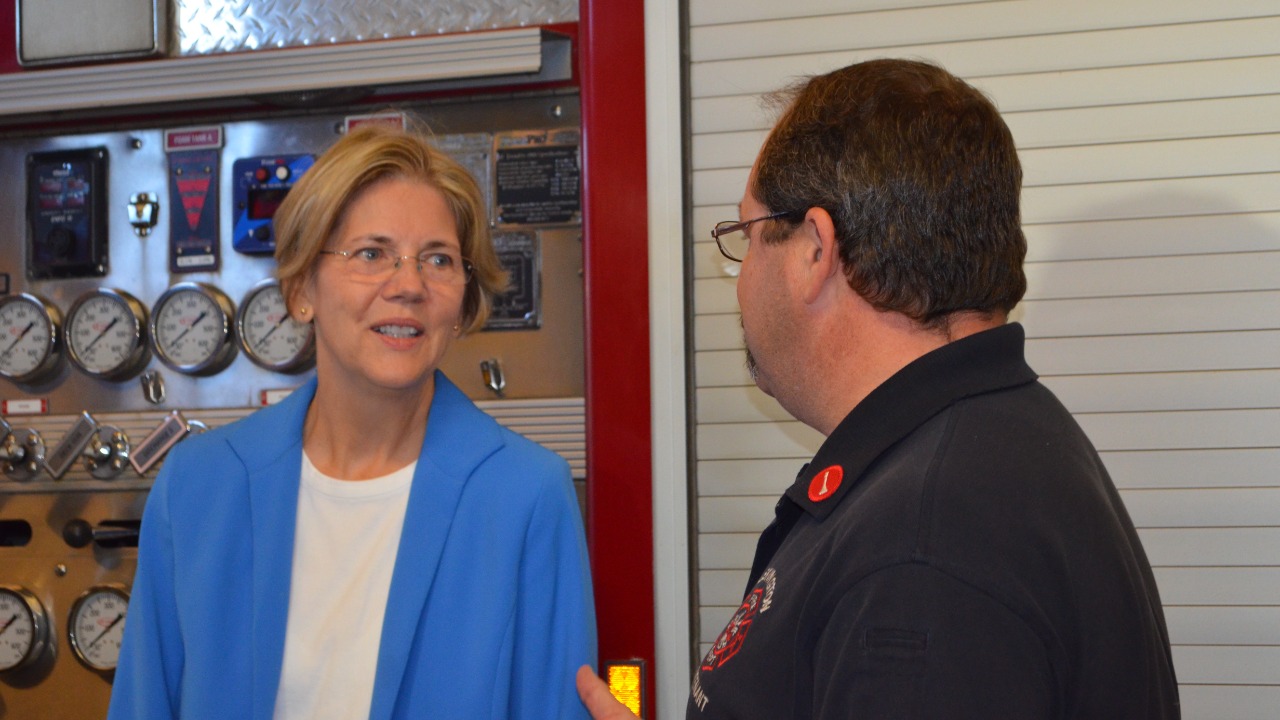
Senator Elizabeth Warren is escalating her clash with President Donald Trump over the future of Social Security, accusing him of “wrecking” the program while she campaigns for a targeted benefit increase. At the center of her push is a proposal to add $200 a month to Social Security checks, framed as emergency relief for seniors and disabled Americans squeezed by higher prices. The fight is rapidly becoming a defining test of whose economic story older voters believe.
Warren is not just warning about potential cuts, she is trying to rewrite the near‑term math for retirees by pairing her critique of Trump with a concrete dollar figure. Her argument is blunt: in Trump’s economy, more and more Americans are struggling to cover rent, groceries, and medical bills, and a flat monthly boost is the fastest way to keep Social Security beneficiaries from falling behind.
Warren’s charge that Trump is “wrecking” Social Security
Warren’s language about Trump and Social Security has grown steadily sharper, culminating in her claim that Donald Trump is taking a “wrecking ball” to the program. In a video message, she links that phrase directly to her plan to add $200 to monthly checks, presenting the contrast as a choice between erosion and expansion of the safety net. In that clip, Donald Trump is cast as the threat to Social Security, while Senator Elizabeth is the one promising a $200 increase.
Her critique is not limited to rhetoric about tone or priorities, it is rooted in specific policy moves and signals from the Trump administration. Warren and other Democrats have zeroed in on comments from Trump’s Social Security leadership that put ideas like raising the retirement age “on the table,” which they argue would cut lifetime benefits for future retirees. In a pointed letter from Senators Elizabeth Warr and her colleagues, Democrats warned that Trump’s Social Security head was putting retirement benefits at risk by entertaining those changes.
The $200 boost and the Social Security Emergency Inflation Relief Act
To counter what she calls Trump’s damage, Warren is rallying Democrats around a straightforward promise: a flat $200 monthly increase for Social Security beneficiaries. The core of that plan is the Social Security Emergency Inflation Relief Act, which would temporarily raise benefits to help seniors and disabled Americans cope with higher costs. In a detailed proposal, Warren and other Senate Democrats describe providing a $200 per month increase for Social Security and veterans’ benefits as a way to shore up what is often the primary source of income for their beneficiaries.
The legislation is designed as an emergency measure rather than a permanent rewrite of the benefit formula, but its scale is significant. Analyses of the Social Security Emergency Inflation Relief Act describe how it would raise payments starting in early 2026 and run through mid‑2026, covering retirees, disabled workers, survivors, and those receiving veterans’ pensions. One breakdown of the plan notes that the Social Security Emergency would deliver that extra $200 a month from January through July 2026, with Senator Warren and Peter Welch of Vermont among its leading champions.
How the six‑month emergency increase would work
Warren and her allies have framed the $200 boost as a short, sharp intervention rather than an open‑ended entitlement expansion. According to coverage of their rollout, Personal Finance Senate Democrats proposed increasing VA and Social Security benefits by $200 a month for six months to help Social Security recipients weather higher prices. The extra $200-per-month emergency lifeline was explicitly pitched as a way to keep seniors from having to choose between food, medicine, and rent.
The timing is also carefully choreographed. Warren’s office has said the leaders planned to introduce the proposal on a Thursday morning, with the goal of getting the boost into checks starting in late December so the money would hit bank accounts just as winter heating bills and holiday expenses arrive. That rollout plan, described by a Warren spokesperson, underscores how Democrats are trying to tie the policy to a concrete, near‑term relief timeline rather than a vague promise.
Who would get the money and how it compares to current benefits
The $200 figure is not abstract, it is meant to be understood against the backdrop of current Social Security benefit levels. Official data from the Social Security Administration show that the average retired worker benefit is only modestly above $1,900 a month, with many recipients living on far less. For someone receiving a $1,500 monthly check, an extra $200 would represent more than a 13 percent bump, enough to cover a typical Medicare Part D premium or several weeks of groceries.
Reporting on the Social Security Emergency Inflation Relief Act spells out that the increase would apply broadly to Social Security retirement, disability, and survivor beneficiaries, as well as Supplemental Security Income and certain veterans’ pensions. One analysis notes that What the bill does is temporarily raise Social Security and SSI cash benefits, ensuring that low‑income seniors and disabled Americans see the same flat $200 increase as higher‑earning retirees. Another breakdown of the legislation explains that Social Security recipients could see their benefits increase by $200 a month under a new proposal from a group of Democratic Senat, a change that would dwarf the typical annual cost‑of‑living adjustment of roughly $21.50 projected from 2025.
Warren’s broader Social Security agenda and survivor benefits
The emergency boost is only one piece of Warren’s Social Security platform, which also includes a push to modernize survivor benefits and support families after a breadwinner dies. In a bicameral effort led with House allies, she has backed legislation to update and expand survivor benefits and provide financial relief to families and veteran pension benefit annuitants. A press statement notes that In October 2025, Senator Warren introduced the Social Security Emergency Inflation Relief Act as part of this broader agenda, with America’s families and veterans at the center of the argument.
In her public messaging, Warren often links these survivor and family provisions back to the same core critique of Trump’s economic policies. She argues that Trump’s approach, including higher tariffs and agency staffing cuts, leaves vulnerable households exposed just as they are dealing with grief or disability. Her bicameral survivor benefits bill is framed as a counterweight to that, ensuring that widows, widowers, and children are not left scrambling when a primary earner dies, and that veteran pension benefit annuitants receive the same kind of targeted relief as retirees on Social Security.
Clashing visions: tariffs, retirement age, and alleged “plotting” to cut benefits
Warren’s charge that Trump is “wrecking” Social Security is not only about direct benefit formulas, it is also about the broader economic environment older Americans face. She has argued that Trump’s tariff strategy is driving up prices on everyday goods, effectively eroding the purchasing power of fixed incomes. In one account of the debate, Padilla and Warren are described as seeing tariffs as a hidden tax on seniors, raising out‑of‑pocket health costs and grocery bills in ways that make a flat $200 boost more urgent.
She has also accused Trump of quietly preparing to reduce Social Security benefits for older Americans. In one pointed critique, Elizabeth Warren Says “Plotting” To Reduce Social Security Benefits For Older Americans, warning that We Must Call It Out And Stop Th before those plans harden into law. Combined with the earlier signal that Trump’s Social Security head was open to raising the retirement age, these accusations form the backbone of her argument that the president is undermining the program while she is trying to strengthen it.
Messaging war: Fox News op‑eds, social media reels, and agency staffing fights
Warren has taken her Social Security message into venues that might once have seemed unlikely for a Democrat, including conservative media. In an opinion piece aimed at Fox News viewers, she criticized Trump and Elon Musk over what she described as threats to Social Security and the broader social safety net. That piece, highlighted in coverage of her media strategy, noted that Trump and Musk were being called out by Warren, a Democrat, in a Fox News forum that reaches many older, conservative voters who rely heavily on Social Security.
At the same time, she has leaned heavily on social media to distill her pitch into simple, shareable lines. In an Instagram reel, she declares, “What I expand Social Security. Make sure that every American who relies on Social Security can afford their basic needs,” before touting her plan to GIVE SENIORS $200/ MONTH. That message, captured in a Jan clip, is designed to cut through policy jargon and present the $200 figure as a concrete promise rather than an abstract legislative goal.
More From The Daily Overview
*This article was researched with the help of AI, with human editors creating the final content.

Nathaniel Cross focuses on retirement planning, employer benefits, and long-term income security. His writing covers pensions, social programs, investment vehicles, and strategies designed to protect financial independence later in life. At The Daily Overview, Nathaniel provides practical insight to help readers plan with confidence and foresight.

