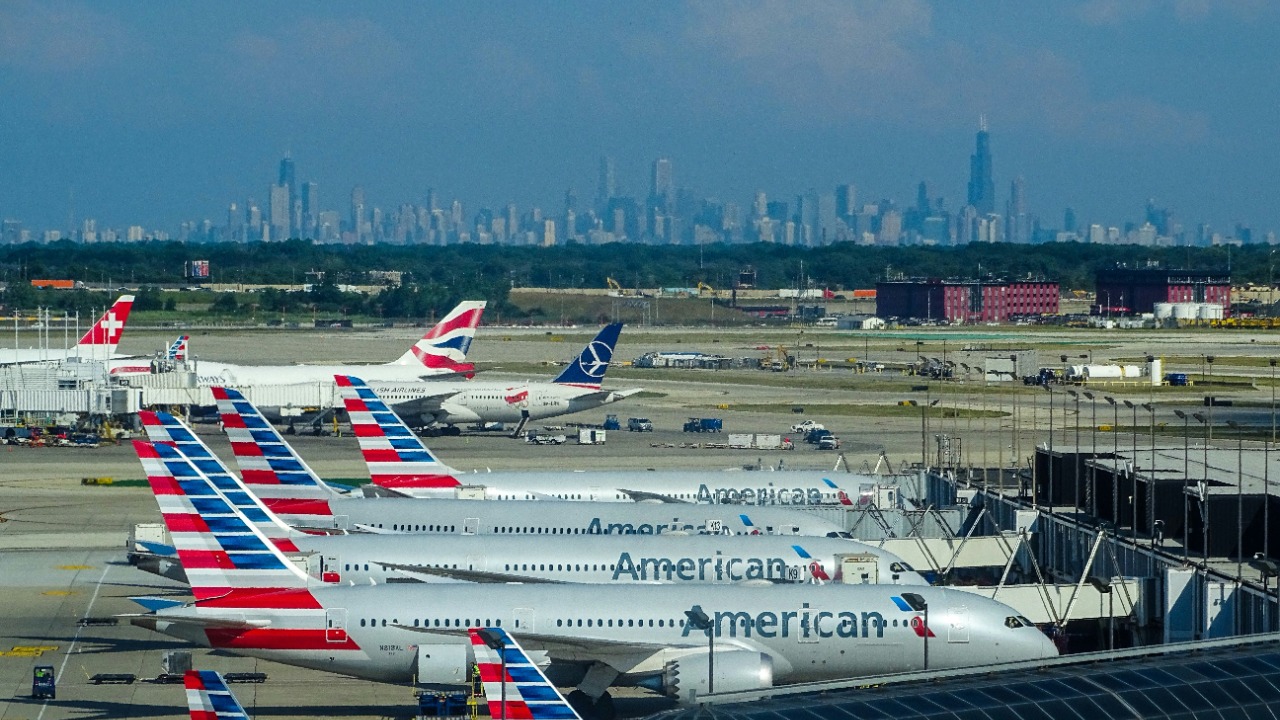
An American Airlines captain’s pay stub, showing year-to-date earnings of roughly $458,000, has turned a niche workplace document into a viral Rorschach test about class, risk and what elite work should pay. The screenshot, posted by a pilot who says he flies Boeing 737s out of Miami, has stunned viewers who are more used to hearing about airline meltdowns than six-figure monthly paychecks. I see the reaction as less about one lucky aviator and more about how little most people understand the economics and pressure behind the cockpit door.
The image has ricocheted across Reddit, Instagram and financial news feeds, where users have dissected every line item and argued over whether the money is justified. Some commenters cheer the figure as overdue recognition for a job that demands constant training and carries huge responsibility, while others compare it to their own stagnant wages and feel a jolt of anger. That split-screen response is the real story: a single pay stub has become a flashpoint in a broader debate over what high-risk, high-skill labor is worth in an era of widening income gaps.
How a single pay stub became a viral sensation
The spark came when a Miami-based captain flying Boeing 737s for American Airlines decided to share a screenshot of his pay statement on Reddit, inviting strangers into a world that is usually hidden behind union contracts and HR portals. The image showed a year-to-date earnings figure that rounded to $458,000, instantly reframing public assumptions about what a commercial pilot can make and turning a routine payroll document into social media spectacle. The post, originating from Miami and tied to a Boeing narrow-body schedule, quickly migrated from Reddit threads into broader feeds where aviation workers and casual travelers alike weighed in on what that number really represents.
As the screenshot spread, it was reposted on Instagram with captions marveling at the “elite money” on display and pointing out that this was not a tech founder or hedge fund manager but a line pilot in a uniform. One widely shared description emphasized that the captain’s role requires constant recurrent training and carries huge responsibility for hundreds of passengers on every leg, a reminder that the figure on the stub is tethered to real-world risk rather than abstract spreadsheets. The viral image, which originated with a Miami-based captain and his Boeing 737 schedule, has since become shorthand for the top end of airline cockpit pay, even as pilots note that it reflects a specific mix of seniority, aircraft type and aggressive flying hours.
The jaw-dropping numbers: $457,894.51 and $458,000 YTD
What grabbed everyone first were the zeros. One circulating screenshot of an American Airlines captain’s pay statement shows year-to-date earnings of exactly $457,894.51, a figure that looks more like a tech executive’s bonus than a line worker’s annual income. In parallel coverage, the same pilot’s compensation is rounded to $458,000 in year-to-date compensation, a clean headline number that has become the shorthand for the story. For many readers, the idea that a pilot can approach half a million dollars in a single year is a revelation, especially when their mental benchmark is the more modest salaries often associated with regional airlines or entry-level first officers.
Behind that headline figure sit hourly rates and work patterns that help explain how the total climbs so high. One breakdown points to an hourly rate “around $360 per hour” for this captain, with the same analysis highlighting that top captains on long-haul fleets can reach even higher brackets. Another report pegs the specific rate at a “whopping $363.87 per hour,” a level that, when multiplied by heavy monthly flight hours and premium pay for overtime or holiday flying, can push annual income toward the $458,000 mark. When I look at those numbers, I see less of a lottery win and more of a pay structure that rewards seniority, aircraft choice and a willingness to stack long days in the sky.
Who is this pilot and what does his job actually involve?
The pilot at the center of the storm is described as a Miami-based captain flying Boeing 737s for American Airlines, a profile that already signals a certain level of seniority and stability. Operating out of Miami means working one of the carrier’s busiest hubs, with dense schedules across the Americas and a mix of domestic and near-international routes that can keep monthly flight hours high. The Boeing 737 is a workhorse of the fleet, and captaining it for American Airlines places this aviator in a role where he is constantly cycling through takeoffs and landings, managing complex airspace and dealing with the operational realities of a major network carrier.
In the Instagram reposts of the original Reddit image, commenters repeatedly stress that this is not easy money, pointing out that the job demands recurrent simulator sessions, medical checks and strict adherence to safety protocols. One caption explicitly notes that the role “requires constant training and carries huge responsibility,” a phrase that captures the tension between the impressive paycheck and the stakes of the work. When I consider that description alongside the Miami base and Boeing 737 schedule, the picture that emerges is of a pilot who has climbed to the top of a demanding career ladder and is now cashing in on the combination of seniority, aircraft assignment and relentless flying.
How pilot pay scales work at major airlines
To make sense of a $458,000 year, it helps to understand how pilot pay is structured at large carriers. Unlike salaried office roles, airline pilots are typically paid by the flight hour, with rates that rise based on aircraft type and years of service. In the case of this American Airlines captain, one analysis points to an hourly rate of $360 per hour, a figure that reflects both his seniority and the pay scale for his aircraft. That same discussion highlights $360 as a key threshold, noting that once a pilot reaches that level, stacking enough monthly hours can transform a solid income into what many observers now call “elite money.”
Long-haul captains can climb even higher on the pay ladder. One breakdown notes that Captains of planes as massive as the Boeing 777 or Airbus A350 can earn up to $450 per hour, a rate that applies only to flight hours but still yields eye-popping totals when schedules are full. Considering the way these pay scales compound with overtime, holiday premiums and profit-sharing, it becomes clear how a motivated captain can push into the high six figures. From my perspective, the viral stub is not an outlier so much as a vivid example of what the top rungs of a well-negotiated pilot contract can deliver.
The role of seniority, overtime and post-pandemic demand
What the viral conversation often misses is how many variables had to line up for this particular pay stub to hit $457,894.51. Seniority is the first and most important factor, since it determines not only hourly rate but also access to preferred schedules and aircraft. A captain with years in the left seat at American Airlines can bid for more lucrative trips, stack them efficiently and take advantage of premium pay opportunities that a junior pilot would never see. The Miami-based Boeing 737 captain at the center of this story appears to have done exactly that, turning his position on the seniority list into a powerful income lever.
Overtime and the broader labor market have also played a crucial role. Airlines have been scrambling to staff flights as travel demand roared back, and that has created windows where captains willing to pick up extra flying can dramatically boost their pay. One detailed breakdown of the viral stub notes that the American Airlines pilot’s salary benefited from a high hourly rate and a schedule packed with flying, resulting in even fatter paychecks as the year went on. When I connect those dots, I see a pilot who not only enjoys a strong contractual rate but has also leaned into the post-pandemic demand surge, trading personal time and fatigue risk for a once-in-a-career earnings spike.
Public reaction: envy, support and sticker shock
The internet’s response to the pay stub has been a mix of awe and unease. Some viewers immediately compared the $458,000 figure to their own salaries, expressing disbelief that a worker outside tech or finance could earn that much in a single year. Others zeroed in on the exact $363.87 per hour rate cited in one analysis, arguing that such a “whopping” number proves the system is skewed toward a narrow slice of specialized workers. The phrase “elite money” has been repeated across comment sections, sometimes admiringly and sometimes with a bitter edge, as people project their own economic frustrations onto a stranger’s pay stub.
At the same time, there is a strong current of support for the pilot’s earnings. In one widely shared reaction, a flyer wrote that they were “absolutely fine” with the captain making that kind of money, pointing to the magnitude of the job and the lives at stake on every flight. Another commenter framed the $457,894.51 total as overdue recognition for a profession that has long been romanticized but not always well compensated, especially at the regional level. When I read through those reactions, I see a public wrestling with two truths at once: that such pay feels out of reach for most workers, and that entrusting someone with hundreds of lives at 35,000 feet might reasonably command a premium.
How this compares to typical pilot salaries
Context matters, and the viral American Airlines captain is not representative of the average pilot’s paycheck. A separate breakdown of pilot earnings, highlighted by Veronika Bondarenko, offers a quick breakdown of pilot salaries that shows a wide range depending on aircraft, employer and experience. Entry-level pilots at regional carriers often start far below six figures, and even mid-career aviators may spend years climbing pay scales before they see anything close to $360 per hour. When I stack those figures against the $458,000 year-to-date number, it becomes clear that the viral stub sits at the very top of the profession’s earning potential rather than the middle.
That gap is part of why the image has hit such a nerve. Many pilots who commented on the Reddit thread and subsequent coverage noted that they had spent years earning modest wages while paying for flight training and building hours, only to see the public fixate on one captain’s peak earnings. A financial explainer that accompanied the viral story emphasized that pilot salaries differ dramatically, and that the American Airlines captain’s pay reflects a specific combination of seniority, aircraft type and market conditions. From my vantage point, the key takeaway is not that every pilot is secretly rich, but that the profession has a steep and often underappreciated income ladder, with only a fraction of aviators reaching the rung that this Miami-based captain now occupies.
The hidden costs and risks behind “elite money”
For all the focus on the $457,894.51 figure, the conversation often glosses over what it takes to reach and sustain that level. Commercial pilots invest heavily in their training, logging hundreds of hours in small aircraft, paying for ratings and enduring years of irregular schedules before they ever touch a major airline cockpit. The Instagram repost that helped the American Airlines stub go viral explicitly notes that the role requires constant training and carries huge responsibility, a reminder that the paycheck is tied to a career path that demands both financial and personal sacrifice. When I think about that trajectory, the $458,000 year looks less like a windfall and more like the back-loaded payoff of a long, risky bet on a specialized skill set.
There are also ongoing risks that do not show up on a pay stub. Pilots must maintain strict medical standards, and a single health issue can end a career overnight, cutting off the earning power that the viral image has made so visible. The job also involves chronic fatigue, time away from family and the psychological weight of knowing that any mistake can have catastrophic consequences. One detailed discussion of the pay stub framed the high earnings as a fair trade for that magnitude of responsibility, with commenters arguing that they would rather see money flow to the person actually flying the plane than to corporate executives. In that light, the “elite money” label feels less like a critique and more like an acknowledgment of the stakes built into every takeoff.
What the viral stub reveals about work, value and transparency
Beyond aviation, the American Airlines captain’s pay stub has tapped into a broader hunger for transparency about who earns what and why. In an era when many workers feel squeezed by rising costs and stagnant wages, seeing a line employee pull in $458,000 forces a reexamination of assumptions about which jobs are truly valued. The fact that the image emerged from Reddit, was amplified on Instagram and then dissected in financial explainers shows how social media has become a de facto clearinghouse for pay transparency, especially in fields where formal disclosure is rare. I see that as a healthy, if sometimes uncomfortable, development that can push industries to justify their compensation structures more openly.
The story has also highlighted the role of individual voices in shaping the narrative. One detailed feature on the viral stub was written by Ashley Lutz, identified as Executive Director, Editorial Growth, who framed the captain’s earnings as “elite money” and noted that some people make in a month what he makes in a day. Another widely shared breakdown by Veronika Bondarenko used the episode as a springboard for a quick breakdown of pilot salaries, helping readers place the $457,894.51 figure in a broader context. When I pull those threads together, the picture that emerges is not just of one well-paid pilot, but of a workforce and a public renegotiating their understanding of what high-stakes labor should be worth in a transparent age.
More From TheDailyOverview

Cole Whitaker focuses on the fundamentals of money management, helping readers make smarter decisions around income, spending, saving, and long-term financial stability. His writing emphasizes clarity, discipline, and practical systems that work in real life. At The Daily Overview, Cole breaks down personal finance topics into straightforward guidance readers can apply immediately.
