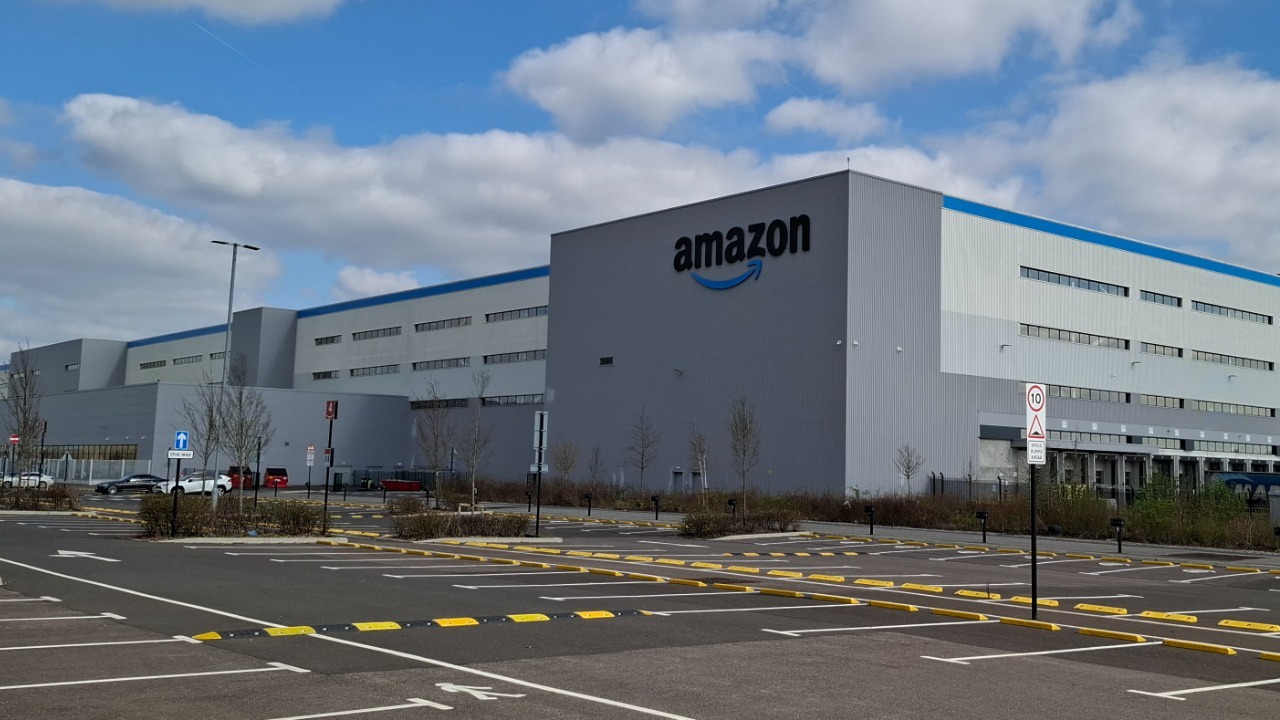
The $883 billion U.S. grocery market is turning into a knife fight between two very different retail empires. Walmart still rules the weekly shop, but Amazon is now openly designing stores, warehouses, and delivery systems to pry that crown loose, even if it takes years of heavy investment and thinner margins.
At stake is not just who sells the most milk and bananas, but who owns the most frequent, habit-forming relationship with American households. I see Amazon trying to turn grocery into a gateway that locks shoppers into its broader ecosystem, while Walmart races to defend a franchise it spent decades building.
The $883 billion prize and Walmart’s home‑field advantage
Grocery is one of the last giant categories where digital disruption has been slower, which is why the $883 billion market has become the next front in the rivalry between Walmart and Amazon. Recent market data shows that Walmart still dominates food and household staples, while Amazon is a distant challenger trying to convert its online strength into repeat grocery trips. Much like Walmart disrupted traditional supermarkets forty years ago, Amazon now wants to be the one reshaping how Americans buy their weekly essentials, turning low-margin groceries into a high-value source of loyalty and data.
Walmart’s edge starts with geography. Roughly 90% of the U.S. population is estimated to live within 10 miles of one of its stores, a physical moat that lets the company blend in-store shopping, curbside pickup, and local delivery at scale. Its sprawling store network effectively doubles as a nationwide fulfillment grid, something Amazon is now trying to replicate in its own way. For now, Walmart’s combination of proximity, price perception, and habit keeps it in the lead, but the gap is no longer guaranteed to hold.
Amazon’s grocery problem: tiny share, huge ambition
For all its e-commerce dominance, Amazon is still a bit player in the supermarket aisle. Currently, Currently, Amazon holds only about a 3% share of the grocery market, even after its $13.7 billion $13.7 billion Whole Foods acquisition, with just 1.6% attributed to 1.6% for Whole Foods itself. That is a strikingly small footprint for a company that effectively defined online shopping, and it explains why internal planning documents and leaked strategies now frame grocery as a must-win category rather than a side bet.
Those internal plans point to a major push into perishables and fresh food, areas where Amazon has historically struggled with cost and complexity. A significant aspect of this new push involves expanding Amazon’s capacity to handle perishable goods, a direct incursion into Walmart’s territory that requires new cold-chain infrastructure and more localized inventory. The company’s core site at Amazon already trains shoppers to expect fast delivery on almost anything, but groceries add a ticking clock and razor-thin margins that make the challenge far tougher than shipping books or electronics.
Borrowing from Walmart: supercenters, SSD warehouses, and hybrid stores
To close the gap, Amazon is increasingly copying the very model that made Walmart a powerhouse. The company is planning an approximately 225,000-square-foot big-box store near Chicago that will sell groceries alongside general merchandise, household essentials, and other categories that look a lot like a modern supercenter. That format is designed to capture the full-basket trip that Walmart has long owned, letting shoppers grab produce, paper towels, and consumer electronics in one stop while also serving as a local hub for online orders.
Amazon is also experimenting with what it calls SSD Supercenter warehouses, a larger warehouse concept that blends storage, automation, and limited in-person shopping. The company has signaled that these SSD Supercenter facilities will support rapid grocery fulfillment while still offering a curated retail floor, effectively turning the back of the house into a high-speed logistics engine. In parallel, Amazon is making a bold move to transfer its e-commerce dominance into physical retail, even as roughly 80% of retail still happens offline, and more large-format stores are in the works outside Chicago and other metro areas.
Whole Foods as a secret weapon in the last mile
Where Walmart has supercenters, Amazon has Whole Foods, and the company is now retooling that chain into a hybrid of premium grocer and logistics node. One upgraded Whole Foods site in suburban Philadelphia, announced last year, now fulfills Amazon orders from the back of the store, turning the sales floor into a showroom and the stockroom into a micro-warehouse. Another document describes how One such location in the Philadelphia area is being used to test automation and new picking methods, a sign that the company sees Whole Foods as a flexible test bed for its broader grocery ambitions.
Amazon last fall unveiled an automated micro-fulfillment center attached to a Whole Foods in Plymouth Meeting, Pa, a concept that allows workers and robots to assemble online orders at high speed while shoppers browse the aisles above. That Plymouth Meeting experiment is expected to inform a wave of similar sites that could open in late 2027, effectively stitching Whole Foods into a dense last-mile network. By integrating these stores into its online ecosystem, Amazon hopes to streamline operations and reduce delivery times, making it easier to promise same-day or even faster grocery delivery in affluent suburbs where Whole Foods already has a presence.
Global pressure, rising costs, and who blinks first
The grocery showdown is unfolding against a backdrop of global competition and cost pressure that neither Walmart nor Amazon can ignore. In China and Europe, players like JD.COM, German retailer CECONOMY, MediaMarkt, Saturn, and Alibaba are blending retail and logistics in ways that raise the bar for speed and convenience. That global experimentation feeds back into U.S. expectations, where over 70% of grocery retailers are already investing heavily in digital capabilities and omnichannel tools, according to Grocery market research. Both giants know that if they move too slowly, nimble rivals could peel away urban and high-income shoppers with slick apps and faster delivery.
At the same time, the economics of this war are getting tougher. The Amazon CEO has already issued a blunt nine-word response to shoppers seeing higher costs, warning that tariffs and inflation will inevitably show up in prices for customers, according to Amazon CEO coverage. That makes it harder to buy market share with aggressive discounts, especially in a category where margins are already thin. Retail strategist DeWayne Baziel, described as a Transforming Strategy in Scalable Growth and GTM Market Expansion Specialist, has argued that the most resilient retailers will be those that can blend Online and Offline in a way that keeps costs in check. In that sense, Amazon opening its FIRST large-format SUPERCENTER store, as REGISTER and AMAZON OPENING announcements describe, looks less like a side project and more like a necessary evolution.
For shoppers, the upside of this brutal contest is more choice and faster service, whether that means curbside pickup at a neighborhood Walmart or same-day delivery from a new Amazon supercenter outside Chicago. For the companies, the risk is that they spend billions building overlapping networks that take years to pay off, especially if consumer demand softens. Much like Amazon once forced every retailer to rethink e-commerce, the current push into grocery is forcing both giants to rethink what a store, a warehouse, and a website should be. Whoever solves that puzzle first will not just win the grocery war, they will shape how Americans shop for almost everything else.
More From The Daily Overview
*This article was researched with the help of AI, with human editors creating the final content.

Grant Mercer covers market dynamics, business trends, and the economic forces driving growth across industries. His analysis connects macro movements with real-world implications for investors, entrepreneurs, and professionals. Through his work at The Daily Overview, Grant helps readers understand how markets function and where opportunities may emerge.

