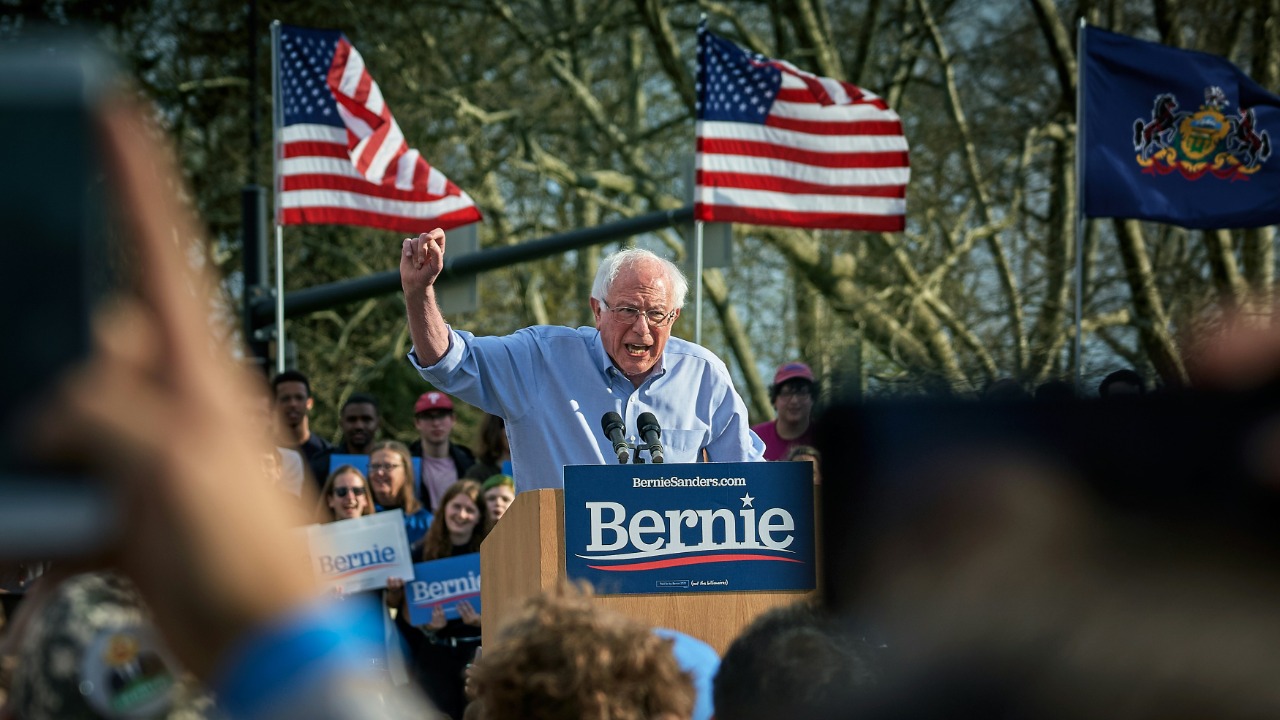
President Donald Trump and Senator Bernie Sanders rarely find themselves on the same side of an economic fight, yet both are now pressing for a nationwide 10 percent ceiling on credit card interest. Their unlikely alignment has turned a technical debate over annual percentage rates into a defining clash over who government should protect in an era of record consumer debt. At stake is whether Washington will force lenders to abandon a business model built on double digit charges that can trap households in years of revolving balances.
The push has already moved from social media posts and television sound bites into formal legislation, with Sanders championing a statutory cap and Trump urging Congress and the banking industry to move quickly. I see this convergence as less a political oddity than a sign that the cost of plastic has become a rare point of bipartisan pressure, even as banks, trade groups and some economists warn that a hard ceiling could backfire on the very borrowers it is meant to help.
The road to a 10 percent ceiling
The current moment grew out of a series of moves by President Trump, who used a Jan. 9 message on Truth Social to call for a universal 10 percent limit on credit card interest for one year and asked that it take effect on Jan. 20, the anniversary of his return to the White House. He followed that with public remarks in which the White House turned up the heat on card issuers, with Trump floating a temporary cap and framing it as relief for families squeezed by high borrowing costs. Coverage of that Truth Social post noted that Trump wanted the cap in place for a single year and explicitly urged Congress to act.
President Trump then set a hard deadline, telling banks that by Jan. 20 they should lower card rates to 10 percent for one year, a move that raised immediate questions about whether private companies would comply without legislation. Reporting on that ultimatum stressed that President Trump had unilaterally announced the date even though only Congress can impose a binding national cap. Legal analysts have also pointed out that, on Jan. 9, President Trump made his statement without clarifying how such a ceiling would interact with existing state usury laws, a gap that has fueled what experts describe as “Scope and Implementation Uncertainty.”
Sanders, Hawley and the 10 Percent Credit Card Interest Rate Cap Act
Long before Trump’s Truth Social push, Sanders had been laying the groundwork for a statutory cap that would outlast any one year experiment. In early 2025, he joined forces with Senator Josh Hawley to introduce a bill that would limit credit card APRs nationwide, a rare partnership between a democratic socialist from Vermont and a conservative Republican from Missouri. A trade group summary notes that Sens Bernie Sanders and Josh Hawley rolled out their proposal to cap rates, while the same account records that industry representatives urged lawmakers to reject what they called a misguided plan.
The legislative vehicle for that effort is S.381, formally titled the 10 Percent Credit Card Interest Rate Cap Act, which was introduced in the Senate as part of the 119th Congress. The official listing shows that Shown Here as introduced, the measure would temporarily cap card interest at 10 percent, and the Library of Congress entry for 381 confirms that Congress is considering it as part of a broader debate over consumer finance rules.
From “unacceptable” to “Trump is right”
Sanders’s current embrace of Trump’s idea is striking because he initially blasted the president’s early talk of a cap as inadequate. When Trump first floated a one year 10 percent ceiling after his reelection, Sanders publicly argued that the plan was “unacceptable,” criticizing what he saw as a narrow focus that ignored deeper affordability issues. A detailed account of that reaction notes that Trump had called for a one year 10 percent cap on interest rates and that Bernie Sanders labeled that approach unacceptable, even as he acknowledged the need to rein in card costs.
Over time, however, Sanders shifted from critic to ally on the basic 10 percent figure, especially as defaults climbed and pressure on households intensified. In a separate interview, he went so far as to say that Bernie Sanders Calls Interest Rate Cap On Credit Card Debt a “Great Idea” As Defaults Surge To Highest Levels Since the financial crisis, framing the cap as a necessary emergency brake. He later wrote an opinion piece under his own byline in which he declared that “Trump is right” about the need to cap card rates at 10 percent and argued that, if leaders are serious about helping working families, they need something real, not another scam, a line captured in a column where he said, “If we are serious about helping working families, we need something real, not another scam,” and explained why he had introduced bipartisan legislation, as reflected in his own words.
Sanders’s moral case against “usury”
Sanders has framed the fight over card rates not just as a technical policy dispute but as a moral reckoning with what he calls usury. In one essay he invoked literature, noting that in The Divine Comedy, Dante reserved a special place in the Seventh Circle of Hell for people who charged usurious interest, and he argued that today’s double digit APRs belong in the same category. That argument appears in a passage where he cites The Divine Comedy, Dante and the Seventh Circle of Hell for usurers, using that image to argue that capping interest at 10 percent is not a radical idea but a matter of economic justice.
He has also cast the cap as a way to curb what he describes as Wall Street exploitation of working families. In a social media post amplified by television, he said that a permanent cap on credit card interest rates would stop Wall Street bank “extortion” of consumers, language that underscores his view of the industry’s business model. That message was summarized in a segment labeled CREDIT CRUNCH, which quoted Senator Bernie Sanders arguing that a permanent cap on credit card interest rates would stop Wall Street bank extortion, and it echoed his broader critique of “Wall Street and” the American Bankers Associati, which he has accused of putting profit ahead of basic fairness, as reflected in another commentary.
What a cap would mean for borrowers and banks
For cardholders, a 10 percent ceiling would be a dramatic shift from today’s typical rates, which often run well above 20 percent for those who carry balances. Consumer finance experts point out that even without a legal cap, borrowers can sometimes negotiate lower APRs or transfer balances to promotional offers, but those tools are limited and often reserved for people with strong credit scores. Practical guides explain that, under current rules, cardholders can call their issuer, threaten to move their business, or seek a balance transfer to get a better deal, advice laid out in a service piece on how Here is how to get a lower rate yourself, which underscores how much leverage banks currently hold.
Banks and some analysts warn that a hard cap could have unintended consequences, including tighter credit and higher fees that shift costs in less transparent ways. Industry voices have argued that if President Trump and Sanders succeed in imposing a universal 10 percent limit, lenders might respond by cutting off higher risk borrowers or scaling back rewards programs that middle class customers value. One analysis of the proposal notes that President Trump has proposed setting a universal 10 percent interest rate cap and that some analysts believe it could hinder economic growth, while others counter that lower rates would free up cash for consumer spending.
More From TheDailyOverview

Cole Whitaker focuses on the fundamentals of money management, helping readers make smarter decisions around income, spending, saving, and long-term financial stability. His writing emphasizes clarity, discipline, and practical systems that work in real life. At The Daily Overview, Cole breaks down personal finance topics into straightforward guidance readers can apply immediately.
