The United States is heading into 2026 with a rare mix of political bravado and cautious economic optimism. President Donald Trump’s signature tax-and-spending package, widely branded the “big, beautiful bill,” is now moving from talking point to lived reality, reshaping incentives for households, companies, and global investors. As the provisions phase in, I see a short-term growth bump colliding with deeper questions about inequality, fiscal risk, and how long the good mood can last.
Forecasts for next year point to faster output, still-firm inflation, and a labor market that looks more resilient than many feared at the start of 2025. The One Big Beautiful Bill Act, or OBBBA, sits at the center of that story, promising lower taxes, new deductions, and sector-specific windfalls that could lift confidence even as they test the country’s long‑term budget discipline.
How the “big, beautiful bill” became economic policy
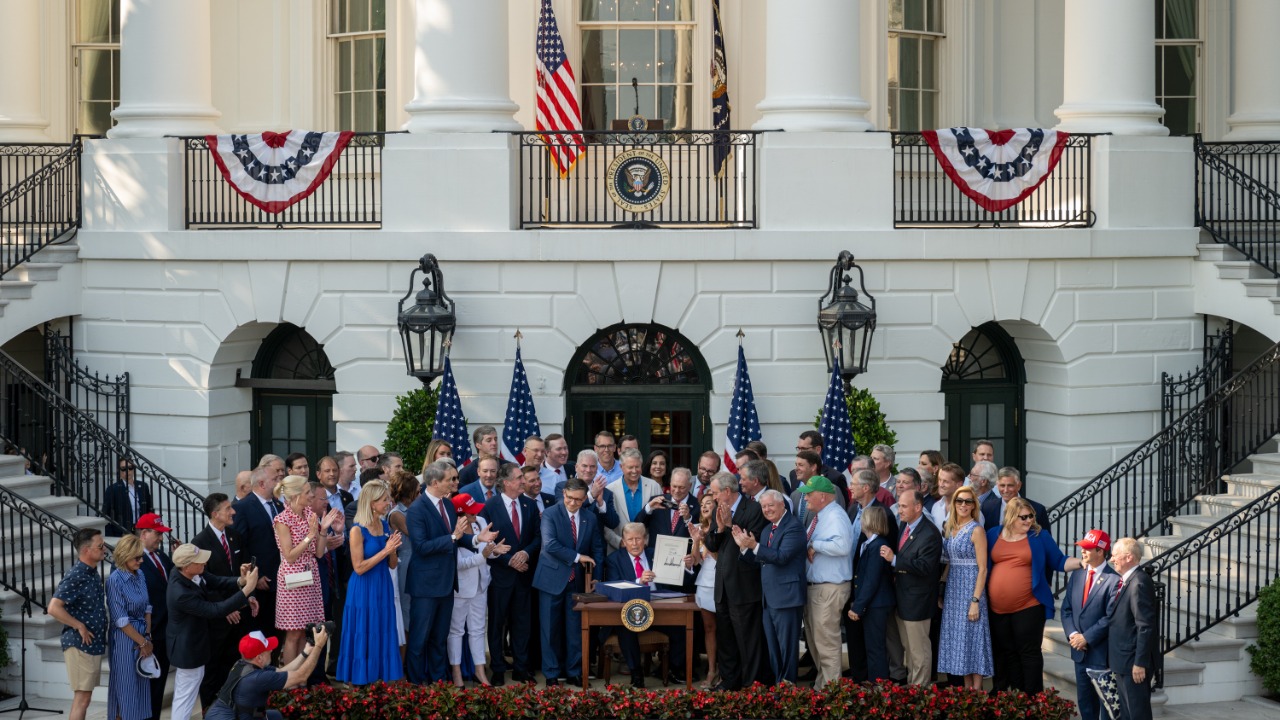
The One Big Beautiful Bill Act did not just appear out of thin air, it capped years of Republican frustration with the existing tax code and social spending architecture. On July 4, 2025, President Trump signed H.R. into law, a moment that What Does the One Big Beautiful Bill Cost describes as the formal birth of a sweeping package of rate cuts, program trims, and new incentives. I see that Independence Day timing as deliberate political theater, framing the law as a liberation from what its backers cast as overtaxation and bureaucratic drag.
Behind the branding, the law is a dense stack of provisions that will roll out over years rather than all at once. The Implementation Timeline of the One Big Beautiful Bill Act details how, starting in 2025, cuts to basic needs programs and other changes arrive on staggered effective dates over the next decade, meaning the full economic impact will build gradually rather than in a single shock. By mapping those phase‑ins, The Implementation Timeline of the One Big Beautiful Bill Act underscores why 2026 is emerging as a pivotal year, when many of the headline tax cuts start to bite even as some spending reductions are only beginning.
Short‑term growth bump: why 2026 looks stronger
Most mainstream forecasters now expect the law to give the economy a modest near‑term lift, and 2026 is where that shows up most clearly. Analysis of the House version finds that OBBBA would boost growth in the short term, with overall taxes lower by roughly one and a half percent of after‑tax income in 2026, a change that should support consumer spending and business hiring. The same work notes that the bill would also boost investment, especially as firms respond to lower marginal rates and more generous cost recovery, a dynamic captured in the assessment that OBBBA would boost growth in the near term even if it complicates the long‑run outlook.
Independent macro projections line up with that story. A major 2026 outlook notes that the United States is positioned for a more modest acceleration in growth to about 2.2, a pace that is hardly a boom but still marks an improvement on the post‑pandemic slog and suggests the fiscal impulse is offsetting some drag from higher interest rates. In that framework, the “big, beautiful bill” acts like a targeted sugar high layered on top of structural forces like artificial intelligence investment, with the report on AI exuberance warning that Dec, But this future is not quite now even as it pegs 2026 growth at about 2.2.
Tax cuts, CPI, and the inflation puzzle
Optimism about 2026 is not just about growth, it is also about whether the United States can keep inflation contained while the fiscal taps are open. One influential forecast expects CPI growth to average 2.8% in 2025 and accelerate modestly to 3.1% in 2026, before easing later in the decade as supply and demand rebalance. That path suggests the tax cuts and new spending in OBBBA will add some price pressure but not enough, in this view, to trigger a new inflation spiral, a judgment embedded in the projection that CPI growth to average 2.8% and 3.1% is still compatible with a soft landing.
That benign inflation call is one reason financial markets have been willing to look through the bill’s deficit impact, at least for now. If price growth does track that 3.1% pace in 2026, the Federal Reserve may feel less pressure to slam the brakes, allowing the tax cuts to flow through to real activity rather than being offset by sharply higher borrowing costs. I read the inflation forecasts as a quiet vote of confidence that the One Big Beautiful Bill Act’s near‑term stimulus can coexist with the central bank’s credibility, even if the longer‑term fiscal math remains unresolved.
What is actually in the One, Big, Beautiful Bill Act?
For households and businesses, the most tangible change is the way the tax code itself is being rewritten. The One, Big, Beautiful Bill Act significantly affects federal taxes, credits and deductions, and it takes effect in 2025, reshaping everything from standard deductions to business expensing rules. The Internal Revenue Service’s summary of the law’s provisions makes clear that this is not a narrow tweak but a comprehensive redesign, with The One, Big, Beautiful Bill Act touching almost every major line on individual and corporate returns.
One headline figure that has captured political attention is the estimated average tax cut per filer. Research on the One Big Beautiful Bill Act notes that the law cuts taxes across the United States, with the average reduction projected to be over $3,700 in 2026, a sizable sum for middle‑income families even if the distribution skews toward higher earners. That estimate, highlighted in the One Big Beautiful Bill Act research, helps explain why consumer sentiment surveys have started to tick up as taxpayers look ahead to fatter paychecks and refunds in the 2026 filing season.
Households, seniors, and the new Social Security deduction
Within that broad tax relief, some of the most politically potent changes are targeted at retirees. The law introduces a new Social Security tax deduction that allows qualifying seniors to shield a portion of their benefits from income tax, a shift that could meaningfully lower liabilities for fixed‑income households. A detailed breakdown of the provision notes that the One Big Beautiful Bill increases the deduction for Social Security benefits up to $6,000 for single filers and $12,000 for married couples, a design that directly links relief to the size of a retiree’s check and filing status, as spelled out in the analysis of Breaking down the OBBBA’s Social Security tax deduction.
For financial planners, those numbers create both opportunities and complications. Guidance for attorneys and advisers stresses that over the Fourth of July, when the Big Beautiful Bill was signed, a rare window for proactive planning opened up, allowing clients to restructure withdrawals, Roth conversions, and charitable giving to take full advantage of the new rules. I see that as a reminder that tax law changes do not operate in a vacuum, they ripple through retirement strategies, estate plans, and even decisions about when to claim benefits, a point underscored in the advisory note that the Big Beautiful Bill created a planning window that savvy households are already trying to exploit.
Winners, losers, and sector‑by‑sector shifts
Not every corner of the economy benefits equally from the new law, and those distributional choices will shape the 2026 landscape. A sectoral analysis finds that the relative winners include defense, border security, and domestic investments in capital‑intensive industries, which see either direct funding boosts or tax preferences that tilt capital flows in their direction. By contrast, some social programs and non‑defense discretionary spending face cuts or slower growth, a pattern that the review of winners and losers warns could be reversed under a different administration but, for now, channels resources toward the priorities embedded in Jul.
Those choices matter for markets as much as for communities. Defense contractors like Lockheed Martin and Northrop Grumman, border technology firms, and infrastructure suppliers stand to gain from higher appropriations and favorable tax treatment, while sectors reliant on federal grants or safety‑net spending may feel a pinch. I expect 2026 equity performance to reflect that tilt, with investors crowding into the perceived winners even as they discount the risk that a future political shift could unwind some of the advantages that the One Big Beautiful Bill Act has just created.
Global trade turbulence and the risky fiscal experiment
Domestically, the bill looks like a growth‑friendly tax cut, but globally it is part of a more confrontational economic posture. An assessment of the economic and global trade impact notes that President Donald Trump’s sweeping tax and tariff package has produced trade turbulence, with Aggressive tariffs and subsidy rollbacks roiling global trade and straining alliances. That same analysis describes the overall approach as an incredibly risky fiscal experiment, arguing that the combination of lower revenues and higher defense and border outlays could widen deficits even as it unsettles trading partners, a concern captured in the review of economic & global trade impact.
For 2026, that means the domestic optimism around tax relief will coexist with a more fragile external environment. Exporters facing retaliatory measures, multinational manufacturers recalibrating supply chains, and allies reassessing security and trade commitments all inject uncertainty into the outlook. I see a real risk that some of the growth dividend from OBBBA’s tax cuts is offset by weaker net exports and higher import prices, especially if the Aggressive tariff stance persists and foreign governments respond in kind.
Treasury’s optimism and the recession debate
Inside the administration, the message is far more upbeat. US treasury secretary Scott Bessent has expressed strong optimism for 2026, predicting a strong, noninflationary growth economy and explicitly downplaying fears of a recession. In public comments, he has acknowledged that housing and rate‑hit sectors remain weak but argued that the broader economy is resilient enough to absorb those pockets of strain, a stance summarized in the report that Scott Bessent is “very, very optimistic” about avoiding a downturn.
That confidence aligns with the growth and inflation forecasts but glosses over the bill’s long‑term fiscal cost. Detailed budget work on What Does the One Big Beautiful Bill Cost emphasizes that the law’s price tag depends heavily on which provisions are allowed to expire and how they interact with existing caps, a reminder that today’s optimism is being financed with tomorrow’s obligations. I read the Treasury’s messaging as a calculated bet that voters will reward the near‑term gains and worry less about the structural deficit, even as the explainer on What Does the One Big Beautiful Bill Cost quietly tallies the long‑run bill.
Short‑term sugar high, long‑term hangover?
Even some of the bill’s supporters concede that the near‑term boost comes with long‑term trade‑offs. A detailed evaluation of the House’s One Big Beautiful Bill concludes that it modestly boosts short‑term growth but hurts the long‑term outlook, largely because it adds to deficits without delivering commensurate productivity gains. The same analysis warns that higher debt could eventually crowd out private investment or force future tax hikes, a tension captured in the judgment that the House’s One Big Beautiful Bill is a mixed bag for sustainable prosperity.
That critique sits uneasily alongside the administration’s triumphal rhetoric but resonates with investors who remember past cycles of tax cuts followed by fiscal retrenchment. If the growth dividend from OBBBA fades after 2026 while interest costs keep climbing, policymakers may face hard choices about whether to extend temporary provisions, trim popular deductions, or revisit the spending side of the ledger. I see that looming debate as the shadow hanging over today’s optimism, a reminder that the “big, beautiful” promise of 2026 is only the first chapter in a much longer economic story.
More From TheDailyOverview

Silas Redman writes about the structure of modern banking, financial regulations, and the rules that govern money movement. His work examines how institutions, policies, and compliance frameworks affect individuals and businesses alike. At The Daily Overview, Silas aims to help readers better understand the systems operating behind everyday financial decisions.