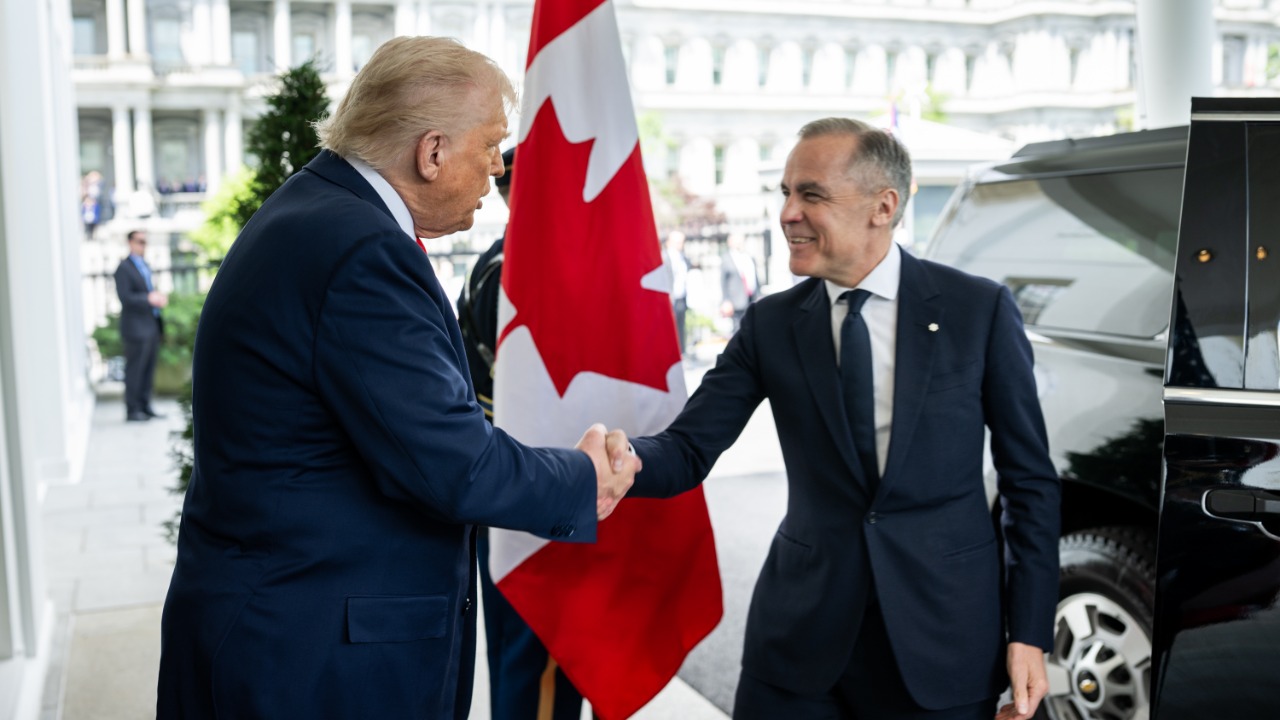
Canada has quietly assembled a playbook that strikes at the core of President Donald Trump’s political identity, the American auto industry. By tightening tariffs on United States vehicles while cutting fresh deals with Asian manufacturers, Ottawa is turning Trump’s signature protectionism back on itself and testing how far Washington will go to keep its northern neighbor in the fold.
What looks like a technical fight over customs codes is, in reality, a sharp geopolitical move. Canada is using its market for cars and electric vehicles as leverage, signaling that if the White House weaponizes trade, it is prepared to redirect billions in business toward South Korea and China instead.
From reluctant partner to auto-sector counterpuncher
I see Canada’s latest steps as the culmination of a shift that began when the Trump administration started targeting Canadian exports with new duties. Ottawa initially tried to contain the damage inside the North American framework, but when that failed, it reached for the one pressure point Washington could not ignore: access to Canadian car buyers. The federal government’s own description of its response makes clear that, effective in early April, Canada imposed a 25 per cent tariff on non‑CUSMA compliant vehicles imported from the United States, a move that explicitly singled out cars and trucks that did not meet the content rules of the Canada‑United States‑Mexico Agreement and that was formalized through a Surtax Order on motor vehicles.
That surtax did not appear in a vacuum. Earlier in the same confrontation, Canada had already announced that it would match United States tariffs on Canadian goods with its own countermeasures, and when President Trump’s new auto duties finally hit, Ottawa escalated. Prime Minister Mark Carney framed the decision as a direct response to the White House, with Canada imposing a 25 per cent tariff on non‑CUSMA compliant United States vehicles after Donald Trump’s duty came into effect, a retaliation that was widely reported as a targeted strike on the president’s political base in the industrial Midwest and that was underscored by Mark Carney himself.
South Korea deal shows Ottawa is ready to shop elsewhere
The real shock for Washington is that Canada is not just punishing United States automakers, it is actively building alternatives. In a new agreement with South Korea, Ottawa has opened the door for more Asian vehicles to enter the Canadian market on favorable terms, a pivot that moves it further from the United States orbit and closer to a diversified supply chain. Reporting on the accord describes how Canada signed an auto deal with South Korea that will ease tariffs on Korean vehicles, a shift that directly affects the flow of cars into Canadian ports and that is detailed in coverage of Canada’s South Korea.
The symbolism is as important as the economics. Images of cars made by Kia Motors lined up for export at the company’s shipping yard in Pyeongtaek, South Korea, captured by photographer Kim Hong, underline how much of the next wave of Canadian car imports could come from Asia rather than the United States. Those vehicles, produced by Kia Motors in Pyeongtaek and destined for foreign markets, now have a clearer path into Canadian showrooms, and every Korean sedan or SUV that lands in Vancouver or Halifax instead of a United States‑built model chips away at the sizable number of American vehicles that once dominated Canadian streets, a dynamic highlighted in reporting on Kia Motors exports.
China EV gambit turns climate policy into trade leverage
Where the South Korea deal reshapes the conventional car market, Canada’s electric vehicle strategy raises the stakes for the future of the industry. Ottawa has struck a trade arrangement to import electric cars from China, positioning itself as a hub for cheaper zero‑emission vehicles at a moment when United States policy is trying to wall off Chinese EVs. The move has already sent shock waves through North American climate and trade circles, with California’s top environmental regulator publicly praising the Canadian decision to bring in Chinese electric cars as a way to accelerate the transition to cleaner transportation, a reaction described in detailed reporting on China EV imports.
I read that endorsement from California as a warning sign for the White House. If the largest car market in the United States is applauding Canada for tapping Chinese supply, it suggests that Trump’s effort to keep Chinese EVs out of North America could be undercut from the north. The same reporting notes that the Canadian leader’s deal with China on electric vehicles was cheered by regulators focused on clean air in California, and that the move sent shock waves through United States industry groups worried about both competition and the precedent of a close ally deepening auto ties with China, a concern that is spelled out in coverage of Canada’s China deal.
Trump’s political calculus collides with Canada’s new clout
For President Donald Trump, the danger is not just economic, it is electoral. His political brand is built on defending American manufacturing, particularly in auto‑heavy states like Michigan and Ohio, and Canada’s retaliation lands squarely in that narrative. When Ottawa imposed its 25 per cent tariff on non‑CUSMA compliant United States vehicles after Trump’s own duties took effect, it signaled that any further escalation from Washington would be met with direct pain for United States automakers, a sequence that was made explicit in accounts of how Canada imposed tariffs only after the president’s duty came into force.
That is why I see Canada’s broader strategy as hitting Trump where it hurts most, the perception that he alone can protect American jobs. By pairing retaliatory tariffs with new supply lines from South Korea and China, Ottawa is telling United States carmakers that their access to a key export market now depends as much on the president’s restraint as on their own competitiveness. The combination of the 25 per cent surtax on non‑CUSMA compliant vehicles, the South Korea auto deal that channels more Kia Motors production from Pyeongtaek into Canada, and the China EV arrangement applauded in California gives Canada leverage it has rarely enjoyed in its economic relationship with Washington, a leverage that is rooted in the very auto sector Trump has spent years promising to shield.
More From TheDailyOverview
*This article was researched with the help of AI, with human editors creating the final content.

Grant Mercer covers market dynamics, business trends, and the economic forces driving growth across industries. His analysis connects macro movements with real-world implications for investors, entrepreneurs, and professionals. Through his work at The Daily Overview, Grant helps readers understand how markets function and where opportunities may emerge.