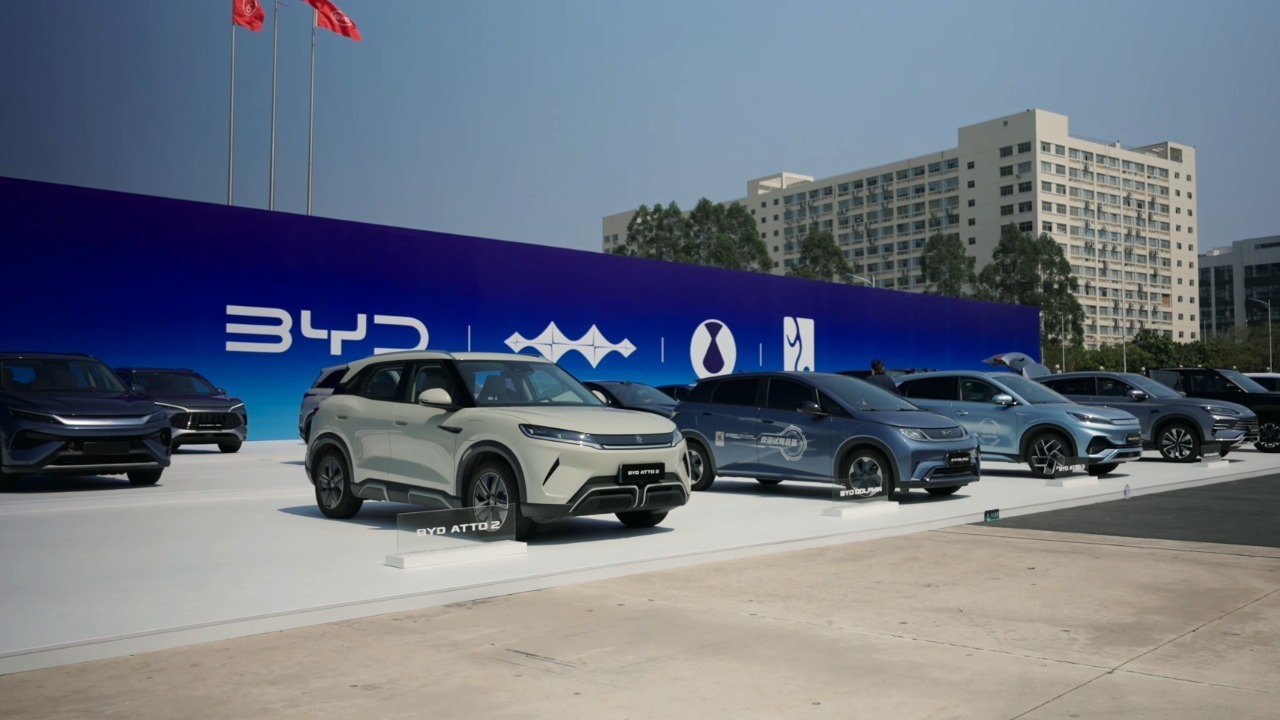
BYD, the Chinese automaker that started as a battery manufacturer, has surpassed Ford Motor Company in global vehicle sales for the first time, a milestone that reshapes the competitive hierarchy of the world’s largest car market. The overtaking did not happen through a single dramatic quarter but through years of aggressive expansion in electric and hybrid vehicles, culminating in a 2024 performance that also pushed BYD’s annual revenue past $100 billion. For Ford, a company that has defined American automotive culture for more than a century, the loss of its long-held sales ranking to a Chinese rival signals a structural shift rather than a temporary blip.
Ford’s 2024 Numbers Tell the Story
Ford’s own regulatory disclosure lays out the baseline. In its annual report filed with the U.S. Securities and Exchange Commission, the company stated that it sold approximately 4.47 million vehicles at wholesale throughout the world in 2024. That figure, drawn from a table of wholesale unit volumes broken down by market, represents a solid global footprint spanning North America, Europe, China, and other regions. By most historical standards, moving nearly 4.5 million vehicles in a single year would place any automaker comfortably among the world’s top sellers.
Yet the number now sits in a different context. Ford’s 10-K filing does not frame its results in terms of competitive threat from Chinese electric vehicle makers, but the math speaks for itself when contrasted with newer rivals. The 4.47 million-unit wholesale total, while stable, reflects a company whose growth trajectory has flattened in key markets even as emerging competitors accelerate. Ford has poured capital into its own EV lineup, including the Mustang Mach-E and the F-150 Lightning, but those efforts have yet to deliver the kind of volume gains needed to match the pace of change in the global market, particularly in segments where price and energy efficiency drive purchasing decisions.
BYD Crosses Two Thresholds at Once
BYD did not just edge past Ford in units sold; it redefined what a relatively young automaker can achieve in a short period of time. The company’s total vehicle sales reached around 4.3 million units in 2024, a figure that, while slightly below Ford’s wholesale count, reflects cars actually delivered to customers rather than shipments to dealers. That distinction matters because retail deliveries are a closer proxy for real demand than wholesale volumes, which can be influenced by inventory build-ups or channel-stuffing. On a like-for-like basis, BYD’s throughput now sits on par with, and arguably ahead of, Ford’s presence in consumers’ driveways.
The financial side of the story is even more striking. BYD’s annual revenue climbed past the $100 billion mark, according to reporting that highlighted how the company’s sales also surpassed Tesla’s for the year. Data cited from the Financial Times coverage shows that the company’s top line has expanded rapidly alongside its unit growth, propelled by a mix of battery-electric vehicles, plug-in hybrids, and a still-growing portfolio of energy products. That dual achievement (challenging a Detroit stalwart in volume while overtaking the best-known EV pure-play in revenue) places BYD in a rarefied tier of global manufacturers that have scaled both technologically and financially in less than two decades.
Vertical Integration as a Competitive Weapon
The most common explanation for BYD’s rapid ascent focuses on Chinese government subsidies, and there is no question that policy support has played a role in the broader Chinese EV ecosystem. But that framing misses a more important structural advantage: BYD manufactures its own batteries, semiconductors, and electric drivetrains in-house. This vertical integration allows the company to control costs at every stage of production, from raw lithium processing to final assembly. By contrast, many Western automakers still depend on a patchwork of suppliers whose pricing and capacity are shaped by global commodity cycles and financial conditions visible in tools such as international market data.
That cost structure is what enables BYD to price its vehicles aggressively in markets across Southeast Asia, Latin America, and increasingly Europe, without sacrificing margins the way many Western EV startups have. The company’s Seagull hatchback, for instance, retails for a fraction of what comparable Western EVs cost, in part because the most expensive components never leave BYD’s internal ecosystem. Critics rightly note that BYD’s domestic pricing benefits from a protected home market and from supportive monetary policy conditions that have kept financing costs relatively low for strategic industries in China. Still, the sheer scale of BYD’s manufacturing operation means that even without subsidies, its per-unit costs would likely remain well below those of most global competitors. Focusing solely on state support risks obscuring the more durable competitive threat that vertical integration poses to traditional automakers, whose legacy platforms and supplier contracts are harder to unwind.
What Overseas Expansion Means for Detroit
BYD’s ambitions extend well beyond China’s borders. The company has been building assembly plants and distribution networks across multiple continents, following a playbook reminiscent of how Japanese automakers like Toyota and Honda entered and eventually dominated key segments of the American and European markets in the 1980s and 1990s. BYD’s overseas push is already visible in countries such as Thailand, Brazil, and Hungary, where it has announced or begun construction on local production facilities designed to serve regional demand. These investments reduce exposure to tariffs and shipping costs while generating political goodwill in host countries eager for manufacturing jobs and technology transfer.
For Ford and other legacy automakers, the competitive pressure is no longer theoretical. BYD’s ability to offer technology-forward vehicles at lower price points threatens to erode market share in exactly the segments where traditional brands have historically enjoyed comfortable margins. Ford’s strength in full-size trucks and commercial vehicles still provides a buffer in North America, where Chinese imports face steep tariffs and regulatory barriers. But in the rest of the world, particularly in developing markets where price sensitivity is highest, BYD’s value proposition is difficult to counter. Even in Europe, where environmental regulations favor electrification, local brands now find themselves squeezed between premium EV makers and a Chinese entrant that can deliver acceptable range, modern software, and competitive safety features at mass-market prices.
A Structural Shift, Not a Sales Fluke
The temptation is to treat BYD’s overtaking of Ford as a single-year anomaly driven by China’s massive domestic market. That reading underestimates the depth of the transformation underway. BYD’s rise rests on a combination of scale, cost discipline, and technological focus that has been honed over many years, supported by internal capabilities that more closely resemble those of an electronics giant than a traditional carmaker. At the same time, the company has benefited from a broader ecosystem of innovation in China, including startup incubators and accelerator programs that have helped cultivate specialized suppliers and software partners; rankings of innovation-focused programmes in other regions underscore how competitive this support infrastructure has become globally.
For Ford, the implications go beyond a bruised ego in the league tables. The comparison with BYD highlights the constraints facing legacy manufacturers as they try to pivot from internal combustion engines to electric drivetrains while still servicing existing customers and dealer networks. Balancing shareholder expectations, unionized workforces, and capital-intensive retooling is inherently slower than building an EV-centric operation from scratch. BYD’s ability to cross both the volume and revenue thresholds in the same year suggests that the center of gravity in the auto industry is shifting eastward and toward companies that blend manufacturing prowess with control over critical technologies. Unless Detroit can accelerate its own restructuring, by deepening partnerships in batteries and software, simplifying product portfolios, and finding new ways to compete on cost, the 2024 sales ranking may be remembered not as a blip, but as the moment when a new global order in autos became impossible to ignore.
More From The Daily Overview
*This article was researched with the help of AI, with human editors creating the final content.

Grant Mercer covers market dynamics, business trends, and the economic forces driving growth across industries. His analysis connects macro movements with real-world implications for investors, entrepreneurs, and professionals. Through his work at The Daily Overview, Grant helps readers understand how markets function and where opportunities may emerge.

