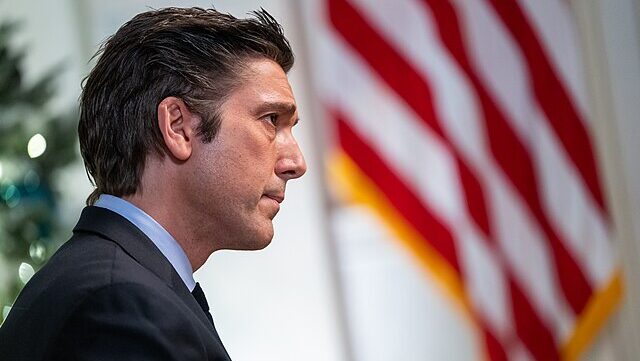
David Muir has built his reputation on a calm delivery that rarely oversells a story, which is precisely why his recent on-air alerts about deadly risks have carried such weight. When he raises his voice to call something a catastrophe in the making or a dangerous and deadly situation, he is signaling that viewers are not just watching the news, they are living inside it.
From extreme weather to online exploitation and national security threats, his warnings sketch a picture of a country facing overlapping dangers that demand more than passive attention. I see a pattern emerging in how he uses his platform: he is not simply narrating crises, he is trying to give viewers enough information to act before the worst happens.
Hurricane Melissa and the language of catastrophe
When David Muir returned to the anchor desk on a Monday in late Oct, his description of Hurricane Melissa as a looming catastrophe cut through the usual churn of storm coverage. On Oct 27, 2025, he told viewers of ABC’s flagship evening newscast that Hurricane Melissa was predicted to become one of the strongest storms on record for Jamaica, with winds that could reach up to 180 mph, a level of detail that framed the system as a deadly threat rather than just another name on a hurricane list. That choice of words, and the precision of the numbers, underscored that people in the storm’s path were running out of time to prepare, not merely watching a distant weather drama unfold.
His warning fit into a broader pattern of coverage in which Hurricane Melissa was treated as a life-or-death event, not just a ratings spike. By emphasizing that the storm could be the strongest on record for Jamaica and spelling out the potential 180 mph winds, he translated meteorological jargon into human stakes, especially for coastal communities and those living in vulnerable housing. The message was clear: evacuation plans, emergency kits, and communication with family were not optional extras but urgent tasks that could decide who survived.
From nightly news to national alarm system
David Muir’s warnings resonate partly because of the platform he occupies. As the anchor of World News Tonight, he sits at the center of a broadcast that reaches millions of households, turning his program into a kind of informal national alert system. When he labels a situation dangerous or deadly, he is effectively amplifying the assessments of agencies and experts, translating their bulletins into plain language that viewers can absorb in a few seconds after work or dinner.
That role has been especially visible in his coverage of severe weather and public safety. When evacuation warnings are issued for parts of California because heavy rain could slam burn scar areas, the stakes are not abstract. The risk of flash flooding and mudslides in those zones is well documented, and his broadcast has highlighted how evacuation orders can mean the difference between a close call and a fatal disaster. By repeatedly returning to these alerts, he reinforces that climate-driven extremes are not one-off anomalies but recurring threats that demand long term preparedness.
A “dangerous and deadly” situation for millions
His language becomes even more pointed when he describes threats that extend far beyond a single region. On Nov 16, 2025, David Muir was reported to have warned millions as they prepared for what he called a dangerous and deadly situation, a phrase that signaled a level of urgency rarely attached to routine news segments. The report noted that he was forced to deliver this warning in the context of a developing crisis, underscoring how quickly a normal broadcast can pivot when new information suggests lives are at risk.
That Nov alert, tied directly to David Muir himself, illustrates how he uses his authority to cut through noise when the stakes spike. Rather than softening the language to avoid alarming viewers, he leaned into the gravity of the situation, effectively telling people that complacency was the greater danger. In a media environment where hyperbole is common, his willingness to reserve such stark phrasing for genuinely high risk moments makes it more credible when he finally deploys it.
The hidden threat of “764” and children online
Not all of the dangers Muir highlights are visible on radar or satellite imagery. Earlier this year, he introduced an exclusive report on an online criminal network that the FBI says is targeting children where they should be safest, at home and on their devices. In that coverage, he described an urgent FBI warning about a dangerous online network called 764, which investigators allege is using social platforms to encourage kids to do cutting and other forms of self harm. The specificity of the number, 764, and the focus on self harm made clear that this was not a vague concern about screen time but a concrete, organized threat.
In the same investigation, Muir highlighted how the FBI believes this network is also pushing children toward cruelty, including attempts to get them to harm their pets, a detail that underscores how the group appears to be testing boundaries and desensitizing kids to violence. A companion clip on social media described how An ABC News exclusive laid out the tactics used to lure young users into these challenges, often through anonymous accounts and coded language. By putting the name 764 on national television and tying it to an explicit FBI warning, Muir effectively gave parents and educators a keyword to watch for in chats, search histories, and app activity.
Security warnings at home and abroad
Muir’s alerts are not limited to storms and social media. When U.S. intelligence agencies raise concerns about potential violence, his broadcast often becomes the first place many Americans hear about it. In a segment shared on social platforms, he told viewers that, on Apr 4, 2024, there was a new security warning in the United States from the FBI and Homeland Security, following an ISIS attack overseas. The bulletin, obtained by his newsroom, described violent threats in America that officials feared could be inspired by events abroad, a reminder that global terrorism can still ripple into domestic life.
By spelling out that both the FBI and Homeland Security were involved, he conveyed that this was not a routine advisory but a coordinated concern across agencies. The segment framed the warning as part of a broader pattern of threat assessments that ebb and flow with international events, and it encouraged viewers to stay aware of their surroundings without succumbing to panic. In doing so, Muir walked a careful line between amplifying a serious alert and avoiding the kind of fearmongering that can distort public perception of risk.
Fact checking, politics, and the credibility behind the warnings
The impact of any warning depends on whether viewers trust the person delivering it, and Muir’s approach to political coverage has become part of that equation. During the high stakes presidential debate that pitted President Donald Trump against his opponent, he and fellow anchor Linsey Davis faced criticism from Trump for their moderating. On Sep 15, 2024, Muir publicly dismissed the complaints as noise and defended how he and Linsey Davis, along with their ABC team, had hunkered down to fact check claims in real time, including those from Trump and Harris at the ABC debate. That insistence on live verification signaled to viewers that he sees accuracy as a non negotiable part of his job, even under partisan fire.
His comments, reported in detail in coverage of Muir and Linsey Davis, underscored that he is willing to challenge powerful figures on air, including the current president, when their statements do not match the facts. That posture feeds directly into how viewers interpret his warnings about hurricanes, online networks, or terrorism. If he is seen as someone who pushes back on misinformation in the political arena, his alerts about deadly threats elsewhere carry more weight, because they are grounded in the same commitment to verification rather than sensationalism.
Why Muir’s warnings matter now
Looking across these episodes, I see a consistent pattern in how David Muir uses his platform: he reserves his strongest language for moments when multiple institutions, from the FBI to Homeland Security to weather agencies, are already sounding alarms. Whether he is describing Hurricane Melissa as a potential catastrophe for Jamaica, relaying an urgent FBI warning about the 764 network targeting children, or explaining a security bulletin about violent threats in America, he is acting as a conduit between specialized briefings and the public’s daily routine. That role is especially critical at a time when climate extremes, digital exploitation, and geopolitical shocks are colliding in ways that can feel overwhelming.
For viewers, the practical takeaway is straightforward. When Muir shifts from his usual measured tone to talk about a dangerous and deadly situation, it is a signal to pause, listen closely, and consider concrete steps, whether that means heeding evacuation guidance in California, checking a child’s apps for references to 764, or staying alert in crowded public spaces after a security bulletin. His warnings do not replace official instructions from agencies, but they often arrive in the living room first, framed in language that makes the stakes impossible to ignore.
More From TheDailyOverview
- Dave Ramsey warns to stop 401(k) contributions
- 11 night jobs you can do from home (not exciting but steady)
- Small U.S. cities ready to boom next
- 19 things boomers should never sell no matter what

Cole Whitaker focuses on the fundamentals of money management, helping readers make smarter decisions around income, spending, saving, and long-term financial stability. His writing emphasizes clarity, discipline, and practical systems that work in real life. At The Daily Overview, Cole breaks down personal finance topics into straightforward guidance readers can apply immediately.
