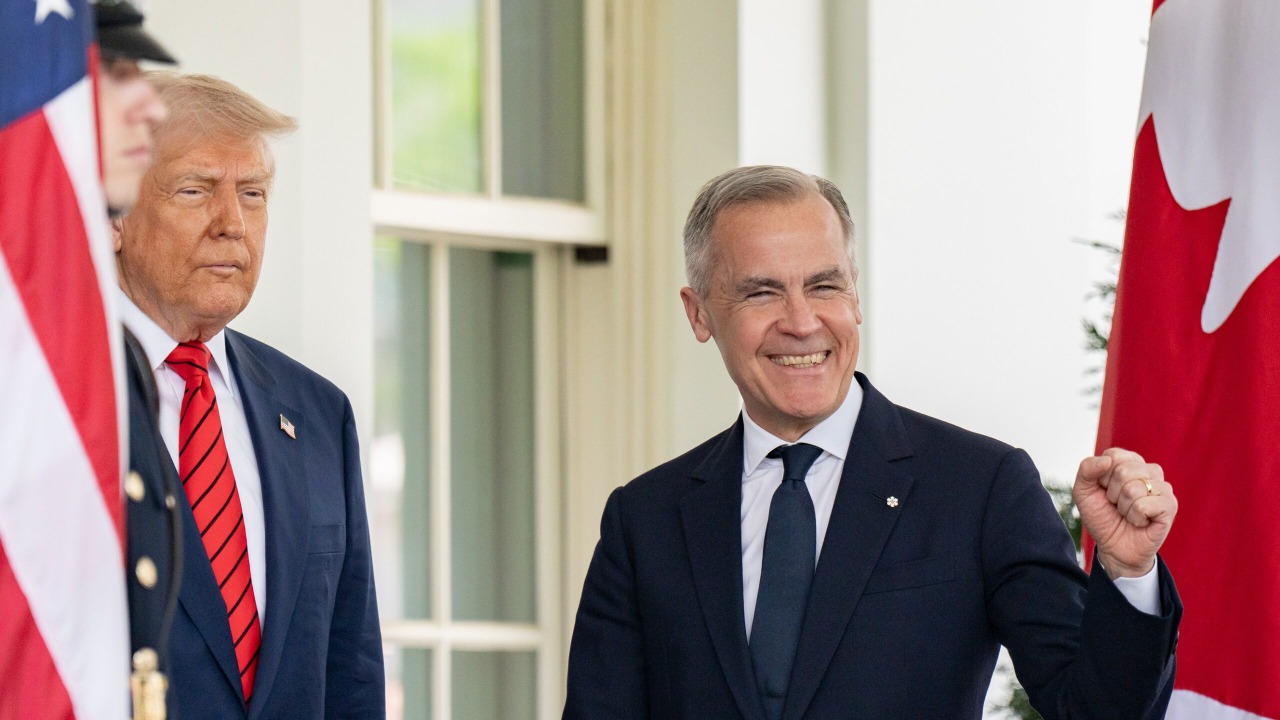
Financial markets have been jolted by President Donald Trump’s latest confrontation with Canada, as investors try to price in what some analysts frame as a potential $300 billion hit to cross-border trade and the North American auto supply chain. The selloff reflects more than a single policy move, it captures mounting anxiety that the United States is prepared to weaponize tariffs against one of its closest partners at a scale that could reshape global manufacturing.
Trump’s escalating tariff threats have collided with a fragile backdrop of stretched equity valuations and slowing global growth, amplifying the shock. I see the reaction as a referendum on whether the United States is still a predictable anchor for the rules-based trading system that underpins everything from car prices to mortgage costs.
The new flashpoint in Trump’s trade war with Canada
The latest market turmoil sits on top of a trade conflict that has been building for more than a year, as Trump has turned a long-running grievance over deficits into a full-spectrum confrontation with Canada and Mexico. The current phase is rooted in the broader 2025–26 dispute, in which Trump has repeatedly argued that tariffs are needed to reduce the United States trade deficit with Canada and Mexico and to force both countries to tighten their own borders. He has framed the measures as a way to revive manufacturing in the United States, even as critics warn that the costs land first on American consumers and factories.
Initial tariff moves earlier in the conflict set the tone for the current standoff. On February, Trump signed executive orders imposing 25 percent tariffs on all goods from Mex, with carve-outs that only delayed when some shipments would be subject to the full 25 percent tariff. That early shock to Mex signaled that Canada could be next in line, and it laid the groundwork for a broader confrontation with Canada and Mexico that is now spilling over into financial markets.
How a tariff threat turned into a $300 billion scare
The immediate trigger for the latest selloff was Trump’s threat to slap new 100 percent tariffs on key Canadian exports if Ottawa pursues trade deals that Washington dislikes. In his latest salvo, Trump has targeted autos, steel, aluminum, lumber and energy, a cluster of sectors that make up the backbone of Canadian shipments to the United Stat and that are deeply embedded in North American supply chains. Reporting on Trump’s threat underscores that these are not symbolic products, they are the very categories that have already been hit hard in earlier rounds of the trade war.
What turned a policy dispute into a $300 billion market scare was the way investors extrapolated those threats into the auto sector in particular. In a widely shared clip, a commentator noted that “Japan Picks Canada, U.S. Auto Industry Stares at $300B Disaster,” a line that captured how a shift in investment decisions could reroute entire supply chains away from the United States. That warning, framed as part of a Krugman Analysis, circulated through Comments describing how the Auto Industry Stares at a potential Disaster if cross-border production is disrupted. The figure itself, $300, is shorthand for the scale of annual auto and parts trade that could be at risk if companies decide that Canada offers a more stable base for long term investment.
Markets react: from opening bell to sector pain
Equity markets did not wait for the tariffs to be finalized before voting with their feet. Stocks opened lower after President Trump announced a 35% tariff on Canadian goods, a move that immediately hit sentiment across the S&P 500. The broad GSPC index dropped roughly 0.5% from record levels as traders reassessed earnings forecasts for exporters and companies reliant on Canadian inputs, according to Stocks data. The Dow and Nasdaq also retreated, reflecting a broad-based pullback rather than a niche reaction confined to a few names.
The pressure was especially acute in sectors directly exposed to cross-border trade. Automakers with assembly plants in Ontario and suppliers that ship components back and forth across the border saw outsized declines, as did homebuilders and construction firms that depend on Canadian lumber. Earlier phases of the conflict had already shown how sensitive these industries are to tariff shocks, with GSPC swings tracking each new escalation. The latest move reinforced the sense that trade policy has become a primary driver of day to day volatility.
Inside Trump’s tariff logic and the Canada and Mexico front
Trump has consistently argued that aggressive tariffs are a necessary tool to reset what he sees as unfair arrangements with Canada and Mexico. In his telling, the goal is to shrink the United States trade deficit with Canada and Mexico, force both countries to secure their own borders more tightly and push global companies to expand manufacturing in the United States. That rationale is laid out in detail in accounts of the Canada and Mexico dispute, which describe how Trump has tied trade policy to broader political themes about sovereignty and security.
Supporters of the strategy often frame it as a long overdue correction to decades of offshoring, while critics warn that it risks backfiring by inviting retaliation and undermining investor confidence. The early focus on Mex, captured in social media posts that shouted “MEXICO PAWH IN PRESIDENT TRUMP TRADE WAR MAI MAI AN HLAU LO,” signaled that the administration was willing to absorb short term pain to pursue its agenda. That rhetoric, preserved in a TRADE WAR discussion, has since been extended to Canada, where the same hard line is now colliding with the reality that the two economies are tightly intertwined.
Sector shock: autos, lumber and the home front
The auto industry sits at the center of the current storm because it embodies the integrated nature of North American production. Assembly lines for models like the Ford F-150 and Chevrolet Silverado rely on parts that cross the border multiple times before a finished vehicle rolls off the line, so a sudden 35% or 100 percent tariff on Canadian components would ripple through prices and employment. Analysts who warned that “Japan Picks Canada” in the latest Krugman Analysis were highlighting how new investment decisions by Japanese automakers could tilt toward Canada if they see the United States as a less reliable partner, a concern amplified in Japan Picks Canada commentary that described how the Auto Industry Stares at a potential Disaster.
Lumber is another flashpoint that brings the trade war into American households. Roughly 85% of imported lumber comes from Canada, which is already subject to separate 35% tariffs under rules set by the Commerce Department. Those figures, detailed in coverage of Trump’s lumber policy, show how a relatively technical dispute over duties can quickly translate into higher costs for homebuilders and, ultimately, for buyers of new houses. As tariffs on Canadian wood feed into the price of framing and furniture, Roughly the entire construction chain is forced to either absorb the hit or pass it on, a dynamic that is now being repeated across autos, steel, aluminum and energy.
Warnings of an ‘economic nuclear winter’
For some investors, the cumulative effect of these moves is not just a cyclical headwind but a structural threat to the global economy. One billionaire investor has gone so far as to warn of an “economic nuclear winter,” arguing that sweeping tariffs may fail to deliver the promised manufacturing revival while inflicting lasting damage on growth. In that analysis, the concern is that even with major tariffs in place, it is still generally cheap to produce goods abroad, so companies may simply reroute supply chains rather than bring jobs back to the United States, a point underscored in a billionaire investor warning.
The same investor has stressed that, finally, it is not clear that the administration will stick with any given tariff regime long enough for companies to adjust, noting that even if levies are imposed, they could be removed a week later. That uncertainty is itself a drag on investment, since firms are reluctant to commit billions to new plants when the rules of the game can change overnight. The critique, captured in a detailed Apr analysis that uses the words Finally and Even to frame its argument, suggests that the real risk is not just higher prices but a prolonged chill in capital spending that could validate the “nuclear winter” metaphor.
Team Trump’s pushback and the political calculus
Inside the administration, allies of Trump argue that markets and commentators are exaggerating the downside. Former Treasury Secretary Steven Mnuchin has said that “people are overreacting a bit” to Trump’s policies, pointing out that the first few months of Trump ( President Donald Trump )’s second term have been marked by escalating trade tensions with Canada, Mexico and China but also by continued strength in some economic indicators. His comments, reported in a Mnuchin interview, reflect a belief that markets will ultimately adjust to a tougher trade stance and that short term volatility is a price worth paying.
Trump himself has doubled down on that message, insisting that his steep sectoral tariffs on autos, steel, aluminum, lumber and energy are already delivering leverage over Canada. Accounts of Trump’s steep measures note that they have hit Canada especially hard, a fact the White House sees as evidence that the strategy is working. At the same time, the broader Trump, United Stat relationship with Canada is being tested as never before, with each new threat feeding into the market narrative that the United States is willing to risk a $300 billion rupture in order to secure political wins.
More From TheDailyOverview
*This article was researched with the help of AI, with human editors creating the final content.

Grant Mercer covers market dynamics, business trends, and the economic forces driving growth across industries. His analysis connects macro movements with real-world implications for investors, entrepreneurs, and professionals. Through his work at The Daily Overview, Grant helps readers understand how markets function and where opportunities may emerge.

