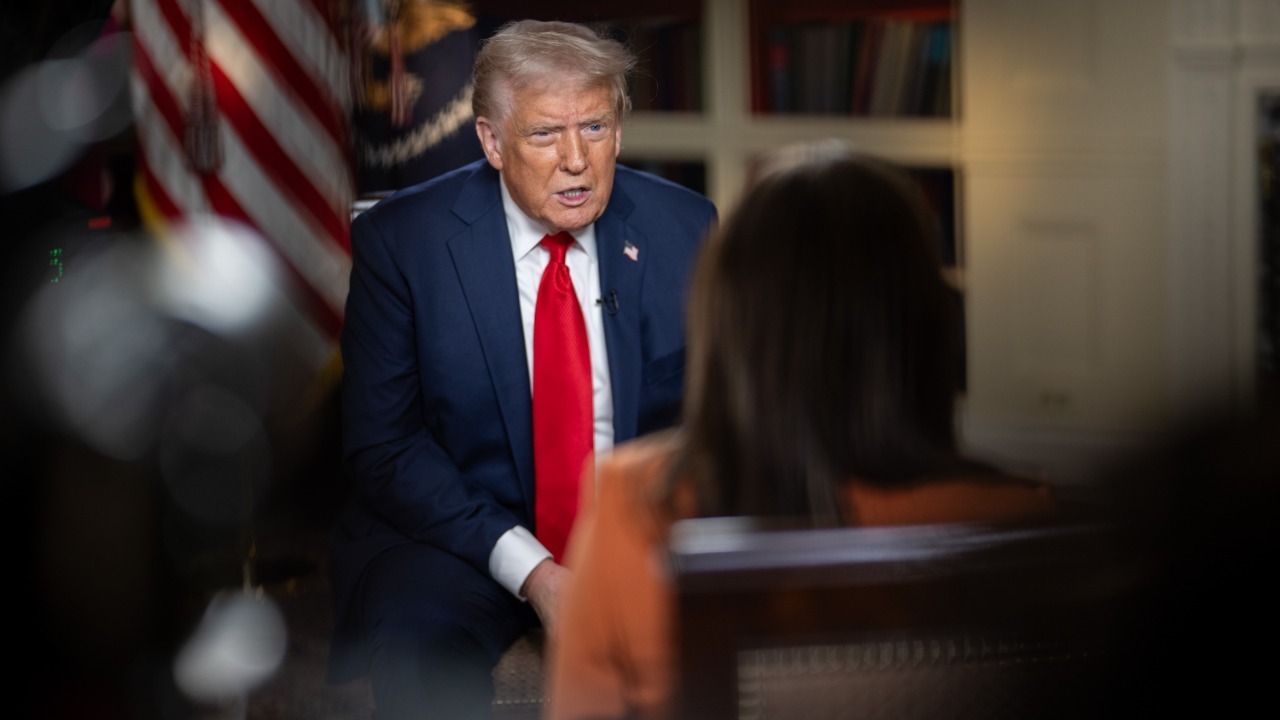
Donald Trump built his political brand on the projection of unshakable strength, a leader who would bend institutions and allies to his will. A year into his return to the White House, that strongman image is fraying under the weight of his own decisions, from foreign adventures to improvised diplomacy. What is left looks less like dominance and more like a pattern of impulsive moves that validate the darkest warnings about his impact on democracy and global order.
The gap between Trump’s swagger and his actual leverage is now visible at home and abroad, in Congress, in Caracas, in Davos and in Greenland. I see a presidency that still talks in the language of power but increasingly reveals vulnerability, isolation and a willingness to gamble with institutions that were meant to constrain any one person.
Democracy on edge as Trump tests the guardrails
Inside the United States, the first cracks in Trump’s aura of invincibility are appearing not in the streets but at the ballot box. At the last off year elections, Democrats stacked up local and state victories that have put them within striking distance of retaking the House, a reminder that even a president who talks like a strongman still has to face voters. Experts quoted in that reporting describe American democracy as “on the brink,” not because elections have vanished, but because Trump has tried to turn once neutral institutions into personal instruments while treating watchdogs as enemies rather than referees. The more he leans on that strategy, the more he invites a backlash from voters who see the stakes as nothing less than the survival of constitutional norms.
At the same time, Trump’s allies in Congress are helping him stretch the limits of executive power in ways that alarm legal scholars and foreign policy veterans. When House Republicans blocked a resolution on Thursday that would have constrained his ability to wage war in Venezuela, they signaled that the legislative branch is willing to act as a shield rather than a check. That vote, which followed Trump’s decision to send forces into Venezuela as part of his early 2026 foreign policy push, underscores how a president with a strongman persona can convert partisan loyalty into real-world authority over life and death. Yet it also exposes him to political risk if the conflict drags on or spirals, because the responsibility for outcomes now rests squarely on his shoulders.
Venezuela and the illusion of unchecked power
Trump’s move into Venezuela was framed by his supporters as proof that he is a decisive commander in chief, unafraid to use force where previous presidents hesitated. In a detailed Analysis, Leslie Vinjamuri notes that Trump’s first foreign policy steps of the year included invading Venezuela and accelerating efforts to pull the United States from 66 international organizations, a combination that projects raw power while hollowing out the cooperative structures that usually legitimize it. The same piece, illustrated by Evan Vucci, describes how Trump’s unilateralism is reshaping alliances and raising questions about whether the United States still sees value in shared rules. That is the paradox of his strongman posture: the more he acts alone, the more he erodes the very networks that once amplified American influence.
Yet the Venezuela episode also reveals the limits of that approach. By relying on a narrow circle of loyalists and sidelining traditional diplomatic channels, Trump has made it harder to build durable coalitions around his objectives in Caracas. Regional partners are wary of being dragged into a conflict that looks driven as much by domestic politics as by strategic necessity, and the blocked war powers resolution shows that even some Republicans are uneasy enough to force a tie rather than a clear endorsement. Trump may still talk as if he has a free hand, but the combination of legal constraints, public skepticism and international hesitation suggests his power is more contested than his rhetoric admits.
Davos, Greenland and a collapsing façade abroad
If Venezuela exposed the structural limits of Trump’s authority, his performance at Davos exposed the personal ones. Trump arrived at the Swiss resort determined to showcase himself as a dealmaker on the world stage, only to turn the gathering into what one account described as a one man spectacle over Greenland. In that telling, Trump’s insistence on claiming victory in a long running dispute about the island overshadowed the forum’s economic agenda and left other leaders baffled. The same report describes how his strongman act seemed to collapse in real time, as bluster gave way to confusion and improvisation in front of an audience of global elites who are used to more disciplined messaging.
Trump’s fixation on Greenland did not begin in Davos, but the summit crystallized how it has damaged America’s standing in Europe. As Trump declared a win over Greenland, a territory of Denmark, European officials concluded that “the damage has been done,” not only to relations with Copenhagen but to broader trust in Washington’s reliability. Within the same narrative, Trump’s rhetoric about the island is portrayed as threatening the long standing world order that has governed Arctic security and NATO cooperation. When a president treats a strategic territory like a personal trophy, allies start to wonder whether their own interests will be sacrificed next.
From bruised hand to bruised credibility
The Davos trip also produced a more literal image problem for Trump. New photos from the summit showed a fresh mark on his hand during meetings, prompting questions about his health and fueling speculation online. A Story by Natalie Neysa Alund for USA TODAY noted that Trump appeared to mix up Iceland and Greenland in his Davos remarks, a verbal slip that, combined with the visible bruise, raised fresh doubts about the vigor he tries to project. The White House declined to offer detailed comment, leaving the images to circulate without a clear explanation and inviting the kind of whispered questions that strongmen usually work hard to suppress.
Those optics matter because they collide with Trump’s own narrative of dominance and control. When Trump turns Davos into what another account called a one man farce over Greenland, and then stumbles over basic geography, it undercuts the image of a leader fully in command of the details. In that account, Trump’s behavior at Davos is framed as confirmation of the world’s worst fears: that the person steering the most powerful military on earth is more focused on personal score settling and symbolic “wins” than on coherent strategy. The bruise on his hand became a metaphor for a presidency that looks tough at a distance but shows signs of strain up close.
The ‘Board of Peace’ and a world losing faith
Trump’s answer to growing doubts about his global leadership has been to propose new structures that concentrate more authority in his own hands. At Davos, he unveiled what he called a “Board of Peace,” a body he said could eventually rival the United Nations. The U.S. President said “everyone wants to be a part” of this board and touted the potential involvement of Vladimir Putin, casting it as a bold new architecture for global stability. Yet detailed reporting on the proposal argues that the project is “doomed to fail,” in part because it appears designed around Trump’s personal relationships and grievances rather than transparent rules. At the unveiling event in Davos, Trump claimed “It’s going to be the greatest,” but diplomats and analysts see a vehicle that could be highly susceptible to corruption and abuse.
More From TheDailyOverview
*This article was researched with the help of AI, with human editors creating the final content.

Grant Mercer covers market dynamics, business trends, and the economic forces driving growth across industries. His analysis connects macro movements with real-world implications for investors, entrepreneurs, and professionals. Through his work at The Daily Overview, Grant helps readers understand how markets function and where opportunities may emerge.

