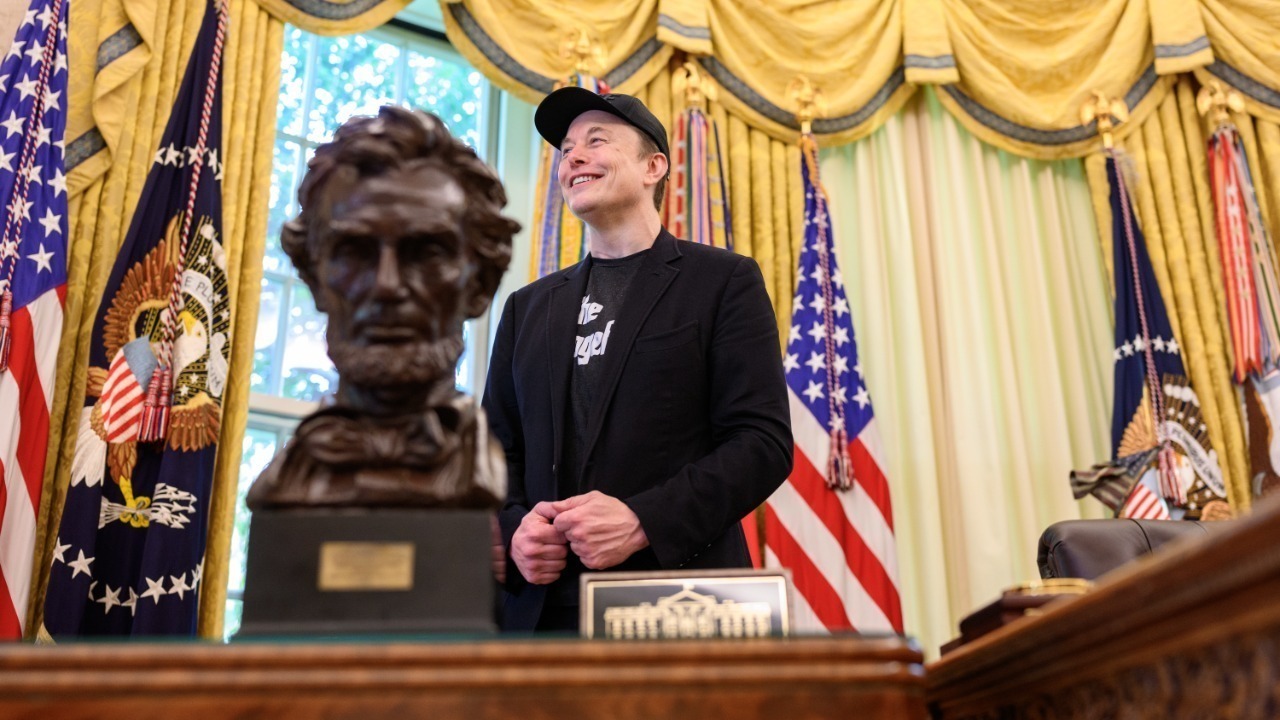
Elon Musk has started talking less about universal basic income and more about what he calls “universal high income,” a future in which he says there will be “no poverty” and little reason to save money at all. The claim sounds utopian, but it also raises a blunt question that markets, workers and policymakers care about: if this world is really “near,” how much money are we actually talking about, and what would it buy?
To answer that, I need to unpack what Musk means, how economists define a similar concept, and why some experts warn that the phrase “high income” can be misleading in an economy reshaped by artificial intelligence.
What Musk is really promising with “no poverty” and no savings
Musk has sketched a future in which automation and artificial general intelligence produce “everything anyone wants,” so that every individual’s basic and advanced needs are met without the traditional pressure to work or save. In that vision, he argues that if everyone has a high income, the very idea of poverty disappears because material scarcity is effectively solved and the relevance of money itself “declines dramatically,” a framing he has tied directly to his claim that there will be “no poverty” once universal high income arrives. He has also linked this to the idea that if everyone’s income is elevated, the relative status signal of money weakens, since, as one analysis of his comments puts it, “if everyone has a high income, then no one does,” which is precisely Musk’s argument about the changing role of cash in such an economy, as reflected in his comments on no poverty.
In a separate discussion of this same future, Musk described a world where people would have “no reason to save money within a few years,” because the combination of advanced robotics and artificial general intelligence would generate such abundant goods and services that both basic and advanced needs could be satisfied as a matter of course. In that scenario, he imagines individuals no longer worrying about retirement accounts or emergency funds, because the system itself guarantees access to housing, healthcare, education and even luxuries, a sweeping promise he has tied to the idea that “There Will Be No More Poverty” and that the economic system will cover an individual’s basic and advanced needs.
From UBI to UHI: how Dec and UHI reframe the debate
Economists and policy analysts have been trying to pin down what “universal high income” would actually mean in practice, and one influential attempt comes from Dec at the Tax Project Institute, which treats UHI as a structured policy concept rather than a slogan. In that framework, UHI is defined as a guaranteed payment to every adult that is set high enough to lift people well above the poverty line, but still grounded in the realities of supply and demand, with Dec stressing that “for this article, and throughout, I will use the term UHI to refer to a specific policy design” so that debates about Musk’s rhetoric can rest on a clear baseline, a definition laid out in detail in the institute’s Dec, UHI explainer.
Crucially, Dec argues that even in an AI driven economy, “the basics of supply and demand do not change because of the AI paradigm change,” which means that simply declaring that everyone will have a high income does not magically solve questions about prices, production capacity or inflation. The broader UHI analysis emphasizes that any serious universal high income scheme has to grapple with how much money is injected into households, how that interacts with labor markets, and whether the productive side of the economy can keep pace with the extra purchasing power, rather than assuming that automation alone will keep shelves full and prices stable.
“There Will Be Universal High Income”: Musk’s 80% bet on jobless abundance
Musk has not just floated UHI as a vague aspiration, he has attached a specific probability to it and tied it to a radical forecast about work itself. In a widely discussed exchange earlier this year, he said, “There Will Be Universal High Income,” and added that he was making that prediction with 80% certainty, while also warning that “None of Us” “Will Have Jobs” in the traditional sense once artificial general intelligence and robotics reach full maturity, a framing captured in the extended title “There Will Be Universal High Income, Elon Musk Predicts With, Certainty That, None of Us, Will Have Jobs.”
In that same conversation, Musk framed the disappearance of conventional employment as both a challenge and an opportunity, suggesting that if machines handle most productive tasks, the central question becomes not how people will earn a living but how they will find meaning and structure in their days. He has repeatedly linked this to the idea that a universal high income would be funded by the enormous productivity gains of AI systems and robots, which, in his telling, would allow society to redirect a share of that output to everyone as a kind of dividend, a logic that underpins his confident assertion that Posting on X about “There Will Be Universal High Income” is not just wishful thinking but a forecast grounded in his view of technological trends.
How much is “high” income, and does it really beat UBI?
When Musk talks about everyone enjoying a “high” income, he rarely attaches a dollar figure, which is where policy thinkers step in to ask how big such a payment would need to be to match his rhetoric. One prominent universal basic income advocate, Scott Santens, argues that “Believing that UBI needs to be high fosters a poor understanding of how UBI works,” because the point of a universal basic income is to provide a secure floor, not to replace all other earnings or to promise a luxury lifestyle funded entirely by the state, a distinction he draws sharply in his essay on Believing that UBI must be massive.
From that perspective, a universal high income of the sort Musk describes would have to be large enough not only to cover rent, food and healthcare but also to fund what he calls advanced needs, such as travel, education upgrades and access to cutting edge technology, which implies a payment far above the poverty line and potentially rivaling a solid middle class salary. Yet as Dec’s work on UHI stresses, the higher the guaranteed payment, the more pressure it puts on the real economy to deliver goods and services without triggering shortages or runaway prices, which is why many economists caution that Musk’s language about “high income” risks obscuring the hard trade offs between generosity, sustainability and the continued role of work based earnings.
Supply, demand and the limits of a money rich future
Even if one accepts Musk’s premise that AI and robotics will massively expand productive capacity, the Dec analysis of UHI is a reminder that the basic mechanics of markets still apply, and that matters for how far any universal payment can stretch. Dec is explicit that “the basics of supply and demand do not change because of the AI paradigm change,” which means that if a universal high income pumps large amounts of purchasing power into households without a corresponding increase in real output, the result will be higher prices rather than the effortless abundance Musk describes, a tension that sits at the heart of the Dec, UHI framework.
That is why some analysts prefer the more modest language of universal basic income, which focuses on guaranteeing a stable floor while leaving room for wages, entrepreneurship and other income sources to shape people’s standard of living, instead of promising that everyone will be “high income” in a way that may not survive contact with real world constraints. Musk’s vision of a world where “There Will Be Universal High Income” and “There Will Be No More Poverty” is ultimately a bet that technology will expand supply so dramatically that these constraints fade, but until that is visible in factories, data centers and logistics networks, the size of any future payment, and whether it truly counts as “high,” remains an open question, unverified based on available sources.
More From TheDailyOverview

Grant Mercer covers market dynamics, business trends, and the economic forces driving growth across industries. His analysis connects macro movements with real-world implications for investors, entrepreneurs, and professionals. Through his work at The Daily Overview, Grant helps readers understand how markets function and where opportunities may emerge.

