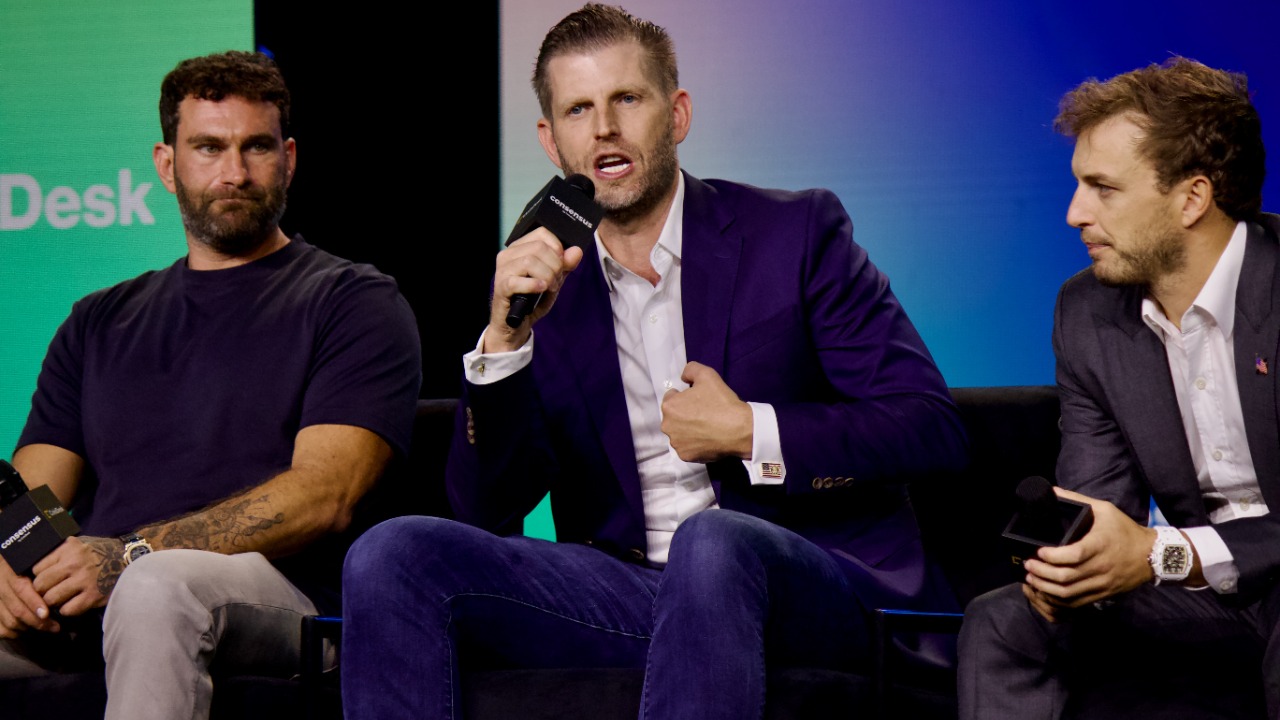
Eric Trump has joined a $1.5 billion deal to take an Israeli combat drone maker public, placing a personal financial bet on a company that markets its weapons around the concept of “low cost per kill.” The investment arrives as the Pentagon accelerates spending on small, AI-enabled attack drones, a budget priority overseen by Eric Trump’s father. The arrangement raises pointed questions about where private profit ends and policy influence begins when a sitting president’s son backs a defense startup actively winning federal contracts.
Inside the $1.5 Billion XTEND-JFB Merger
The deal is structured as an all-stock business combination between XTEND, an Israeli drone manufacturer, and JFB Construction Holdings, a publicly traded shell company. According to JFB’s merger filing, the transaction carries an implied acquisition value of roughly $1.5 billion. Once completed, XTEND shareholders are expected to hold approximately 70% of the combined entity on a fully diluted basis, with JFB shareholders retaining around 30%. The filing names Eric Trump among a group of strategic investors that also includes Unusual Machines, Protego, and Aliya, placing the president’s son alongside established players in the small-drone and defense-technology ecosystem.
Separately, JFB moved to raise cash ahead of the merger. On Feb. 13, 2026, the company entered securities purchase agreements to sell 802,000 common shares at $12.50 per share, generating estimated gross proceeds of $10.0 million and roughly $9.2 million net, with Dominari’s placement work disclosed in a contemporaneous Form 8-K. A portion of those proceeds will be funneled into XTEND through a Simple Agreement for Future Equity, or SAFE, giving JFB an early financial stake in the drone maker before the merger closes. By converting a construction-focused public listing into a defense technology vehicle, the deal offers XTEND a relatively fast path into U.S. capital markets, sidestepping some of the investor vetting and visibility that accompany a traditional IPO roadshow while still delivering a multibillion-dollar valuation.
What XTEND Builds and Who Is Buying
XTEND’s core product line centers on AI-enabled, modular attack drones designed for close-quarters combat, a niche where human operators need precision in cluttered, urban, or indoor environments. The company recently won a competitively awarded, firm-fixed-price contract from the Office of the Assistant Secretary for Special Operations/Low-Intensity Conflict Capability Development and Innovation directorate, according to a press release distributed via PR Newswire’s platform. That award covers the development and delivery of what XTEND calls an “Affordable Close Quarter Modular One-Way Attack Drone Kit,” with “one-way attack” serving as industry shorthand for a loitering munition designed to destroy itself on impact.
The company’s investor materials emphasize that its systems are built around modular payloads and intuitive control interfaces, allowing relatively lightly trained operators to guide drones through tight spaces and onto specific targets. XTEND’s presentation to investors, lodged with regulators as part of the merger process, highlights a production presence in Tampa that anchors its U.S. manufacturing strategy. That domestic footprint is strategically important at a time when Pentagon procurement officials are increasingly wary of Chinese-origin components and Congress has moved to restrict purchases from major Chinese drone brands. By assembling systems inside the United States, XTEND positions itself to meet Buy American requirements and to appeal to military planners who want to field large numbers of expendable drones without triggering supply-chain vulnerabilities.
The Trump Family’s Expanding Defense Footprint
Eric Trump’s investment does not exist in a vacuum. As Bloomberg has reported, the XTEND transaction adds to the Trump family’s growing ties to the defense sector, including prior ventures that intersect with military technology and security services. Drones are a growing focus of the Pentagon, which Eric Trump’s father oversees, and a Wall Street Journal market dispatch underscored that XTEND is already the beneficiary of a multimillion-dollar U.S. defense contract. The overlap between a president’s budget authority and his son’s financial interests in a company actively winning federal work creates a proximity that traditional ethics frameworks were not built to address.
There is no public evidence that Eric Trump played any role in XTEND securing its Special Operations contract, and XTEND’s own announcement describes the award as competitively bid. Still, the structural concern persists regardless of any single transaction. When a president’s family member holds equity in a defense startup, every subsequent contract award, budget line increase, or regulatory interpretation that benefits that company invites questions about whether merit or access carried more weight. The Trump family has faced similar scrutiny in other arenas, from digital-asset ventures to hotel licensing deals, but defense procurement is uniquely sensitive because decisions are made by political appointees who ultimately serve at the president’s pleasure and because those decisions can determine which technologies are fielded in active combat.
Why “Low Cost Per Kill” Is the Pentagon’s New Doctrine
The XTEND pitch hinges on a phrase that has drawn particular attention: “low cost per kill.” According to a Wall Street Journal account of the investment, the company uses that language directly in discussions with investors, framing its drones as a way to deliver lethal effects at a fraction of the price of traditional munitions or crewed aircraft sorties. That framing aligns with a broader shift inside the Pentagon toward attritable systems, platforms cheap enough to be lost in large numbers without jeopardizing the overall force. In conflicts where adversaries can field swarms of low-cost drones, U.S. planners are under pressure to deploy their own mass-produced systems rather than rely solely on a handful of exquisite, high-value assets.
Supporters of this doctrine argue that inexpensive, AI-enabled drones can save lives by keeping human soldiers farther from the front line and by giving commanders more options to strike fleeting targets. Critics counter that talking in terms of “cost per kill” risks abstracting the human consequences of warfare into a spreadsheet metric, potentially lowering the political and moral barriers to the use of force. The ethical tension is sharpened when such systems are developed by a company in which the president’s son is a shareholder: every incremental improvement in the efficiency of lethal operations not only shapes military doctrine but also potentially boosts the valuation of a firm tied to the first family, blurring the line between national-security calculus and private financial gain.
Ethics, Oversight, and What Comes Next
The XTEND-JFB merger and Eric Trump’s role in it expose gaps in the existing oversight architecture for presidential families. Traditional conflict-of-interest rules focus on officeholders and, to a lesser extent, spouses; adult children who are not formal advisers often fall into a gray area. As the merger documentation makes clear, Eric Trump is not a passive mutual-fund investor but a named strategic participant in a defense transaction that depends heavily on federal contracts. That status raises questions for Congress, inspectors general, and ethics watchdogs about whether new disclosure or recusal standards are needed when close relatives of a sitting president take equity stakes in companies whose fortunes rise and fall on government spending decisions.
For now, the constraints are largely political rather than legal. Lawmakers can hold hearings, request documents, and press Pentagon officials on how they firewall procurement decisions from any perceived White House pressure. Watchdog groups can track contract awards and budget items that touch XTEND’s product lines, looking for patterns that might suggest preferential treatment. But unless and until statutes change, the primary check on such arrangements is public scrutiny, scrutiny that will only intensify as the merged company moves toward a public listing and as its “low cost per kill” drones transition from investor slide decks into operational units. In that environment, the XTEND deal may serve as an early test of how democratic institutions handle the convergence of AI-enabled warfare, Wall Street capital, and presidential family business.
More From The Daily Overview
*This article was researched with the help of AI, with human editors creating the final content.

Grant Mercer covers market dynamics, business trends, and the economic forces driving growth across industries. His analysis connects macro movements with real-world implications for investors, entrepreneurs, and professionals. Through his work at The Daily Overview, Grant helps readers understand how markets function and where opportunities may emerge.

