The European Union’s new trade pact with Mercosur is more than a commercial milestone. It is a concrete example of how major economies are knitting together vast markets while the United States steps back from the rule‑writing table. As the EU locks in preferential access to South America, Washington’s choice to lean on tariffs and unilateral pressure is leaving American firms and workers on the outside of a system that will shape global trade for decades.
By pairing its market power with long‑term diplomacy, the EU is turning Mercosur into a strategic partner and not just a supplier of commodities. The result is a sprawling framework that covers goods, services, and standards, and that quietly illustrates what the US is walking away from when it treats trade agreements as political liabilities rather than strategic tools.
The scale of the EU–Mercosur bet
At its core, the EU–Mercosur accord is about size and leverage. After nearly 25 years of talks, the agreement between Mercosur and the creates one of the world’s largest free trade areas, linking more than 700 million consumers across both sides of the Atlantic. EU governments gave their formal backing in Brussels, where BRUSSELS officials described it as the bloc’s largest free trade accord with the Sout American region, a deal that will slash tariffs on everything from industrial goods to agricultural exports.
For the EU, this is not just about cheaper beef or more competitive car parts. The Year Ahead analysis notes that once fully ratified, The EU–Mercosur trade agreement could cut duties on European exports by as much as 40%, giving manufacturers and farmers a structural edge over rivals that lack similar preferences. The European Commission’s own figures show that The EU accounted for 16.9% of Mercosur’s total trade in 2023 and that Mercosur is the EU’s tenth‑largest trade in goods partner, underlining how much existing commerce will now be governed by common rules rather than ad hoc tariffs.
How Europe is using trade to answer American tariffs
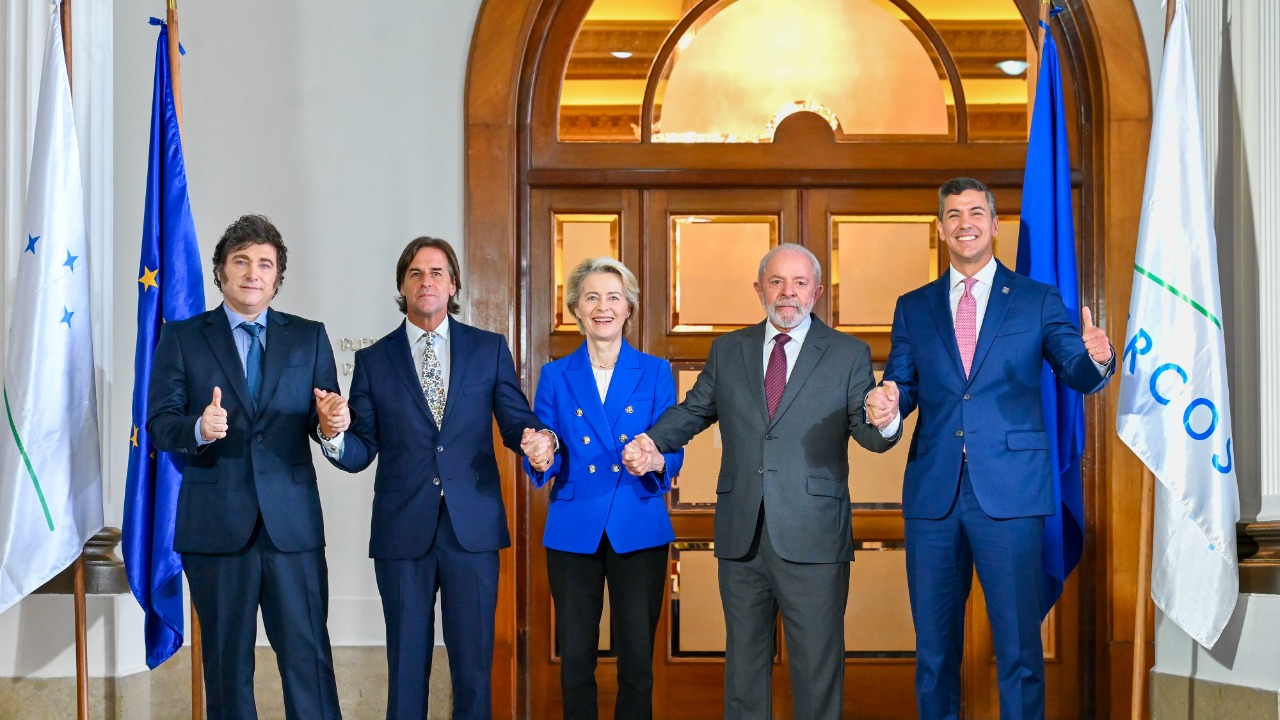
The political symbolism of the pact is as important as the tariff cuts. The signing ceremony in Paraguay’s capital, Asunci, was framed as a major geopolitical victory for the EU in an age of American tariffs and surging Chinese exports, a moment when Brussels could present itself as a predictable partner rather than a protectionist power. European leaders stressed that the agreement expands the bloc’s footprint in South America at a time when Washington and Beijing are contesting influence across the region.
That message has been reinforced in public remarks. After the signing of the Mercosur pact, After the deal, European Commission President Ursula von der Le told reporters that Europe had to “step up” in response to a new US reality, a clear reference to President Donald Trump’s tariff‑heavy approach. The EU trade chief has gone further, arguing that the EU–South America trade pact will help offset the impact of US measures just as the European Union was signing its biggest ever free trade deal in Paraguay with South America’s Merkasur block, underscoring how trade policy has become a tool of strategic hedging against Washington as well as Beijing.
A rules‑heavy pact that rewrites the playbook
Beyond tariffs, the EU–Mercosur framework is dense with rules that will shape how companies operate across the Atlantic. Analysts of What Are the Implications of the EU, Mercosur Free Trade note that Negotiations between the Euro bloc and South America have produced detailed commitments on industrial goods, services, and sensitive products like wines and cheeses, giving European brands legal protection in markets that have often been difficult to penetrate. For the first time, the pact also establishes a structured bilateral framework between the EU and MERCOSUR that covers copyright and related rights, as well as civil, administrative, and border enforcement measures, according to a legal analysis that stresses how For the first time intellectual property enforcement is being hard‑wired into this bilateral relationship.
European officials argue that this rule‑setting power is precisely what the US is forfeiting. The agreement also safeguards the EU’s ability to project standards on issues such as sustainability and labor, with experts noting that the deal is designed to balance ties with China and the United States as Our understanding of global competition shifts. Another assessment stresses that The EU is certainly a tough negotiator and that the Mercosur accord will make some constituencies on both sides unhappy, but it is likely to endure because it anchors The EU and Mercosur in a shared legal framework at a time when China and the United States are competing for influence without comparable region‑spanning deals.
Washington’s retreat and the costs for US influence
From a US perspective, the most striking feature of the EU–Mercosur pact is that it happened without Washington in the room. Commentators have pointed out that The EU–Mercosur agreement underscores a broader reality: the world is moving forward with or without the U.S., and that The EU and Mercosur are now shaping benefits without American input. Another analysis of the same dynamic argues that Countries seeking growth are increasingly turning to Brussels rather than Washington, a trend that the Countries of Latin America have now made tangible by signing with Europe.
European policymakers are candid about the backdrop. One think‑tank commentary describes The Mercosur deal as a much‑needed win for the EU against a backdrop of Trumpian trade wars, noting that Last Friday, EU leaders passed the EU–Mercosur trade deal after 25 years of ne, turning an otherwise bleak start to 2026 into a rare diplomatic success for The Mercosur file. In practice, that means European carmakers, chemical producers, and food exporters will enjoy preferential access that US competitors lack, a structural disadvantage that will be hard to reverse as supply chains and investment decisions adjust to the new rules.
Part of a wider European pivot to trade diplomacy
The Mercosur breakthrough is not an isolated move. The EU is simultaneously racing to lock in other partnerships, including a sweeping trade pact with India. Negotiators say that India has kept dairy out of the deal, but that the pact is expected to be formally signed after legal vetting and will deepen ties with what is already the EU’s ninth largest trading partner. In parallel, reporting from Europe notes that the agreement announced Tuesday reflects a new priority for the 27‑nation EU, the world’s largest trading bl, as leaders respond to Related Articles of widespread sentiment across the bloc that trade is now a core instrument of geopolitical strategy.
Officials have been explicit that this is partly about finding Trump alternatives. Coverage of the EU–India talks describes them as a rebuff to the US president’s tariff‑first approach, with negotiators in New Delhi and Brussels presenting their work as a counterweight to Washington’s unpredictability and Beijing’s state‑driven model, a dynamic captured in the India coverage. The EU’s broader push for new trade partnerships, highlighted again in the agreement announced Tuesday that reflects a new priority for the 27‑nation EU, shows how Brussels is using its market to build a web of alliances while Washington relies on ad hoc tariffs and bilateral pressure, as noted in the Tuesday reporting.
More From TheDailyOverview
*This article was researched with the help of AI, with human editors creating the final content.

Grant Mercer covers market dynamics, business trends, and the economic forces driving growth across industries. His analysis connects macro movements with real-world implications for investors, entrepreneurs, and professionals. Through his work at The Daily Overview, Grant helps readers understand how markets function and where opportunities may emerge.

