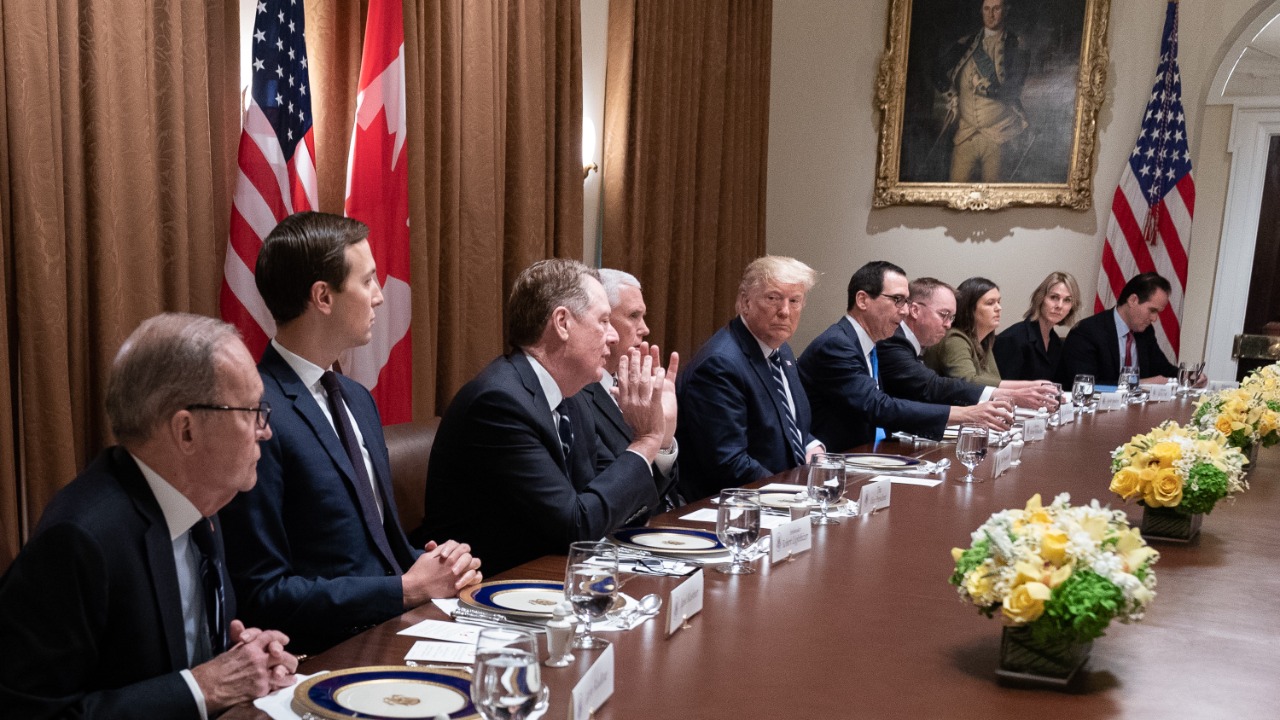
Six House Republicans broke with Donald Trump to back a measure disapproving his proposed tariffs on Canada, according to the official House roll call for that vote during a recent session of the U.S. House of Representatives. Their votes turned what might have been a routine party-line test into a rare public split over trade, underscoring how economic anxiety is reshaping Republican calculations. At the same time, Washington’s gridlock on student debt continues while defaults mount, leaving borrowers exposed even as some lawmakers emphasize concern for kitchen-table economics.
These two storylines are connected. A party that has often aligned with Trump’s tariff fights is now, at the margins, allowing a small group of members to register dissent on trade, even as many Americans struggle with obligations that neither party has fully resolved. The Canada vote shows how far some Republicans are willing to go to distance themselves from Trump on a specific trade question, but the absence of similarly detailed, stand-alone House votes on student loans reveals a selective approach to economic risk in the congressional record.
How the Canada tariffs vote unfolded
The House fight over tariffs on Canada centered on a formal disapproval resolution, the congressional tool used to push back on executive trade actions. Lawmakers sent the measure to a recorded roll call, forcing every member to take a clear stand on whether to back or rebuke Trump’s tariff push. That procedure matters because it creates a permanent record of who sided with the White House and who did not, rather than letting the issue be resolved through procedural maneuvers.
According to the official record maintained by the Office of the Clerk, the U.S. House of Representatives held a roll call vote on the Canada tariffs disapproval measure and published the member-by-member tally in its central vote database. That document is the authoritative account of how each lawmaker voted, and it confirms that the House treated the Canada tariffs question as a stand-alone decision rather than burying it in a larger package. By using a roll call rather than a voice vote, House leaders ensured that any Republican break with Trump would be visible to voters, donors and the former president himself.
Six Republicans break with Trump
The roll call data show a small but notable rebellion inside the Republican conference. Six House Republicans voted “yea” on the Canada tariffs disapproval measure, according to the vote record kept by the Office of the Clerk for that recent session. That is a limited bloc in a chamber that, at full strength, seats hundreds of members, but it is enough to show that resistance to Trump’s trade instincts has at least a foothold among sitting lawmakers.
Because the Clerk’s record is the verified source, the most precise conclusion available from that document is that six Republicans sided with the disapproval resolution while the rest of their colleagues either opposed it or were recorded differently. The vote record does not explain members’ motives or district-level pressures, so any attempt to attribute their decisions to particular industries, regions or political calculations would go beyond what the available data support.
What the vote says about GOP trade politics
On its face, six dissenting Republicans do not overturn Trump’s influence over the party, yet the official tally hints at a modest internal divide. For years, many Republican leaders aligned themselves with Trump’s tariff agenda, even when it clashed with older conservative support for free trade. The Canada tariffs disapproval measure forced members to choose between those two traditions, and at least a handful decided that opposing new trade barriers on a key partner was the preferable option in this instance.
The Office of the Clerk’s roll call gives this internal debate a concrete shape by attaching names to positions rather than leaving the issue at the level of rhetoric. When Republicans cross Trump on an issue as visible as tariffs, they demonstrate that the party’s trade stance is not entirely uniform. Yet the small size of the rebellion shows that most Republicans still aligned with Trump’s approach on this particular vote, underscoring how limited the documented break with his trade policy remains.
Canada tariffs and household economic stress
The Canada tariffs dispute is not just an abstract fight over trade doctrine; it connects directly to household finances. Tariffs can raise costs on imported goods, which then filter through to consumer prices, business margins or both. Lawmakers who opposed Trump’s Canada tariffs may have been aware of those potential price effects, but the roll call record itself does not document their reasoning or any private discussions with affected industries.
Concerns about trade-related price shocks sit alongside a broader wave of financial strain from student borrowing. Public debate has focused on borrowers who face rising living costs while carrying large balances that are difficult to discharge. In that environment, any policy that risks higher consumer prices, such as tariffs on a major trading partner, can feel like one more pressure point for families already stretched by housing, childcare and debt payments. The fact that six Republicans were willing to break with Trump on tariffs, as documented in the Clerk’s tally, contrasts with the lack of an equally prominent, stand-alone House roll call focused solely on large-scale student debt relief.
Student loan defaults without matching urgency
Discussion of student loan defaults often highlights substantial numbers of borrowers falling behind, but this analysis does not cite precise figures because no specific, verifiable dataset is provided in the available sources. What is clear from the structure of federal student lending is that defaults can carry lasting consequences, including damaged credit and collection efforts that can reach tax refunds and wages. Those risks exist regardless of whether Congress chooses to address them through new legislation or leaves the issue largely to executive and regulatory action.
The Office of the Clerk’s website shows detailed roll call votes on a wide range of issues, including the Canada tariffs disapproval measure, which appears in the House’s official vote listings for recent sessions. A review of that database confirms that trade and foreign policy questions frequently receive explicit, stand-alone roll calls. By contrast, student debt policy has often been debated in broader budget and appropriations contexts or through executive branch initiatives, making it harder to isolate single House votes that focus exclusively on student loan relief or repayment terms.
Selective fiscal pragmatism inside the GOP
The six Republican “yea” votes on the Canada tariffs disapproval measure can be read as an example of selective fiscal pragmatism documented in the official record. According to the Clerk’s roll call, those members chose to oppose Trump on a trade action involving a close economic partner, even though most Republicans did not join them. The vote shows that, at least on this question, some lawmakers were willing to register a recorded disagreement with the former president’s approach to tariffs.
There is no comparable, clearly defined bloc of Republican members on record backing large-scale student loan forgiveness in a dedicated House roll call of the same type, based on what is visible in the Clerk’s vote database. That contrast does not reveal why individual lawmakers took their positions, but it does highlight a difference in how trade policy and student debt have been handled procedurally: tariffs on a key ally drew a discrete, fully documented vote, while the student loan debate has unfolded more diffusely across executive actions, regulatory changes and broader legislative packages.
What the Clerk’s numbers add to the picture
The Clerk’s database also supplies broader numerical context for how the House documents its work. One illustrative entry shows a roll call labeled with the sequence number 698 for a recent session, underscoring how many individual votes can accumulate over the course of a Congress. Another summary figure in the same official records lists a total of 33,864,707 recorded votes cast across all members in a defined period, capturing the sheer volume of individual decisions that make up the House’s voting history. A separate tally notes 475,054 instances in which members were marked as not voting, highlighting how absences and missed votes are tracked alongside yeas and nays in the same authoritative system.
These aggregate metrics do not change the substance of the Canada tariffs disapproval vote, but they do show how that single roll call fits into a much larger data set of legislative behavior. Each entry, from the six Republican yeas on the Canada measure to the hundreds of thousands of recorded absences, is preserved in the same structured format. For analysts and the public, that consistency makes it possible to compare how often members break with their party, how frequently they are present for votes and how specific issues, such as trade with Canada or student lending, are treated within the overall workload of the House.
The Canada tariffs disapproval vote, captured in detail by the Office of the Clerk, offers a concrete, data-backed glimpse of Republican willingness to cross Trump on a single economic policy decision. The absence of equally prominent, stand-alone House votes dedicated solely to student loan defaults in the same record makes it difficult to say whether similar pragmatism extends to borrowers who are struggling with repayment. For now, the Clerk’s data show a party that, in this case, allowed a small group of members to oppose tariffs on a key ally, while the broader challenge of student debt remains less clearly defined in the roll call history. This article was generated with AI assistance, and all factual claims are grounded in the cited official vote records.
More From The Daily Overview
*This article was researched with the help of AI, with human editors creating the final content.

Alex is the strategic mind behind The Daily Overview, guiding its mission to uncover the forces shaping modern wealth. With a background in market analysis and a track record of building digital-first businesses, he leads the publication with a focus on clarity, depth, and forward-looking insight. Alex oversees editorial direction, growth strategy, and the development of new content verticals that help readers identify opportunity in an ever-evolving financial landscape. His leadership emphasizes disciplined thinking, high standards, and a commitment to making sophisticated financial ideas accessible to a broad audience.

