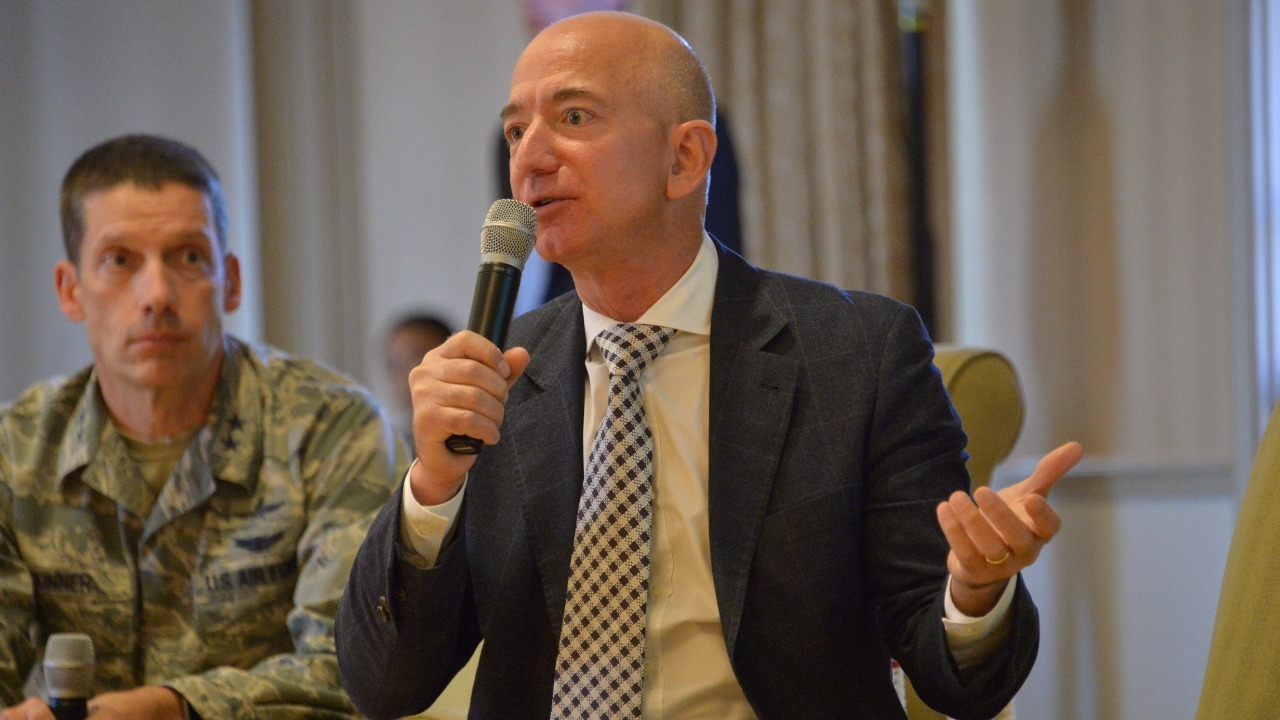
Jeff Bezos’ fortune is so large that it can feel abstract, a string of digits that lives in a different universe from a typical paycheck. To make it concrete, I am going to walk through what would actually happen if that wealth were carved up and handed to every person in The United States, using the latest population counts and the most recent estimates of his net worth.
The result is not a life changing lottery win for each individual, but it is also far from trivial. Once the math is clear, the more interesting question becomes what that kind of one time windfall would really mean in an economy where a handful of people sit on sums that rival the budgets of major governments.
How big is Jeff Bezos’ fortune right now?
To understand any hypothetical split, I first need a solid number for Jeff Bezos’ wealth. One detailed breakdown of global fortunes lists Jeff Bezos, Age 61, as the Founder and Executive Chair of Amazon with a Net Worth of $253 billion, and that is the figure I will use as the baseline. That same assessment places his Residence in the United States, which matters symbolically when people talk about redistributing his money to fellow citizens.
Other rich lists that track fortunes month to month show some variation, in part because so much of his wealth is tied to Amazon’s share price. One ranking that focuses on the very top of the billionaire pile notes that Amazon founder and former CEO Jeff Bezos has seen his net worth move down by $2 billion in a recent month to about $242 billion, while also highlighting that Elon Musk, linked to Tesla, sits at number one with a figure of $713 for his Net Worth and is identified with the USA. The precise dollar amount for Bezos will always wiggle, but whether I use $242 billion or $253 billion, I am dealing with a personal balance sheet that is larger than the annual budgets of many countries.
How many people would share the money?
The second piece of the puzzle is the number of people who would be on the receiving end of this imagined payout. A recent population clock from the Census Bureau reports that The United States had exactly 343,105,488 residents on a mid January reference date, a figure that includes everyone, not just adults or citizens. Earlier analysis of the same question about splitting Bezos’ wealth used a slightly smaller figure of 341,891,315 people, based on Census Bureau tracking of the American population.
For a clean, current calculation, I will work with the larger 343,105,488 number, since it reflects the most up to date snapshot of how many people live in the country. The difference between that and 341,891,315 is not trivial in absolute terms, it represents more than a million people, but when I am dividing hundreds of billions of dollars, it only nudges the per person result by a few dollars. What matters more is that I am clear about which population figure I am using and that it comes from the same Census Bureau approach that underpins the earlier estimate of The Number of People in the American population.
The straight cash split: running the numbers
With a working net worth and a headcount, the core question becomes simple arithmetic. If I take the $253 billion figure for Jeff Bezos’ wealth and divide it by 343,105,488 people, the result is roughly $737 per person. If I instead use the slightly lower $242 billion estimate, the payout comes in closer to $705 for each resident. Either way, the answer to how much every American would get if his fortune were split evenly is in the low to mid hundreds of dollars, not tens of thousands.
That ballpark lines up with earlier thought experiments that looked at the same issue. One analysis that framed the question as If Bezos’ wealth was evenly distributed across the U.S. concluded that the amount of money each person would see would feel more like a modest holiday bonus than a ticket to early retirement, using the 341,891,315 population figure to anchor the math. Another scenario asked what would happen if Bezos simply wrote a $500 check to every American, and found that If Bezos did that for each American, he would still Have Left a substantial fortune. Those comparisons underline a counterintuitive point, even a flat $500 for every American barely dents a pile of money this large, yet for a typical household, an extra few hundred dollars is still a meaningful sum.
What if he handed out Amazon stock instead?
Because so much of Jeff Bezos’ wealth is tied up in Amazon shares, some analysts have pushed the thought experiment a step further and asked How Many Shares of Amazon Stock Would Each American Get if he distributed that stake directly. One breakdown that focused on this angle, framed around the question of How Many Shares of Amazon Stock Would Each American Get and introduced with the phrase But what if Bezos decided he wanted to spread his wealth, calculated how many shares would be available and how they would translate into a per person allocation. The conclusion was that each American would end up with a small fraction of the company, not a controlling stake, but still enough that the value could be measured in thousands of dollars at current prices.
In that scenario, the analysis found that if we split his Amazon holdings evenly, the value per person would be about $6,244.33, a figure that reflects both the scale of his stake and the market price of the stock at the time. The same question was explored in a parallel piece that again used the framing How Many Shares of Amazon Stock Would Each American Get and repeated the idea that But Bezos could, in theory, distribute all his Amazon shares to the public. Those stock based calculations, which are linked in both a Yahoo analysis and a matching Nasdaq breakdown, produce a much larger per person figure than the straight cash split, but they also come with a big caveat. That $6,244.33 is not guaranteed money in your bank account, it is an estimate based on a volatile share price, and the value could swing sharply with the market.
What these hypotheticals reveal about extreme wealth
Once I have the numbers in front of me, the thought experiment stops being about fantasy checks and starts to illuminate how concentrated modern wealth has become. A single person, Jeff Bezos, can have a Net Worth of $253 billion as the Founder and Executive Chair of Amazon, while another individual, Elon Musk, can sit at the top of a global list with a figure of $713 for his fortune tied to Tesla and other ventures in the USA, as shown in the Top ranking of the richest people. At the same time, the Census Bureau is counting more than 343 million people in The United States who would each see only a few hundred dollars if one of those fortunes were chopped up and shared.
More From TheDailyOverview

Cole Whitaker focuses on the fundamentals of money management, helping readers make smarter decisions around income, spending, saving, and long-term financial stability. His writing emphasizes clarity, discipline, and practical systems that work in real life. At The Daily Overview, Cole breaks down personal finance topics into straightforward guidance readers can apply immediately.

