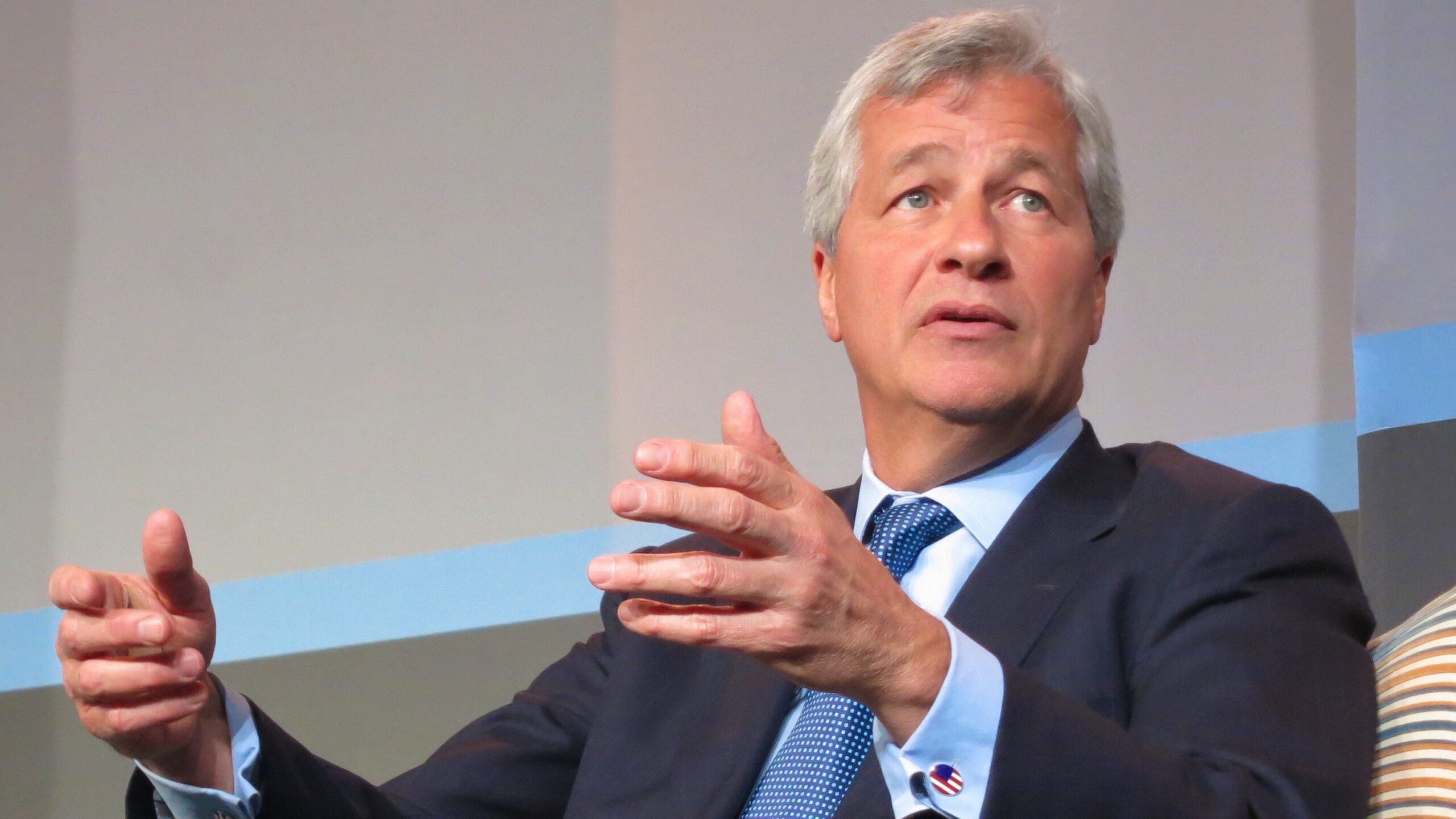
JPMorgan Chase CEO Jamie Dimon has put the odds of a U.S. recession at roughly 50%, warning that the sweeping tariffs launched under the “Liberation Day” trade policy are both inflationary and a drag on growth. With the latest federal inflation data showing prices still climbing and the Federal Reserve flagging tariff-related risks to the economy, investors holding stocks in retirement accounts face a question with real financial consequences: how exposed are their savings if Dimon’s warning proves correct?
What Dimon Said and Why It Stings
Speaking at a Bloomberg event, the head of the largest U.S. bank by assets called tariffs “inflationary” and said they are “slowing down the economy,” according to a Bloomberg transcript of his remarks. Dimon estimated the probability of recession at approximately 50%, deferring to JPMorgan economists for the precise figure but making clear he considers the risk serious. His comments carry weight not because bank CEOs are always right about recessions, but because JPMorgan sits at the center of global capital flows and trade finance, giving Dimon a direct view of how tariff costs ripple through supply chains and corporate balance sheets.
The specific mechanism Dimon described is straightforward: tariffs raise input costs for businesses, those costs get passed to consumers as higher prices, and consumers respond by pulling back spending. That sequence, if it accelerates, can squeeze corporate earnings and drag stock valuations lower. Dimon did not name a target for the S&P 500 or predict a specific crash date, so investors should treat his comments as a risk assessment rather than a market call. Still, a 50% recession estimate from the CEO of America’s biggest bank is not background noise, especially when it aligns with emerging data on prices and policy uncertainty.
The Tariff Structure Behind the Warning
The trade policy Dimon was reacting to took effect in two stages. President Donald J. Trump declared a national emergency to authorize broad trade measures under the International Emergency Economic Powers Act, as detailed in a White House fact sheet that branded the package “Liberation Day.” A baseline 10% tariff on imports from all countries took effect on April 5, 2025. Four days later, on April 9, reciprocal tariffs ranging from 11% to 50% hit 86 countries, according to an official statement from U.S. Customs and Border Protection. Additional duties targeted small packages from China and Hong Kong specifically, tightening the squeeze on consumer goods and e-commerce.
Importers now pay these levies through new codes under HTS Chapter 99, which CBP uses to classify IEEPA-based tariff actions and guide brokers on compliance. The White House documentation includes enumerated exclusions and gives the executive branch authority to modify rates, meaning the tariff map could shift again with little legislative input. That uncertainty is itself a cost: businesses cannot plan capital spending, inventory strategies, or long-term contracts when duties on key inputs might change by executive order. For stock investors, this policy volatility translates into earnings uncertainty, which tends to compress the price multiples that drive equity valuations and can amplify downside when sentiment turns.
Inflation Data Confirms the Pressure
Federal data released days ago backs up the inflationary side of Dimon’s argument. The Bureau of Labor Statistics reported that the Consumer Price Index for All Urban Consumers rose 0.2% month over month in January 2026 and 2.4% on a year-over-year basis. Core CPI, which strips out volatile food and energy prices, climbed 0.3% for the month. That core reading matters because it captures the kind of sticky, goods-driven inflation that tariffs tend to produce, especially when importers pass higher landed costs through to retail shelves. A 0.3% monthly pace, if sustained, would annualize well above the Federal Reserve’s 2% target and leave real wage gains under pressure.
The Federal Open Market Committee, which met January 27 and 28, discussed exactly this risk. Minutes from the meeting show policymakers weighing inflation threats tied to tariffs and other supply-side shocks, and debating how persistent those forces might be. If the Fed concludes that tariff-driven price increases are likely to last rather than fade, it will be less willing to cut interest rates, and higher rates for longer would put additional downward pressure on stock prices by raising discount rates and tightening financial conditions. The combination of rising input costs, squeezed consumer demand, and a cautious central bank is the exact environment Dimon appears to be flagging as dangerous for equities and, by extension, for retirement portfolios built on them.
Who Gets Hurt Most If Stocks Drop
A stock market decline driven by tariff inflation would not hit all households equally. Retirees and near-retirees with heavy equity allocations in 401(k) plans and IRAs face the sharpest immediate risk because they have the least time to recover losses and may already be drawing down assets. Many target-date funds gradually shift toward bonds, but a prolonged equity slump can still reduce the nest egg available for required minimum distributions or planned withdrawals. Younger workers with decades until retirement can ride out volatility, but even they feel the squeeze if inflation erodes the purchasing power of their wages faster than their portfolios grow, forcing them to save more just to maintain the same real retirement target.
The Department of Labor regularly publishes data on wages, benefits, and retirement plan participation, and its labor statistics help frame how households experience inflation and market swings. Yet no federal agency has released a detailed analysis isolating the impact of the “Liberation Day” tariffs on retirement balances specifically, leaving savers to connect the dots between price indices, portfolio returns, and contribution rates. Aggregate CPI figures tell us prices are rising, but they do not break out how much of the increase comes from tariffed goods versus other factors like housing or services inflation. Households that spend a larger share of income on imported consumer goods, from electronics to clothing, face a bigger real-income hit than wealthier households whose spending tilts toward services and domestic assets. In that sense, the tariff regime functions as a regressive cost increase even before it touches stock portfolios, and a market downturn layered on top would widen gaps in retirement security.
What Investors in Retirement Accounts Can Do Now
For savers trying to navigate this environment, Dimon’s 50% recession odds are a signal to reassess risk rather than a cue to abandon stocks. One practical step is to review asset allocation in tax-advantaged accounts and compare it with time horizon and withdrawal plans. Investors within five to ten years of retirement might decide that a tariff-driven inflation shock and potential recession justify trimming equity exposure modestly in favor of high-quality bonds or cash equivalents, while still keeping enough stock exposure to participate in long-term growth. Those with longer horizons can focus on diversification across sectors, recognizing that companies with strong pricing power and domestic supply chains may weather tariff disruptions better than import-dependent manufacturers or retailers.
It is also worth stress-testing retirement plans against more conservative assumptions. Instead of assuming historical average returns, savers can model scenarios with lower equity gains, slightly higher inflation, and a short recession in the next few years to see whether current contribution rates are sufficient. If the projections reveal a gap, increasing savings, delaying retirement by a year or two, or planning for more flexible spending early in retirement can all help rebuild margin for error. Dimon’s warning, combined with the latest inflation and Federal Reserve signals, does not guarantee a downturn, but it does justify treating trade policy as a real financial variable, one that belongs in the same conversation as interest rates, asset allocation, and long-term retirement goals.
More From The Daily Overview
*This article was researched with the help of AI, with human editors creating the final content.

Grant Mercer covers market dynamics, business trends, and the economic forces driving growth across industries. His analysis connects macro movements with real-world implications for investors, entrepreneurs, and professionals. Through his work at The Daily Overview, Grant helps readers understand how markets function and where opportunities may emerge.

