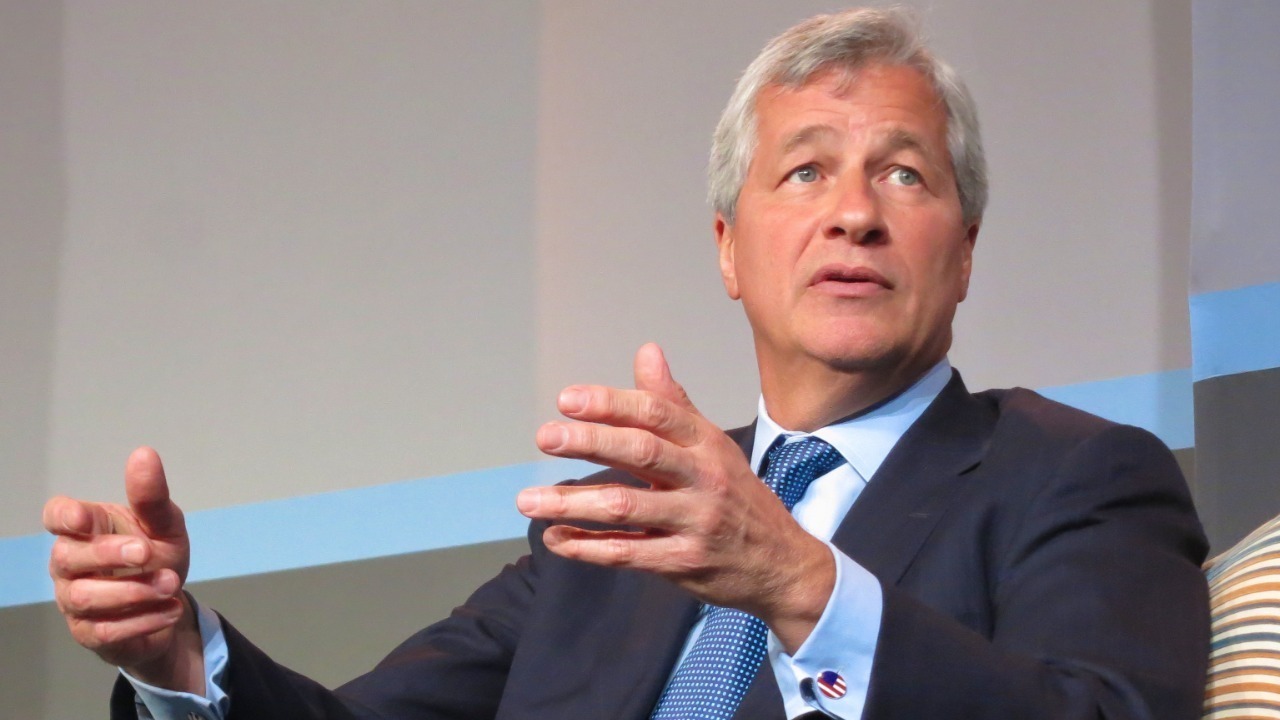
The chief of the largest American bank is again sounding the alarm about Washington’s finances, warning that a $38 trillion national debt is pushing the United States toward a crisis. Chase CEO Jamie Dimon is framing the debt as a looming shock to the economy, not a distant abstraction, and he is pressing political leaders to confront it before markets do it for them.
Dimon’s message is blunt: the current trajectory is “not sustainable,” the math is getting harsher, and the eventual reckoning will be more painful the longer it is delayed. Coming from a veteran of multiple financial crises, his warning is less about predicting the exact timing of a crash and more about insisting that the country is running out of room to ignore the problem.
Dimon’s “tectonic plate” warning on a $38 trillion burden
Chase CEO Jamie Dimon has been unusually vivid in describing the scale of the federal debt problem, likening it to one of two “tectonic plates” under the American economy that could collide in the near future. He has zeroed in on the roughly $38 trillion national debt and argued that the current path of borrowing and interest costs is “not sustainable,” a phrase he has repeated as a kind of baseline diagnosis rather than a headline-grabbing exaggeration, according to Chase CEO Jamie. In his view, the danger is not that the United States suddenly loses access to credit, but that compounding interest and rising obligations gradually squeeze out the capacity to invest in growth.
Dimon has stressed that he does not know exactly when the breaking point arrives, but he is adamant that it exists. He has said that “like most problems” it is better to confront the debt before markets force a reckoning, a point he has been making since at least last September and has reiterated in more recent comments, as reflected in his remarks cited by Like Dimon. The core of his argument is that the arithmetic of a $38 trillion balance sheet, layered with higher interest rates, will only grow more unforgiving if policymakers keep postponing structural fixes.
From “it will bite” to “the cliff”: how his rhetoric has escalated
Over the past two years, Dimon’s language has shifted from cautious concern to explicit warnings of a potential shock. Earlier this year he told investors that the United States’ national debt problem will “bite eventually,” urging both households and the government to examine their spending habits and borrowing assumptions as the cost of money rises, a message captured in his comments on the broader Economy. In that setting, CEO Jamie Dimon framed the issue as a slow burn that could suddenly become acute if investors begin to doubt Washington’s willingness to control its deficits.
His earlier warnings were already stark. In 2024, Chase CEO Jamie Dimon described the United States economy as heading toward “the cliff” and even predicted the possibility of a debt “rebellion” if voters and markets lose patience with rising obligations, according to reporting on the Chase CEO Jamie. That phrase, “the cliff,” is telling: he is not talking about a gentle glide path to stability, but about a point where incremental deterioration gives way to a sudden loss of confidence.
Why Dimon says the debt math no longer works
Dimon’s critique is rooted in what he sees as simple arithmetic rather than ideology. He has argued that once debt reaches the scale of $38 trillion, even modest increases in interest rates translate into enormous annual costs that must be financed with either higher taxes, reduced spending, or more borrowing. He has warned that the “math grows more unforgiving” as compounding interest eats into fiscal space, a concern he has voiced in interviews summarized in the math. In his view, the country is moving from a world where low rates masked the cost of borrowing into one where those costs are front and center.
He has also tied the debt problem to a broader sense that the economy is under strain from multiple directions. Analysts summarizing his recent comments note that the economy is already under duress from rising debt loads and that key numbers behind his concern, such as the ratio of debt to output and the share of federal revenue consumed by interest, are trending the wrong way, as highlighted in a breakdown of the Key Points. For Dimon, the risk is that the United States drifts into a position where servicing past borrowing crowds out the investments needed to sustain future growth.
Debt, geopolitics, and fragile supply chains
Dimon has not isolated the debt issue from the rest of the global landscape. He has repeatedly pointed to rising geopolitical friction as a force that magnifies economic vulnerabilities, especially in supply chains that depend heavily on strategic rivals. In one recent discussion, he lamented that the United States has allowed itself to become dependent on other countries for rare earth minerals and key pharmaceutical ingredients, a concern captured in a social media summary of Dimon. His argument is that a heavily indebted country is less resilient when it must respond to shocks in trade, technology, or security.
That linkage between fiscal capacity and strategic flexibility is central to his warning. If the United States must devote an ever larger share of its budget to interest payments, it has less room to invest in reshoring critical industries, modernizing infrastructure, or strengthening defense. Dimon has suggested that this combination of high debt and fragile supply chains is one of the “tectonic plates” that could collide with another, such as geopolitical conflict or a sudden shift in investor sentiment, a theme echoed in analyses of the American outlook. In that framing, the debt is not just a budget line, it is a constraint on national power.
What Dimon wants Washington and Wall Street to do next
Dimon’s prescriptions are less detailed than his warnings, but he has been clear on a few priorities. He has urged elected officials in both parties to stop treating the debt ceiling as a recurring drama and instead focus on the underlying drivers of deficits, from entitlement promises to tax policy. He has emphasized that “like most problems” it is better to address the imbalance now than to wait until markets impose harsher discipline, a point he has made in multiple forums and that is reflected in his comments quoted in CEO. For Wall Street, his message is to stop assuming that the federal government can borrow indefinitely without consequence and to start pricing in the risk that interest costs and political gridlock will eventually collide.
He has also called on households and businesses to rethink their own leverage in an environment where the federal government is already so indebted. In his view, the combination of high public debt and aggressive private borrowing leaves the system more exposed if growth slows or rates rise further, a theme he returned to when he warned that the national debt will “bite eventually” and urged Americans to examine their spending habits, as captured in coverage of the Jamie Dimon. The underlying message is that while Washington’s choices are central, the broader culture of debt also needs to shift.
Dimon’s consistency on this topic is striking. From his early talk of a looming “rebellion” over debt to his more recent description of the national balance sheet as a tectonic risk, he has been pressing the same basic case: the United States is running out of time to treat its $38 trillion obligation as a background issue. His repeated insistence that he does not know exactly when the crisis hits, but is certain that the current path is “not sustainable,” has been documented in multiple summaries of Like his remarks and in analyses of Like Dimon. For a country that has grown used to cheap borrowing and political stalemate, his warning is a reminder that even the deepest capital markets have limits.
More From The Daily Overview
*This article was researched with the help of AI, with human editors creating the final content.

Grant Mercer covers market dynamics, business trends, and the economic forces driving growth across industries. His analysis connects macro movements with real-world implications for investors, entrepreneurs, and professionals. Through his work at The Daily Overview, Grant helps readers understand how markets function and where opportunities may emerge.

