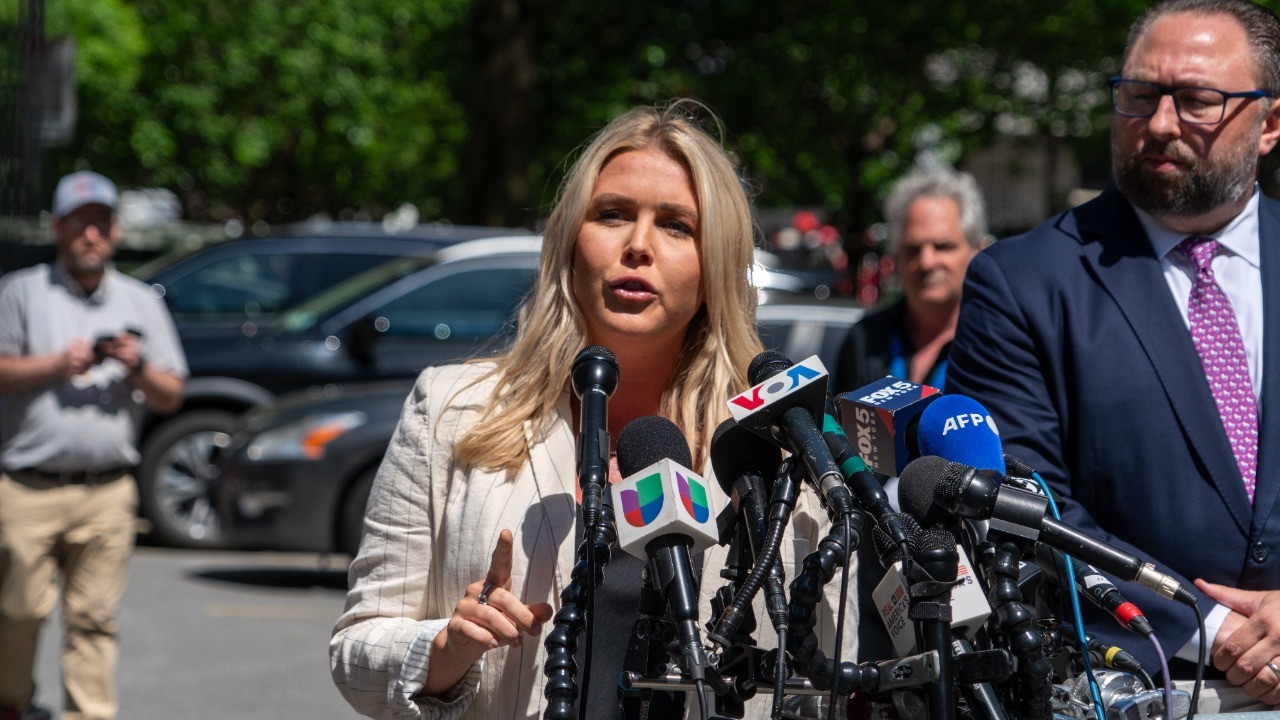
Karoline Leavitt’s rise from New Hampshire congressional hopeful to White House press secretary has unfolded under a cloud of unresolved campaign debt. Her failed House run did not just end with a loss at the ballot box, it left a six-figure tab that still hangs over her political brand and raises persistent questions about how she handled donor money.
That old campaign, Karoline for Congress, remains deeply in the red, with filings and subsequent reporting showing obligations of more than $300,000 that have yet to be repaid. The unpaid bills, undisclosed debts, and illegal contributions that should have been refunded now sit uneasily beside her role as the public face of the White House.
The size of the debt and what the filings show
The starting point for understanding the controversy is the sheer scale of what Karoline for Congress still owes. Federal filings and follow up reporting describe a committee that is more than $300,000 in the hole, with some accounts pegging the outstanding obligations at over $325K and one disclosure listing $326,370 in unpaid debts that had not been properly reported for years. In January 2025, In January, Leavitt acknowledged in amended reports that her committee had failed to list $326,370 in obligations, a figure that underscored how far the campaign’s finances had drifted from basic transparency requirements.
Those numbers are not abstract. They sit in black and white on reports submitted to the FEC, and they are echoed in summaries that describe how Karoline Leavitt’s 2022 congressional campaign still owes over $325K in debts with no cash on hand to pay them. One brief notes that Karoline Leavitt’s 2022 congressional campaign still owes over $325K in debts, per FEC filing, while another recounts that Karoline Leavitt’s 2022 Congressional Campaign Is Still More than $300K in Debt After Spending Illegal Donations, reinforcing that the liability is not a rounding error but a structural problem that has persisted long after Election Day.
How illegal and excessive donations turned into a liability
Behind the top-line figures is a more complicated story about how the debt ballooned. Reporting on the amended filings describes hundreds of thousands of dollars in contributions that violated federal limits, money that should have been returned to donors but instead was spent by the campaign. Roughly two-thirds of the new debt is tied to mandated refunds to donors who gave more than the legal cap, which means the committee now owes money back to people whose generosity it already used to pay for the race.
Federal rules in 2022 limited individual contributions to $2,900 for both the primary and general elections, or $5,800 per ele, a combined $5,800 per cycle, according to the FEC limits described in contemporaneous coverage. Yet later reviews of Karoline for Congress found that donors had been allowed to exceed those thresholds, creating a pool of illegal contributions that regulators say should have been refunded. As one account put it, As illegal contributions, the funds should have been returned, but the outlet reported that she and her campaign already spent the money, leaving the committee with a legal obligation it could not easily meet.
A campaign that stopped raising money but kept the bills
What makes the situation more striking is that Karoline for Congress effectively stopped functioning as a fundraising vehicle while the debts remained. Reports on the committee’s activity note that Karoline for Congress did not raise a penny in late 2025 to refund donors who made excessive contributions, even as the refund obligations piled up. Instead of using her growing national profile to chip away at the balance, the committee appears to have gone dormant on the revenue side while creditors and donors waited.
That inertia has left vendors and supporters in limbo. One detailed account of the committee’s finances describes how Karoline Leavitt’s 2022 campaign committee still owes hundreds of thousands of dollars, with Rob Phillips of AxCapital, who serves as the committee’s treasurer, declining to respond to questions about the path forward. Another report notes that Robert Phillips, the Karoline for Congress committee treasurer, did not respond to NOTUS’ request for comment, reinforcing the sense that the people formally responsible for the books have offered little public explanation for why the debts remain unpaid.
The ethics questions shadowing a White House role
The unresolved debt would be notable for any former candidate, but it is especially sensitive now that Karoline Leavitt serves as White House press secretary. Ethics experts have warned that large, lingering campaign obligations can create the appearance of leverage over a public official, particularly when the money is owed to donors or vendors who might have business before the administration. Ethics experts that I have seen quoted say it sort of raises a few different ethical questions, including whether people who are owed money might expect favorable treatment or access in return for patience.
Those concerns are sharpened by the nature of the debt itself. Roughly two-thirds of the new debt derives from mandated refunds to donors who gave more than the campaign contribution limit, according to one detailed breakdown of the filings. Another analysis of the situation frames it as Trump WH Press Secretary took hundreds of thousands of dollars in contributions that exceeded legal caps, with Per the reporting, the matter is still ongoing and could result in further regulatory scrutiny. When the person at the lectern is explaining the administration’s position on ethics and the rule of law, the fact that her own committee is still untangling violations of campaign finance rules is not a small footnote.
What the numbers say about repayment prospects
Even if Karoline Leavitt wanted to wipe the slate clean quickly, the math is daunting. In recent years, the White House press secretary has been paid approximately $180,000 in salary, a figure that gives some sense of her personal earning power in the role. For Leavitt to settle the debt out of her own pocket would require devoting a significant share of that income to old campaign bills, something that is not required by law and that few political professionals actually do.
Instead, most campaigns in this position try to raise new money to pay off old obligations, but Karoline for Congress has not shown signs of that kind of aggressive cleanup effort. One summary of the filings notes that Karoline Leavitt’s 2022 congressional campaign still owes over $325K in debts, per FEC filing, and that the committee has no cash on hand, a combination that suggests little immediate capacity to pay. Another account of the same filings emphasizes that Karoline Leavitt’s 2022 Congressional Campaign Is Still More than $300K in Debt After Spending Illegal Donations, underscoring that the hole was dug with money that should never have been available to spend in the first place.
How regulators and watchdogs are framing the case
So far, the situation has played out largely on paper, in the form of amended reports and public scrutiny, rather than in high profile enforcement actions. The FEC relies heavily on self reporting and complaints to trigger deeper investigations, and in this case the most visible step has been Leavitt’s own decision to file 17 amended reports acknowledging the $326,370 in previously undisclosed debt. In January, Leavitt’s amended filings effectively conceded that the original reports had not complied with disclosure rules, a move that may mitigate penalties but also cements the record of violations.
Outside watchdogs have filled some of the vacuum by parsing the numbers and highlighting the stakes. One detailed review of the committee’s finances notes that Karoline Leavitt’s 2022 campaign committee still owes $323,000 and that Rob Phillips of AxCapital, who serves as the committee’s treasurer, did not respond to requests for comment, while a separate analysis of the same filings points out that it is technically not illegal under federal law for a campaign to carry debt indefinitely, even if it has no cash on hand. Another narrative of the saga, framed around Trump’s White House press secretary revealing her failed fundraising practices, stresses that For Leavitt to settle the debt, she would either need to raise new money or find another way to satisfy creditors, neither of which has happened yet.
What it means for donors, vendors, and Leavitt’s future
For the people and companies on the other side of the ledger, the unpaid balances are more than a political story. One vendor, Riccio Enterprises, is owed $1,300 according to a breakdown of the committee’s obligations, a relatively small amount that nonetheless illustrates how local businesses can end up carrying the cost of a failed race. Donors who exceeded the $2,900 and $5,800 limits are in a different position, technically entitled to refunds that the campaign has not yet provided, even as they watch Karoline Leavitt’s national profile grow from the White House podium.
Politically, the unresolved debt is likely to follow her into any future run for office. Voters and opponents now have a paper trail showing that Karoline Leavitt’s Failed Campaign Owes More Than $300K, that Karoline Leavitt’s 2022 congressional campaign still owes over $325K in debts, and that In January, Leavitt had to acknowledge $326,370 in unpaid obligations that had been off the books. Ethics observers have already begun to frame the situation as a test of how seriously the administration takes its own standards, with Ethics experts warning that leaving donors and vendors unpaid while stepping into one of the most visible jobs in Washington is exactly the kind of mixed signal that erodes public trust.
More From TheDailyOverview
This article was researched with the help of AI, with editors refining and creating the final content.

Grant Mercer covers market dynamics, business trends, and the economic forces driving growth across industries. His analysis connects macro movements with real-world implications for investors, entrepreneurs, and professionals. Through his work at The Daily Overview, Grant helps readers understand how markets function and where opportunities may emerge.

