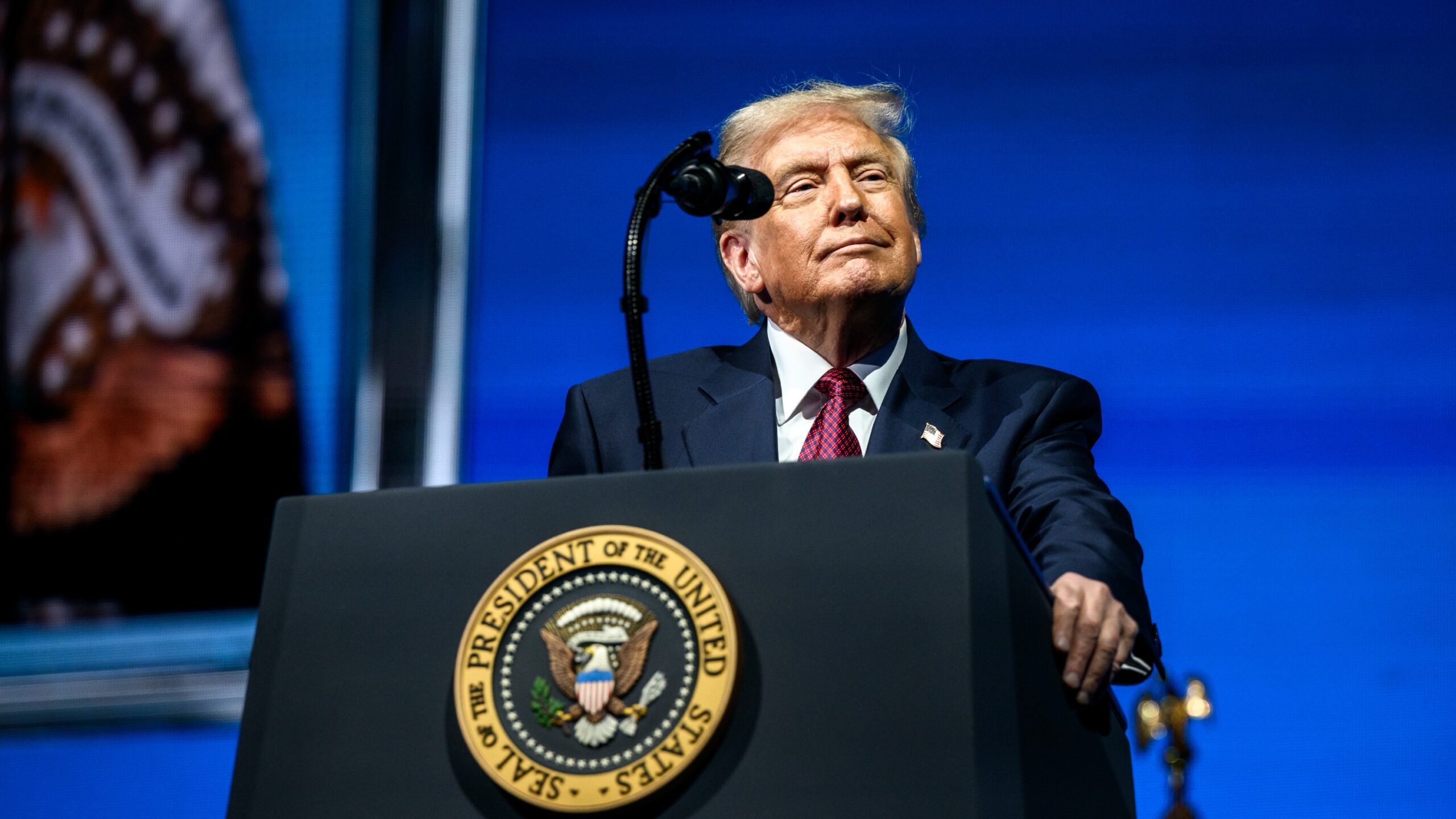
Maria Bartiromo’s pointed question to President Donald Trump about the federal government’s stake in Intel captured a deeper anxiety on the American right: when Washington buys into flagship companies, does it quietly rewrite the rules of capitalism. Her challenge, asking whether this is really free market capitalism, crystallized a debate that has been building since the administration began using equity stakes as a tool of industrial and national security policy.
At the center is Intel Corp, where the United States has taken a significant ownership position while Trump boasts that taxpayers have already made “tens of billions” on the bet. The clash between Bartiromo and the president is not just about one chipmaker, it is about whether a conservative White House can justify partial state ownership of private firms without abandoning the market principles it claims to defend.
The Davos exchange that put Intel in the hot seat
The confrontation unfolded as Maria Bartiromo, a high-profile business anchor, sat down with Trump during the World Economic Forum in Davos, Switzerland, on a Wednesday earlier this month. At 58, she has spent decades covering markets, which made her blunt question about the United States Taking a Stake in Intel and Other Companies all the more striking. In the interview, she pressed the president on how his strategy of government equity in major corporations squared with his long standing promises to champion free enterprise, asking in effect, “How is that free market capitalism,” and forcing him to defend a policy that unsettles many traditional conservatives who watch her program.
According to accounts of the exchange, Bartiromo did not simply tee up a friendly prompt, she openly challenged President Donald Trump on whether Washington should be deciding how companies use their profits and whether taxpayers should be partial owners of firms that are supposed to answer to private shareholders. Coverage of the Davos conversation notes that During the session at the World Economic Forum in Davos, Switzerland, on Wednesday, she pushed Trump to explain why the federal government should be in the business of picking winners, including Intel and a stake in MP Mountain Pass, rather than letting markets allocate capital on their own terms. Her framing turned what might have been a technical policy discussion into a broader ideological test.
Trump’s national security capitalism
Trump’s answer leaned heavily on national security, recasting the Intel stake as a matter of military readiness rather than a departure from market orthodoxy. He argued that when the United States needs advanced weapons, including tomahawks or any kind of a patriot system, he wants them within 24 hours, not at the mercy of fragile supply chains or foreign suppliers. In his telling, partial ownership of key manufacturers is a way to guarantee that when the country needs critical hardware, it can get it quick, with domestic production capacity on call and aligned with government priorities.
In the same exchange, Trump insisted that this approach is compatible with free enterprise, describing it as “a very free market” even as he defended direct federal stakes in strategic firms. Reports on the interview quote him saying that When the United States needs tomahawks or other systems, he wants them fast, and that And they’d be doing it in America because We have the strongest military, tying the Intel position to a broader push for domestic production of sensitive technologies. In that framing, equity stakes are not about central planning, they are about ensuring that the industrial base can support the armed forces on demand.
Inside the Intel deal and the Secure Enclave push
The Intel arrangement did not appear out of thin air, it is part of a structured effort to rebuild domestic chip capacity after years of offshoring. Earlier reporting shows that the U.S. Government agreed to Acquire a Stake in Intel as part of a package that combined grants under the CHIPS Act with a new Secure Enclave program aimed at protecting sensitive semiconductor supply chains. One account notes that the government’s initial position was set at 9.9%, a level that gives Washington a meaningful voice without outright control, and that the deal was framed as a way to anchor advanced fabrication facilities on American soil.
Trump himself has highlighted that Intel agreed to give the federal government a 10 percent stake in the struggling company in exchange for support, a figure that surfaced when Trump announced Friday that Intel had accepted the terms. Advisers have described chips as a “strategic necessity,” arguing that the United States must be self sufficient in the production of advanced semiconductors used in everything from smartphones to missile guidance. In that context, the Secure Enclave initiative, detailed in reporting by Jane Edwards, is designed to channel CHIPS Act grants and equity into a cluster of secure facilities that can serve both civilian and defense needs without relying on potentially vulnerable foreign fabs.
From Intel to a broader portfolio of state stakes
Intel is the highest profile example, but it is not the only company in which the Trump administration has taken a direct financial interest. Less than a year into his term, Trump had already led the federal government to take ownership stakes in five publicly traded companies, including Intel and firms tied to heavy industry and critical minerals. Reporting on this pattern notes that Less than a year into his term, Trump moved to use equity as leverage in sectors he views as strategically important, from semiconductors to steel and rare earths, signaling a willingness to blur the line between regulator and shareholder.
That strategy has extended to other deals, such as a stake in MP Mountain Pass, a key rare earths producer, which was cited alongside Intel and Other Companies when Bartiromo pressed him on whether Washington was now in the business of running corporate America. Supporters inside the administration argue that these positions give the government a direct channel to influence investment decisions in sectors where private capital might otherwise underinvest because of long payback periods or geopolitical risk. Critics counter that once the state is on the cap table, it becomes harder to claim that prices and capital flows are set by market forces alone.
Trump’s boast: “tens of billions” and the free market test
Trump has tried to defuse ideological criticism by pointing to the bottom line, telling audiences that the federal Intel stake has already paid off handsomely. In a recent appearance, he said that Trump Says Federal Intel Stake Has Made “Tens Of Billions” and that the Stock Climbs as investors respond to the government’s backing. By his account, the Treasury has booked enormous paper gains on its Intel Corp position, which he presents as proof that the government can both protect national security and make money for taxpayers at the same time.
Yet the president’s boast does not fully answer Bartiromo’s underlying question about the nature of the system he is shaping. Even if the Intel investment is profitable, it still represents a shift toward a model in which the state takes equity in private firms to achieve policy goals, a move that some analysts compare to earlier episodes of industrial policy. One detailed assessment of The Intel investment notes that it has two primary aims, to strengthen the American economy and to secure critical technology, and argues that such interventions can be justified if they are transparent, time limited, and focused on correcting clear market failures. The same analysis warns that if Washington normalizes equity stakes across sectors, it risks politicizing capital allocation and undermining the very free market signals that have long guided U.S. growth.
More From TheDailyOverview
*This article was researched with the help of AI, with human editors creating the final content.

Grant Mercer covers market dynamics, business trends, and the economic forces driving growth across industries. His analysis connects macro movements with real-world implications for investors, entrepreneurs, and professionals. Through his work at The Daily Overview, Grant helps readers understand how markets function and where opportunities may emerge.

