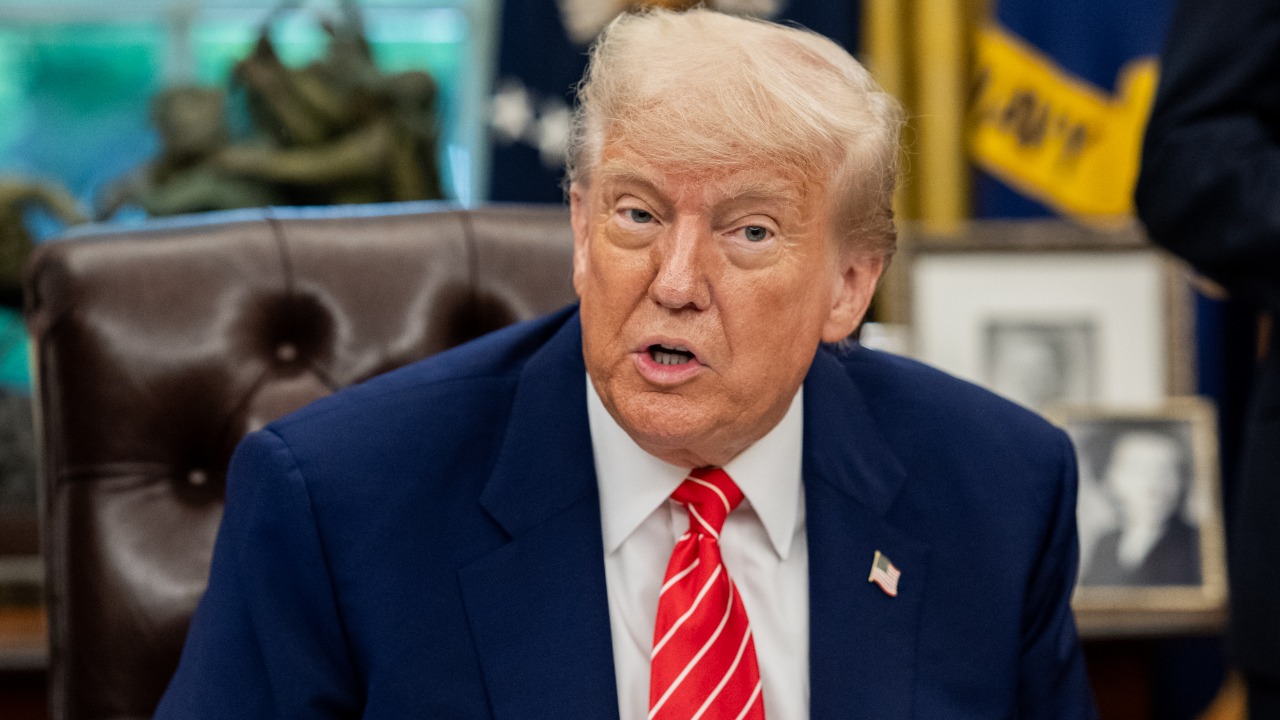
Global markets are reeling after President Donald Trump reignited trade war fears with a fresh barrage of tariff threats tied to a dispute over Greenland. A sell-off that began in New York quickly rippled through Europe and Asia, wiping out recent gains and reviving memories of the most volatile stretches of the last trade conflict. Investors are now trying to decide whether this is the start of a deeper rupture or a sharp but short-lived shock.
At the center of the storm is a geopolitical flashpoint that had largely faded from view. Trump’s decision to link new tariffs on European goods to tensions over Greenland has jolted traders who thought the era of tariff brinkmanship was behind them. Instead, markets are suddenly repricing everything from tech earnings to currency risk as the White House signals it is prepared to weaponize trade policy again.
Wall Street’s worst day since October
The immediate market reaction was brutal. U.S. stocks tumbled, with the Dow industrials dropping 871 points and the Nasdaq composite sliding 561.07 points, a fall of 2.4 percent to 22,954.32, as traders dumped growth names and crowded into havens. Technology stocks were the heaviest weights on the market, with chipmakers such as Nvidia at the center of the rout as investors reassessed how exposed their supply chains are to a renewed tariff fight, according to data on The Nasdaq.
By the close, the damage stretched across major benchmarks. The broader tech-heavy index tracked as NASDAQ COMP was marked at 22,954.32, down 2.39 percent, while the DOW DJI fell to 48,488.59, a loss of 1.76 percent, underscoring how selling pressure spread beyond a single sector. Even alternative assets were not spared, with Bitcoin BTC sliding to 88,916.05, a drop of 4.14 percent, highlighting how the shock from Trump’s tariff rhetoric over Greenland has bled into risk assets that often trade independently of equities, according to figures compiled on NASDAQ.
Tariff threats over Greenland rattle global investors
What turned a routine pullback into a rout was the way Trump escalated his language around tariffs linked to European resistance over Greenland. Earlier this week, U.S. stocks fell sharply, led by the tech sector, after President Donald Trump intensified his threats to slap new levies on European goods in response to the dispute, a shift that traders read as a direct challenge to the fragile truce that had calmed trade tensions. Market gauges that track economically sensitive shares, including a widely watched cyclical index, sank as investors digested the prospect of a broader U.S.–EU trade war, according to Key Takeaways.
The shockwaves did not stop at the U.S. border. Stocks slumped on Wall Street and markets in Asia fell as traders tried to price in the risk that the White House could follow through on tariffs that would hit everything from industrial exports to luxury goods. Reporting By DAMIAN J. TROISE described how the sell-off gathered pace through the trading day, with investors fretting that higher import costs would collide with already sticky inflation and slow growth, a combination that has historically been toxic for valuations, as captured in an account labeled By DAMIAN.
From the trading floor to Davos: how the shock spread
The selling was visible in real time on the floor of the New York Stock Exchange, where traders watched screens flash red as the Dow slid 870 points and the S&P 500 dropped about 2 percent for its worst day since October. Live coverage by Sean Conlon, Chloe Taylor and Pia Singh detailed how the mood shifted from cautious to outright defensive as Trump’s tariff comments hit the tape, with volatility gauges spiking and safe-haven demand pushing Treasury yields lower, a sequence that underscored how quickly sentiment can flip when policy risk returns, according to updates that followed Sean Conlon.
Even as traders reacted on the floor, attention was already turning to the next stage of the confrontation. Trump is set to hold talks in Davos after floating a 200 percent tariff threat on champagne and other European exports, a move explicitly tied to the Greenland dispute that has infuriated European leaders. Futures markets reflected the anxiety, with Nasdaq 100 contracts falling as much as 2 percent at one point, signaling that investors expect the pressure on high-growth names to persist if the rhetoric hardens into policy, according to a live tariff tracker that noted how Trump is preparing for Davos Greenland talks.
Strategists see pain, but not panic
Despite the scale of the sell-off, some on Wall Street argue that the damage is likely to be contained. One prominent strategist said the S&P 500 is unlikely to pull back more than 5 percent even as concerns about a U.S.–EU trade war resurface, suggesting that earnings momentum and still-solid consumer demand could cushion the blow. Markets were rattled on Tuesday as the Greenland tensions battered stocks, but the same analysis noted that prior tariff scares often produced buying opportunities once the initial shock faded, a view that has left at least one veteran of Wall Street inclined to add risk rather than cut it.
Others are more cautious but still see limits to the fallout. A daily briefing for professional investors noted that some are fleeing U.S. assets as Trump doubles down on Greenland, but it also highlighted PRO level analysis that Doubts the sell-off will last, pointing to the lack of concrete tariff implementation and the possibility of a negotiated outcome. Analysts argued that while Trump’s weaponization of tariffs has clearly unsettled markets, the underlying economic backdrop has not deteriorated enough to justify a prolonged bear phase, a tension captured in commentary that tracked how Wall Street is parsing the Greenland shock.
What the Greenland shock means for currencies and data
The equity slump has been mirrored in currencies, where the dollar has come under pressure as traders reassess the U.S. risk premium. Stock markets and the dollar plunged as Trump ramped up tensions over Greenland, with Wall Street logging its worst day since October as the president doubled down on his threats. The combination of falling share prices and a weaker greenback suggests investors are starting to question whether the U.S. can continue to attract capital at the same pace if trade policy becomes a recurring source of instability, a concern that has surfaced in coverage of how Stock markets and the dollar reacted.
Behind the scenes, the sell-off is also a reminder of how dependent modern markets are on real-time data. Platforms that aggregate prices for stocks, mutual funds, indexes, currencies and cryptocurrencies have been flooded with traffic as investors track every tick in benchmarks and havens. Services such as Google Finance, which provide a simple way to search for financial security data while flagging that figures may be delayed or subject to terms of use, have become essential tools for both professionals and retail traders trying to navigate the Greenland shock, a role spelled out in the Google Finance disclaimer that underpins much of the market’s information flow.
More From The Daily Overview

Grant Mercer covers market dynamics, business trends, and the economic forces driving growth across industries. His analysis connects macro movements with real-world implications for investors, entrepreneurs, and professionals. Through his work at The Daily Overview, Grant helps readers understand how markets function and where opportunities may emerge.

