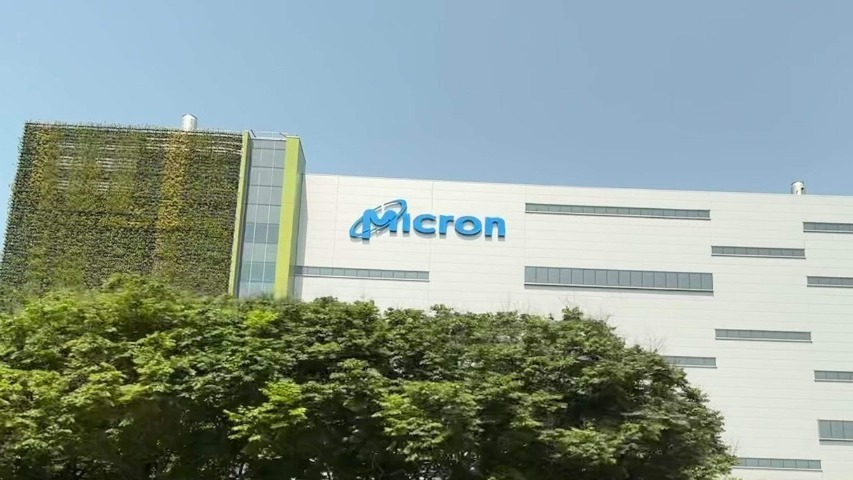
Micron’s decision to buy a major Taiwan chip plant for $1.8 billion has landed like a thunderclap in a market already stretched by artificial intelligence euphoria and supply fears. The deal promises a rapid jump in memory output just as demand is running ahead of capacity, but it is also forcing investors to confront how much risk they are willing to stomach after a spectacular run in Micron’s stock. I see the move as a calculated bet that the AI boom will last long enough to justify a fresh wave of spending, even if it rattles Wall Street in the short term.
The $1.8 billion bet that rewires Micron’s map
At the heart of the market’s anxiety is the sheer scale and speed of Micron’s latest expansion. The company has agreed to acquire Powerchip’s P5 manufacturing site in Taiwan for $1.8 billion, a move that will significantly increase its DRAM output by 2027 and deepen its presence in one of the world’s most strategically sensitive chipmaking hubs, according to Micron. The acquisition of the P5 site from Powerchip has already jolted local markets, with Powerchip shares jumping as investors priced in the value of handing over a prime asset to a global memory heavyweight.
Micron is not simply buying a building, it is buying time. The company’s own description of the transaction underscores that the P5 facility will help it address demand that is currently exceeding supply, particularly in DRAM used for AI and data center workloads, a point it has emphasized in outlining how the deal will expand its manufacturing footprint in Taiwan and. For a company that has already warned that AI-driven memory shortages are “unprecedented,” the logic is straightforward: lock in capacity now, or risk ceding share to rivals later.
Cleanrooms, Clay and the global buildout
The Taiwan purchase is only one piece of a much larger construction spree that is reshaping Micron’s global footprint. The company has said the $1.8 billion acquisition will add 300,000 square feet of cleanroom space, a massive expansion that is explicitly aimed at boosting DRAM production capacity to meet rising demand from AI and data centers, according to its own description of the DRAM buildout. That scale matters, because cleanroom square footage is the hard constraint that determines how many wafers a memory maker can push through its lines, and therefore how much revenue it can capture when pricing is strong.
At the same time, Micron is pouring money into the United States, where its massive complex in Central New York has now broken ground. The project has been described as a historic investment by Micron and the federal Administration that cements Central New York as a global center for advanced manufacturing, a political and industrial milestone that underscores how deeply the company is tying its future to both U.S. and Asian supply chains, according to officials who have hailed the Central New York project. The combination of a new Taiwanese fab and a flagship U.S. campus shows Micron trying to hedge geopolitical risk while still tapping the deep talent and supplier base that exists in Asia.
AI shortages, “quick fixes” and the wafer squeeze
Behind the construction frenzy is a simple problem: there are not enough high-end memory chips to feed the AI boom. Micron has described the AI-driven memory chip shortage as “unprecedented” and has warned that the imbalance between supply and demand is likely to last beyond 2026, a view it has tied directly to the relentless demand from AI workloads that is accelerating its manufacturing expansion across the U.S. and Asia. That backdrop helps explain why the company is willing to write such a large check for existing capacity instead of waiting for greenfield projects to come online.
Some market watchers see the Powerchip deal as a tactical maneuver to plug a near-term hole. In investor discussions, the price tag of $1.8 billion has been described as highly efficient when Compared to the $100 billion committed to the New York complex, with the argument that buying a nearly ready fab is a “quick fix” to the wafer shortage that lets Micron ramp output faster and grab share from rivals like SK Hynix and other Hynix and peers focused on AI memory, according to detailed breakdowns of the $100 billion contrast. Another analysis of the same transaction frames it as The Fix that allows Micron to address the wafer bottleneck quickly and gain market share against Hynix and other competitors in AI memory, highlighting how investors view the P5 site as a bridge between today’s shortage and the longer term capacity that is still under construction, according to commentary that labels the deal The Fix.
That sense of urgency is reinforced by other investor notes that again stress the price tag of $1.8 billion as highly efficient Compared to the $100 billion Micron has committed to New York, arguing that acquiring a nearly operational Taiwanese fab is a cheaper and faster way to add capacity to meet AI demand than waiting for new U.S. facilities to ramp, according to further analysis of the New York comparison. In other words, Micron is trying to thread the needle between long term industrial policy projects and the immediate commercial reality that AI customers want bits today, not five years from now.
Wall Street’s whiplash: from 239.1% gains to surging shorts
All of this is happening against a backdrop of extraordinary stock market performance that has left Micron’s valuation exposed to any hint of bad news. Over the past year, Micron NASDAQ shares have surged 239.1%, a run of explosive gains that far outpaced the broader market and reflected investors’ conviction that the company would be one of the biggest winners from the AI memory cycle, according to data that tracks how Micron has outperformed. That kind of rally inevitably invites skepticism, and the Powerchip deal has become a focal point for investors trying to decide whether the stock has run too far too fast.
One sign of the growing tension is the sharp increase in bearish bets. Market data shows that short interest in Micron Technology has grown significantly, with analysts explicitly flagging the agreement to acquire a large Taiwanese chip fab from PSMC as one of the key news stories driving sentiment, according to a breakdown that highlights how Here the PSMC purchase is feeding into short sellers’ narratives. The same analysis notes that Micron Technology is now a magnet for both bullish and bearish speculation, with the Taiwanese PSMC transaction at the center of that tug of war.
Insiders, analysts and the split-screen on risk
Even as short interest climbs, some of the people closest to the company are signaling confidence with their own money. Filings show that a Micron Technology NASDAQ director recently executed Director Purchases of $3,911,752.00 in Stock, a sizable buy that has been cited as evidence of Positive Sentiment among insiders and has coincided with Major sell side support, including a rating boost from Citi that underscores how parts of Wall Street still see upside in the shares, according to a summary of the Director Purchases. That kind of insider buying does not guarantee future returns, but it complicates the narrative that management is blindly chasing capacity without regard for shareholder value.
Analysts who focus on the company’s fundamentals also point back to the structural forces driving Micron’s strategy. The same data that shows short interest rising emphasizes that Micron Technology is being reshaped by its decision to acquire a large Taiwanese fab from PSMC, with the deal framed as a pivotal moment in the company’s effort to secure enough wafers to serve AI customers, according to a closer look at how Micron Technology is being traded. On the operational side, Micron itself continues to stress that the AI-driven memory shortage is forcing it to accelerate its manufacturing expansion across the U.S. and Asia, a message it has repeated in outlining how On Saturda it expects demand to outpace supply for its DRAM in the U.S., according to its own comments on the On Saturda outlook.
More From TheDailyOverview

Elias Broderick specializes in residential and commercial real estate, with a focus on market cycles, property fundamentals, and investment strategy. His writing translates complex housing and development trends into clear insights for both new and experienced investors. At The Daily Overview, Elias explores how real estate fits into long-term wealth planning.