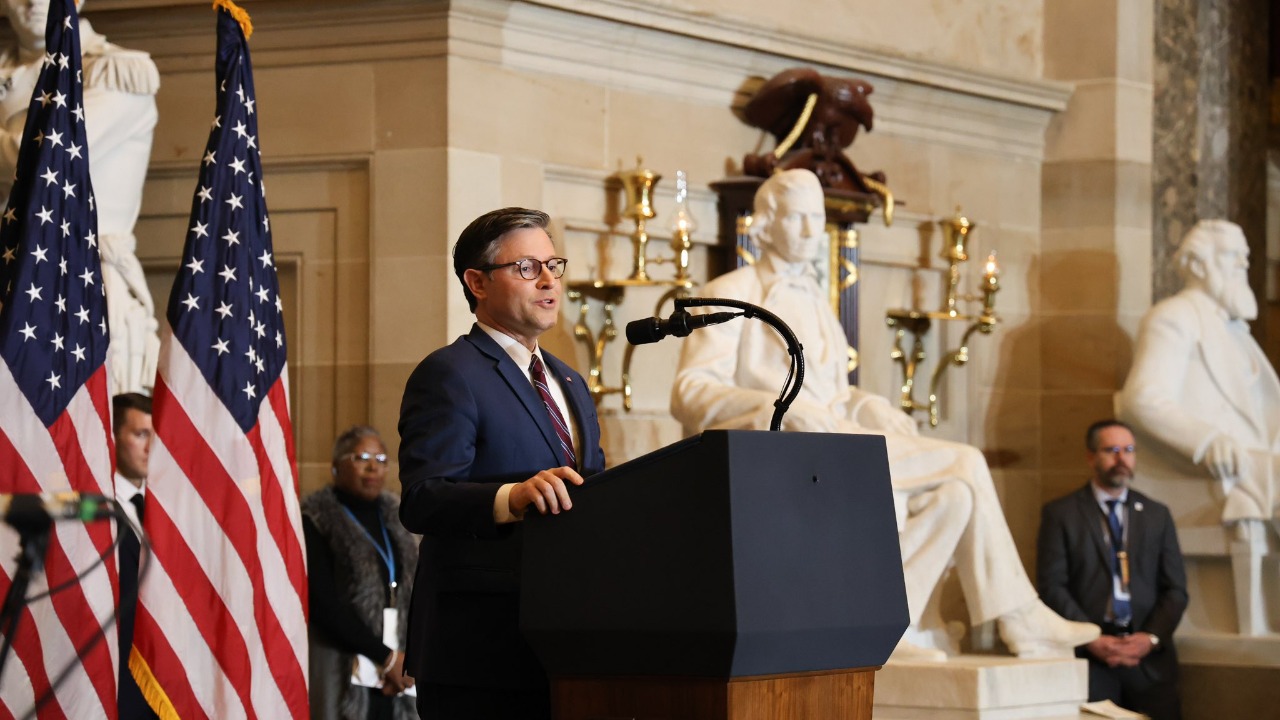
Mike Johnson built his reputation in Congress arguing that lawmakers, not the White House, should control the nation’s trade weapons. His past push to claw back tariff authority from the executive branch now sits awkwardly beside his role as House speaker, where he is under pressure to protect President Donald Trump’s expansive use of those same powers.
The clash between Johnson’s earlier constitutional rhetoric and his current political calculations is no longer theoretical. It is playing out in courtrooms, on the House floor, and in pointed letters from senators who insist that Congress must finally test whether it still believes its own words about who gets to tax imports.
Johnson’s constitutional case for congressional control
When Mike Johnson first pressed the issue of tariffs, he framed it as a basic question of separation of powers, not a referendum on any one president. He argued that the Constitution gives the power to impose taxes and duties to Congress, and that lawmakers had ceded too much of that authority to the executive branch through broad statutes that let presidents declare trade emergencies almost at will. In his telling, Congress had a duty to reassert itself before temporary delegations hardened into a permanent shift of power.
Johnson’s stance was not purely academic. He said that he would have “stepped in” to block President Donald Trump if he believed the president was overstepping his authority on trade, a line that underscored his claim that Congress must be prepared to check the executive even when it is politically inconvenient. That warning, reported in coverage of how Johnson wanted Congress to reclaim power, positioned him as a conservative willing to challenge a Republican president on constitutional grounds, at least in theory.
Tariffs, Trump, and the mandate argument
At the same time, Johnson has been careful to validate President Donald Trump’s political standing on trade, even as he questioned the legal framework that enabled Trump’s tariffs. He has described Trump as operating with a popular green light, saying that “The President is using the authority that the people gave him, I would argue a mandate they gave him, to fix the trade” system. That formulation, highlighted in reporting on how The President was using the authority that the people gave him, allowed Johnson to praise Trump’s goals while still hinting that Congress might need to narrow the tools available to achieve them.
This dual message, deference to Trump’s mandate paired with concern about open-ended statutes, helps explain why Johnson’s earlier push to reclaim tariff powers never turned into a full-scale rebellion. He signaled that he saw Trump’s trade agenda as legitimate, even necessary, but wanted Congress to write clearer rules so that future presidents could not stretch emergency authorities beyond recognition. The unresolved question is whether Johnson, now holding the speaker’s gavel, is prepared to put that theory into practice when it could directly constrain the current White House.
Supreme Court skepticism and Johnson’s reaction
The legal backdrop to Johnson’s argument shifted when the Supreme Court began to scrutinize how far presidents can go in wielding tariff powers that Congress delegated decades ago. During one high profile case, Justice Neil Gorsuch and some of the other justices worried aloud that it would be difficult to unwind such sweeping executive authority once the court had blessed it. Their concern was not just about one set of tariffs, but about the long term consequences of letting any president treat trade statutes as a blank check.
Johnson responded by criticizing conservative justices who questioned Trump’s tariff powers, casting their skepticism as a threat to the president’s ability to confront what he sees as unfair foreign competition. His comments, detailed in coverage of how Gorsuch and other justices worried about unrolling executive authority, underscored the tension in Johnson’s position. He has argued that Congress should narrow the statutes that give presidents such latitude, yet he bristled when the judiciary signaled it might step in to do some of that limiting itself.
Senate pressure to honor Congress’s own words
As Johnson navigates the legal and political crosscurrents, a trio of senators is trying to force the House to confront the issue directly. Senators Tim Kaine, Rand Paul, and Ron Wyden have pressed him to schedule votes on Senate passed legislation that would roll back Trump’s cost raising tariffs, arguing that the House cannot keep ducking a clear constitutional question. In their view, the chamber Johnson leads has already spoken through the nation’s founding document, and it is time to align trade law with that text.
The senators’ letter leans heavily on first principles, declaring that “The Constitution is clear. Only Congress has the power to impose tariffs.” They note that The Senate has already voted to determine how emergency trade authorities should be used, and they want Johnson to “follow intent of law” by letting the House take a stand as well. Their push, outlined in a statement that stressed that The Constitution is clear and Only Congress has the power to impose tariffs, puts Johnson’s earlier rhetoric under a spotlight. If he truly believes Congress must reclaim its role, they argue, he should not be afraid to put the question on the floor.
A speaker caught between principle and power
Johnson’s journey from backbench constitutional hawk to speaker managing a fractious majority has turned his tariff stance into a test of how much principle survives contact with power. As a rank and file member, he could argue that Congress had given away too much without having to deliver the votes to take any of that power back. As speaker, any move to limit Trump’s trade tools would be read as a direct challenge to a president who still dominates Republican politics and expects loyalty from party leaders.
That political reality helps explain why Johnson’s earlier promise that he would have “stepped in” if Trump overstepped on trade remains largely hypothetical. The structural concerns he raised about broad delegations of tariff authority have only grown more salient as presidents of both parties test the outer edges of emergency statutes. Yet the incentives of his current job push him to defend Trump’s discretion in the short term, even as courts, senators, and his own past words point toward a future in which Congress finally reclaims the power to tax imports that the Constitution reserved to it.
More From TheDailyOverview
- Dave Ramsey warns to stop 401(k) contributions
- 11 night jobs you can do from home (not exciting but steady)
- Small U.S. cities ready to boom next
- 19 things boomers should never sell no matter what

Julian Harrow specializes in taxation, IRS rules, and compliance strategy. His work helps readers navigate complex tax codes, deadlines, and reporting requirements while identifying opportunities for efficiency and risk reduction. At The Daily Overview, Julian breaks down tax-related topics with precision and clarity, making a traditionally dense subject easier to understand.

