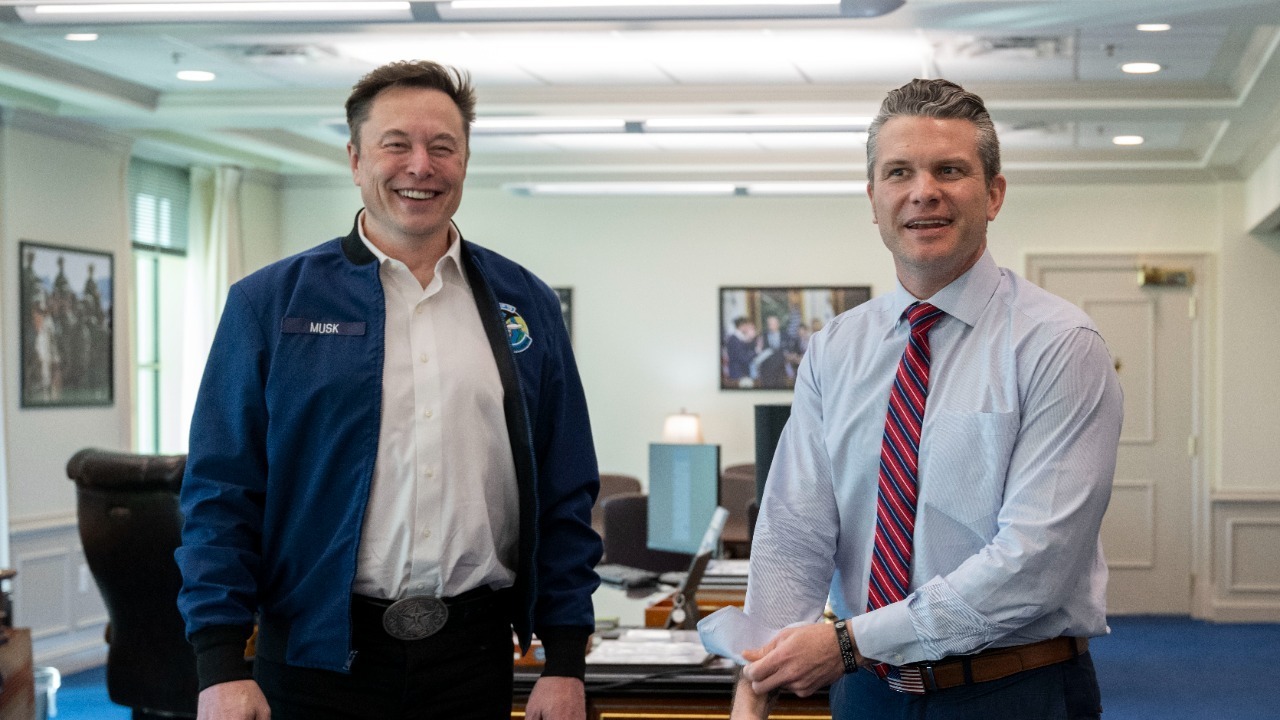
Elon Musk has turned his fire on Washington’s balance sheet, arguing that America’s swelling national debt is no longer just a long‑term worry but an imminent threat. With the total burden already past $38.56 trillion and annual interest costs overtaking the military budget, he is now warning that without a radical productivity leap from artificial intelligence and robotics, the United States is “1,000% going bankrupt.” His prescription is as sweeping as his diagnosis, raising a stark question for policymakers and households alike: is Musk outlining a viable escape route, or simply swapping one form of risk for another?
At the core of his argument is a simple, brutal math: when interest payments grow faster than the economy, the room for everything else, from defense to social programs, shrinks. Musk’s controversial fix is to treat AI as a kind of fiscal exoskeleton, using automation to strip out waste, fraud and bureaucracy across government and finance. I think that framing is both provocative and revealing, because it recasts the debt fight not as a partisan budget battle but as a race between compounding interest and compounding technological gains.
The ‘1,000%’ bankruptcy warning and an ‘insane’ debt spiral
Musk has been escalating his language about the fiscal outlook, telling interviewers that America is “1,000% going to go bankrupt” if it fails to harness AI and robotics at scale. In one recent exchange he argued that the national debt has already climbed past $38.56 trillion, a level he describes as “insane” and unsustainable. He has also stressed that the interest payments on that debt now exceed what the country spends on its military, a symbolic tipping point that helps explain his sense of urgency.
Earlier this year he framed the situation as a looming “day of reckoning,” warning that there could be “no way” to fix the problem if compounding interest is allowed to run unchecked. In that context he has highlighted what one report called a “Staggering Interest Expense”, arguing that the cost of servicing existing obligations is crowding out the capacity to invest in growth. When Musk talks about America “failing as a country,” as he did in another interview about America’s debt, he is really describing a slow squeeze in which interest eats the fiscal future.
Why Musk thinks only AI and robots can save the United States
What makes Musk’s latest warning different from the usual deficit talk is his insistence that traditional tools, from tax hikes to spending cuts, are no longer enough. He has said bluntly that without artificial intelligence and robotics, the United States is on an inevitable path to fiscal collapse. In his telling, the only realistic way to outrun compounding interest is to engineer a step‑change in productivity, using machines to do in seconds what currently takes human workers hours or days.
In several interviews Musk has argued that AI systems could comb through federal spending to identify waste and fraud at a scale humans cannot match. He has linked this view to his broader belief that the country faces a “1,000%” chance of bankruptcy without such tools, a phrase that underscores how little faith he has in incremental reform. When he talks about AI and robots “saving” the economy, he is not just imagining humanoid assistants but a full stack of automated systems embedded in tax collection, benefits administration and procurement.
Inside the controversial fix: automating waste, fraud and bureaucracy
Musk’s proposed fix starts with a harsh assessment of how the federal government currently spends money. Asked recently what worries him most about the debt, Musk replied that he is focused on waste and fraud, suggesting that large chunks of federal outlays never reach their intended targets. He has argued that AI could continuously audit transactions, flagging suspicious patterns in real time instead of relying on slow, manual reviews that often come years after the money is gone.
In that vision, robotics and automation would also reshape how services are delivered. Musk has pointed to his experience building highly automated factories and logistics systems as proof that similar techniques could streamline public operations, from processing tax returns to managing infrastructure projects. His broader warning that the debt trajectory is unsustainable is paired with a promise that AI‑driven efficiency could free up enough resources to stabilize the books without draconian cuts to popular programs.
From DOGE experiments to a broader AI‑first fiscal strategy
Musk’s fixation on automation as a fiscal tool did not appear in a vacuum. Reflecting on his work with DOGE, he has said he hoped to slow the unsustainable financial trajectory the U.S. is on by experimenting with faster, cheaper transaction systems. That experience seems to have reinforced his belief that both AI and blockchain‑style infrastructure can strip friction out of payments and record‑keeping, which in turn could reduce the cost of administering everything from Social Security to defense contracts.
In his latest comments he has folded those experiments into a broader thesis that only a technology‑first strategy can buy time before rising rates send debt‑interest payments soaring even further. If agencies adopt AI to automate compliance checks and use digital ledgers to track funds, Musk argues, they could cut leakage and delays that currently inflate costs. I think it is reasonable to predict that this rhetoric will accelerate experiments with blockchain‑based procurement and benefits systems, and it is plausible that by 2028 such tools could account for a noticeable share of federal transactions, even if the exact percentage remains uncertain.
How Musk’s warnings land with voters, markets and the White House
Musk’s language is calibrated to resonate far beyond the policy community. In one widely shared interview he warned that America will “1,000%” go bankrupt and “fail as a country” if the debt keeps climbing, language that doubles as financial advice to households to protect their savings. Another report described how Elon Musk has become a prominent voice on the country’s growing debt burden, warning that America faces financial collapse without a course correction. For investors, those comments are a reminder that one of the world’s richest people sees sovereign risk not as an abstract concept but as a live variable in their portfolios.
Politically, his interventions complicate the narrative in Washington. President Donald Trump has already made economic growth and deregulation central to his agenda, and Musk’s call for aggressive AI deployment aligns with that deregulatory instinct while also highlighting the scale of the fiscal challenge. When Musk warns that the United States will a “day of reckoning” with “no way” to fix the issue, he is effectively daring both parties to treat AI not just as a tech policy topic but as a core plank of fiscal strategy.
The missing pieces: jobs, privacy and the human cost of an AI fix
For all its urgency, Musk’s pitch glosses over some of the hardest questions about an AI‑driven state. Automating large swaths of government work would almost certainly displace workers, from call‑center staff to mid‑level analysts, at a time when many communities already feel left behind. In one interview from JAKARTA, the Tech billionaire Elon Musk repeated his warning that the United States will be “1,000%” bankrupt without AI and robots, but he spent far less time on how to retrain or support the people whose jobs those systems might absorb.
There are also serious questions about data privacy and cybersecurity when AI systems are plugged into the deepest layers of the federal apparatus. A government that relies on machine‑learning models to monitor benefits, taxes and contracts would be aggregating and analyzing vast amounts of sensitive information, which in turn becomes a target for hackers and hostile states. Musk’s focus on efficiency is understandable, but the assumption that more automation is always better deserves scrutiny, especially when the stakes include not just budget lines but the trust citizens place in their institutions.
Debt, AI and America’s place in a world of aging giants
One way to understand Musk’s alarm is to compare America’s trajectory with other heavily indebted economies. Japan has long carried a debt load far larger than its annual output, while China is wrestling with local government and property‑sector liabilities, yet neither has a tech figure quite as prominent as Musk warning that their countries are “1,000%” doomed without AI. In that sense, his rhetoric reflects a uniquely American mix of fiscal anxiety and technological optimism, a belief that the same innovation engine that built Silicon Valley can also rescue the federal balance sheet.
At the same time, other major economies are racing to embed AI in their own public sectors, from tax enforcement to healthcare, which means Musk’s call for an AI‑enabled state is also a call to keep pace with global rivals. Reports that Elon Musk has on his warnings about the United States growing national debt suggest he sees this as a race the country cannot afford to lose. If AI does deliver the kind of productivity gains he anticipates, the gap between governments that adopt it aggressively and those that do not could widen quickly, with direct consequences for borrowing costs and geopolitical leverage.
More From The Daily Overview
*This article was researched with the help of AI, with human editors creating the final content.

Grant Mercer covers market dynamics, business trends, and the economic forces driving growth across industries. His analysis connects macro movements with real-world implications for investors, entrepreneurs, and professionals. Through his work at The Daily Overview, Grant helps readers understand how markets function and where opportunities may emerge.

