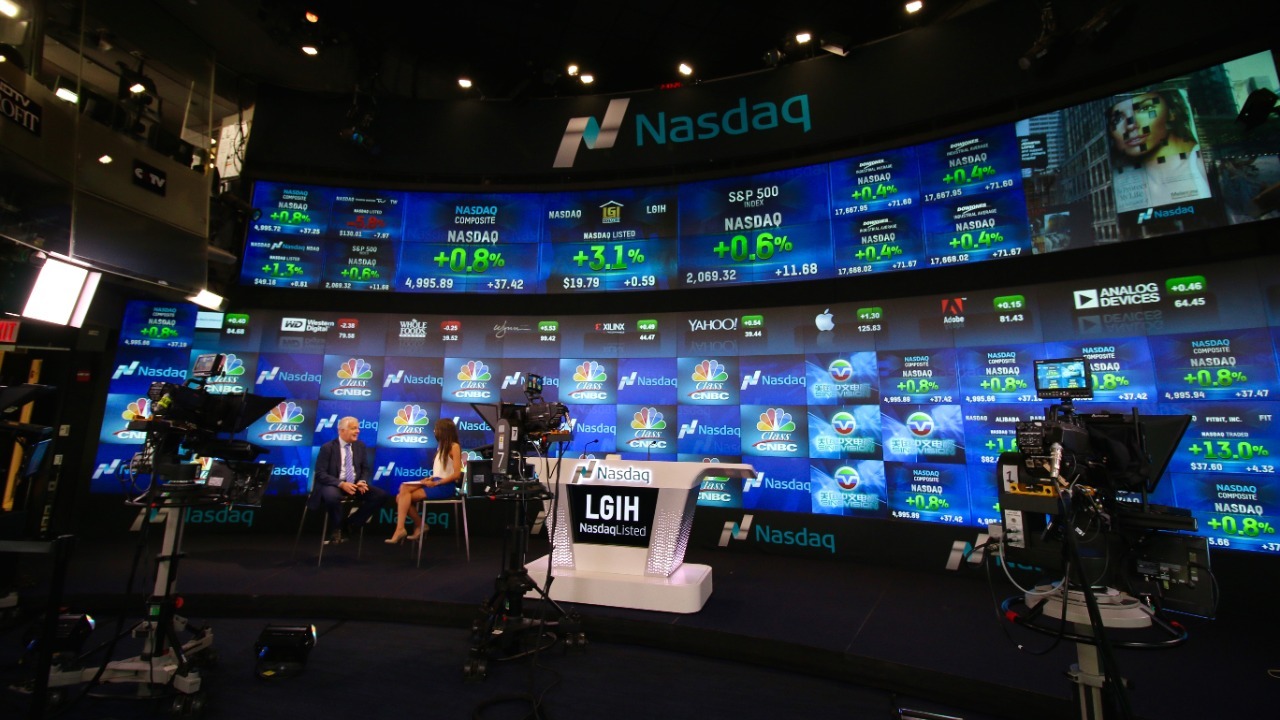
Wall Street’s tech engine is back in high gear, and the Nasdaq is leaving the broader market in its wake as artificial intelligence and software names roar higher. A powerful rebound in cloud and chip stocks has turned what looked like a late‑cycle grind into a fresh momentum phase for growth investors. The result is a market in which the S&P 500 is still climbing, but the real action is concentrated in the companies building and supplying AI infrastructure.
The gap between the tech‑heavy Nasdaq and the S&P 500 is not just a story about sentiment, it reflects a concrete shift in where capital is flowing and which business models investors now trust. As AI spending ramps across data centers and enterprise software, traders are rewarding platforms and chipmakers that can translate that demand into earnings, while treating slower‑growing software names more cautiously.
Nasdaq’s surge leaves the S&P 500 behind
The latest leg of the rally has seen the Nasdaq Composite outpace the S&P 500 as investors crowd back into AI and software leaders. Tech‑focused benchmarks on Wall Street have been the clear winners, with the Nasdaq Composite, identified as COMP and IND, pulling ahead as traders rotate toward high‑growth names tied to machine learning and cloud infrastructure. Reporting on the recent session shows that the Nasdaq’s leadership has been driven by a concentrated group of AI beneficiaries, underscoring how much of the market’s energy is now clustered in that corner of the equity universe, while the broader 500 stock index advances at a steadier pace linked to the overall U.S. economy.
That divergence is visible in the way major indices closed, with the S&P 500 Index rising 0.47% to 6,964.82 points even as the Nasdaq Composite Index advanced by a larger margin, nearly 1%, to 23,238.67 points. At the same time, the Dow Jones Industrial Average gained only 0.04% to 50,135.87 points, highlighting how the old‑economy benchmark is lagging the tech‑heavy complex. The closing snapshot, described in detail in one At the report, captures a market where AI‑linked growth is dictating the pace, and the Nasdaq’s heavier exposure to those names is translating directly into outperformance.
AI optimism powers Oracle and big software
One of the clearest signs of this shift is the way investors have re‑rated large enterprise software vendors that can show a credible AI roadmap. Oracle has become a bellwether in this regard, with its shares climbing as traders bet that AI‑driven demand will accelerate its cloud infrastructure and database businesses. On a recent trading day in Feb, coverage under the banner “Oracle Climbs” and “Optimism Despite Software Sector Weakness” highlighted how the company’s AI narrative helped offset broader softness across software, suggesting that investors are now discriminating sharply between AI‑enabled platforms and slower, traditional software models.
Market data from that session show the S&P 500, tracked as SNPINDEX and GSPC, rising 0.47% to 6,964.82 even as Oracle’s strength stood out against a backdrop of sector‑wide hesitation. Another account of how the markets moved noted that the same 500 index added 0.45% to finish at 6,964 on Monday, while the Nasdaq Composite also pushed higher, helped by large‑cap enterprise software names that are repositioning themselves around AI workloads. I see Oracle’s AI‑fueled advance, described in detail in one Nas recap and another How the analysis, as emblematic of a new hierarchy inside software, where AI‑ready platforms command a premium while legacy subscription models are treated with growing skepticism.
Why AI infrastructure is attracting the most capital
Under the surface of index moves, the most aggressive buying is targeting the infrastructure that makes AI possible, from data‑center chips to high‑bandwidth networking. Rising artificial intelligence spending across Big Tech is sharpening investor focus on the companies that supply the hardware and services behind those deployments. One detailed breakdown notes that this “Rising” wave of capex is turning certain chipmakers into clear beneficiaries, as hyperscale cloud providers race to expand GPU clusters and memory bandwidth to support ever larger models. In my view, that spending pattern explains why the Nasdaq, with its heavier concentration of semiconductor and cloud names, is pulling away from the more diversified S&P 500.
Analysts have even described the valuation of at least one big chip stock as a rare gift for investors, arguing that the market is underestimating how durable AI‑driven demand will be as data‑center operators standardize on advanced accelerators. That perspective, laid out in an Investing analysis, reinforces the idea that AI infrastructure is not a passing fad but a multi‑year capital cycle. As long as Big Tech keeps ramping data‑center budgets, the Nasdaq’s tilt toward these suppliers should continue to give it an edge over the S&P 500’s broader mix of financials, industrials, and consumer names.
High‑beta winners: chips, cloud, and crypto‑adjacent plays
The beneficiaries of this AI and software resurgence are not limited to household‑name megacaps. A look at individual movers shows how high‑beta tech and adjacent plays are amplifying the Nasdaq’s gains. MicroStrategy, listed as MSTR, recently traded at 134.93, up 26.11%, while Applied Materials, or AMAT, changed hands at 322.51, up 6.09%. Broadcom, identified as AVGO, was quoted at 332.92, up 7.22%, alongside smaller names such as HIMS at 23.02 and GLXY at 19.76, the latter up 17.34%. These outsized percentage moves, captured in a futures‑linked snapshot that also referenced the IUXX benchmark at 25,075, illustrate how speculative capital is chasing both AI hardware suppliers and more speculative growth stories tied to digital assets and telehealth.
I see this pattern as typical of late‑stage tech rallies, where core AI and cloud leaders pull in more risk‑tolerant money that then spills over into secondary beneficiaries. The presence of MSTR, which has become closely associated with crypto exposure, alongside AMAT and AVGO, which are central to semiconductor manufacturing and networking, shows how investors are building baskets that blend pure AI infrastructure with correlated high‑growth themes. The detailed pricing and percentage gains, laid out in a MSTR quote summary, underline how much more volatile these names are than the average S&P 500 constituent, and how that volatility is feeding into the Nasdaq’s superior performance.
Software’s split personality: AI leaders vs. legacy SaaS
While AI‑aligned software names are thriving, the broader software sector is showing signs of strain, creating a split personality within the group. On Feb 9, coverage of the S&P 500 Index, tracked as SNPINDEX and GSPC, noted that Oracle’s AI‑driven strength helped steady major U.S. benchmarks even as many software peers lagged. The same analysis argued that the rise of AI could render some traditional software‑as‑a‑service (SaaS) business models somewhat obsolete, particularly those that rely on incremental feature updates rather than deep integration with AI workflows. In my reading, that tension explains why the Nasdaq’s gains are so uneven under the hood, with a handful of AI‑first platforms carrying much of the weight.
Investors are increasingly rewarding companies that can show how AI will expand their addressable market or improve margins, while punishing those that treat it as a marketing add‑on. The report that framed Oracle’s AI‑fueled advance as a stabilizing force for the 500 index, even as “software sector weakness” persisted, captured this divergence clearly. It suggested that some SaaS vendors risk being bypassed if they cannot embed AI deeply enough to justify premium pricing. That dynamic, detailed in a On Feb breakdown, is another reason the Nasdaq’s leadership is so concentrated, and why stock pickers inside software need to be more selective than they were during the earlier SaaS boom.
Macro backdrop: steady S&P 500, surging tech
All of this is unfolding against a macro backdrop that still looks supportive for equities overall, even if the real fireworks are in tech. Recent trading sessions saw the S&P 500, again tracked as SNPINDEX and GSPC, rise 0.47% to 6,964.82, while another account pegged the same 500 benchmark up 0.45% to 6,964 on Monday. Those modest but steady gains suggest that investors remain comfortable with the broader earnings and interest‑rate outlook, even as they increasingly favor growth over value. The fact that the Dow Jones Industrial Average only added 0.04% to 50,135.87 points, while the Nasdaq Composite Index advanced 0.90% to 23,238.67 points, reinforces the idea that tech is the main engine of this market rather than a sideshow.
In that context, the Nasdaq’s ability to “outpace” the S&P 500 on an AI and software rebound looks less like a short‑term anomaly and more like a continuation of a structural trend. Wall Street’s tech‑focused Nasdaq Composite, labeled COMP and IND in index data, has repeatedly led major averages whenever AI enthusiasm flares, reflecting its heavier weighting in chips, cloud, and high‑growth software. A recent overview of how the Nasdaq outpaced the S&P 500 on this latest AI and software rebound, which explicitly contrasted the tech benchmark with the 500 stock index, underscored how concentrated the leadership has become. That narrative, captured in a Nasdaq Composite summary, leaves me convinced that as long as AI capex and cloud demand keep rising, the Nasdaq is likely to keep crushing the S&P 500 on the way up, even if both indices continue to set new highs.
More From The Daily Overview
*This article was researched with the help of AI, with human editors creating the final content.

Grant Mercer covers market dynamics, business trends, and the economic forces driving growth across industries. His analysis connects macro movements with real-world implications for investors, entrepreneurs, and professionals. Through his work at The Daily Overview, Grant helps readers understand how markets function and where opportunities may emerge.

