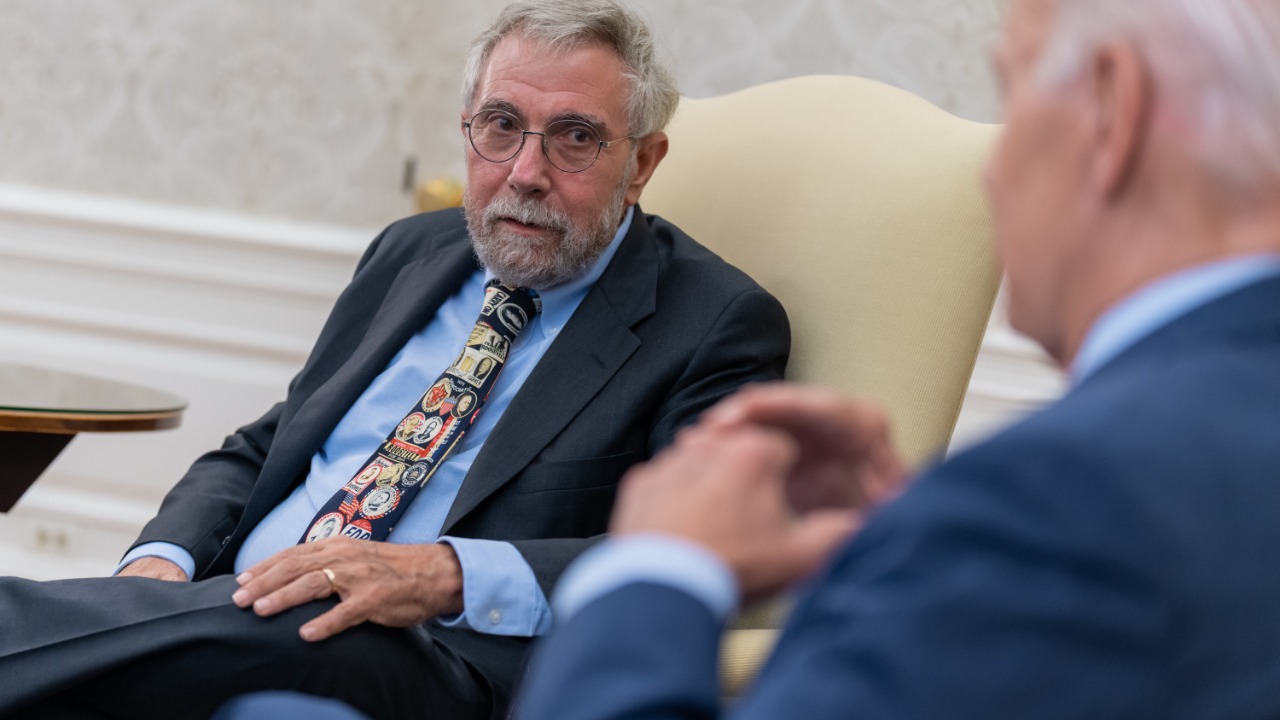
Nobel Prize winning economist Paul Krugman is again warning that the calm on Wall Street is masking serious trouble in the real economy. He argues that a mix of fragile growth, speculative excess around artificial intelligence and aggressive trade policy under President Donald Trump is pushing the United States toward a new financial shock. His message is blunt: the next crisis is unlikely to look like 2008, but the ingredients for a painful downturn are falling into place.
AI euphoria, “dead cat bounces” and a schizoid 2025 market
I see Krugman’s sharpest warning in his critique of the AI stock boom, which he now treats as a potential trigger rather than a harmless sideshow. On Nov 25, 2025, he described how AI related shares that had slumped earlier in the year suddenly roared back, a pattern he linked to speculative “dead cat bounces” driven less by profits than by hopes for rapid interest rate cuts. In that analysis, he argued that the latest AI rallies bear an “unmistakable resemblance” to the late 1990s tech bubble, with investors crowding into a narrow group of technology companies on the assumption that central banks will always step in to rescue them, a pattern echoed in coverage of Economist Paul Krugman. That kind of narrow, policy dependent boom is exactly the sort of imbalance that can unwind violently if expectations shift.
In his own newsletter on Nov 25, 2025, Krugman went further, calling the United States economy in 2025 “schizoid.” On the one hand, he wrote, Donald Trump abruptly reversed 90 years of U.S. trade policy, a break with postwar orthodoxy that he argues is boosting some headline indicators while undermining long term stability. On the other hand, the same piece warned that the Federal Reserve “can’t rescue AI,” meaning monetary policy alone cannot guarantee that today’s AI heavy portfolios will hold their value if earnings disappoint. Reporting on Nov 25, 2025, captured that tension, noting how he highlighted “unusual market behavior” around AI stocks that “shot back up” despite broader economic uncertainty, a pattern that has been flagged in separate coverage of the looming crisis.
A strong looking economy with hidden fractures
Krugman’s broader case is that the apparent strength of Trump’s economy is masking deep structural weaknesses. In an Oct 21, 2025 essay, he described how the United States has avoided a formal recession so far but has drifted into what he called a “no hiring” environment, where workers who lose jobs struggle to find another and bargaining power erodes. He pointed to survey data and wage patterns to argue that employees have “much less bargaining power” than headline unemployment figures suggest, a dynamic he linked to what he called an “unexpected compression” in pay, as detailed in his analysis of how the U.S. economy is in worse shape. That disconnect between solid GDP numbers and fragile household finances is a classic precondition for a sharper downturn.
He has been even more explicit in public commentary on Trump’s record. On Oct 22, 2025, he warned that Trump’s economy is “in worse shape than it looks,” stressing that a buoyant stock market is not a reliable guide to underlying health and that investors are overexposed to a handful of large technology companies. In that piece, Krugman cautioned readers that it is “important to be aware” of how quickly sentiment can turn when valuations are stretched, a point that has been amplified in reporting on how Krugman sees the market’s tech concentration as a vulnerability. Earlier this year, he also put the probability of a recession at 50% in a discussion labeled “Recession Risk and Growth Outlook,” tying that risk to stagflation pressures, weak consumer confidence and the collision of high borrowing costs with slowing growth.
Trade shocks, complacent markets and the limits of rescue
Behind these warnings is a consistent argument that Trump’s trade agenda is amplifying the danger. In an Apr 24, 2025 interview, Krugman, who won the Nobel Prize, said a United States downturn “Recession Seems Likely” as the White House leans into blanket, sectoral and retaliatory tariffs that disrupt supply chains and invite foreign retaliation. He has argued that these policies, which Trump has framed as leverage, instead risk a stagflationary mix of higher prices and weaker global demand. On May 19, 2025, in a segment explicitly titled “Recession Risk and Growth Outlook,” Krugman warned that Trump’s trade policies could produce exactly that outcome, with tariffs, high rates and weak consumer confidence colliding at the same time.
What worries him just as much is how little of this risk is reflected in asset prices. In an Aug 27, 2025 newsletter, he wrote that his read of economic and financial history is that market pricing “almost never” takes into account the possibility of a sudden break, arguing that investors tend to extrapolate the recent past until the very moment conditions snap. He framed the current calm as a textbook case of that complacency, a view that has been widely shared and debated, including in a discussion thread that highlighted his line that “Neither” the United States nor other major economies are pricing in obvious dangers. A day later, on Aug 28, 2025, users on a policy forum circulated his argument under the heading “Why aren’t markets freaking out,” underscoring how his concern about investor psychology has moved from academic circles into broader political debate.
A decade of warnings converging on the present
Krugman’s latest alarms do not come out of nowhere. Back on Mar 2, 2020, he told an audience that the United States was “in a worse position than before the financial crisis,” arguing that policymakers had failed to rebuild fiscal and political buffers after 2008 and that the system remained vulnerable to shocks. That assessment, delivered under the banner of Paul Krugman at the University of Chicago News, now reads like a preface to his current critique of Trump era policy. The throughline is his insistence that ignoring tail risks in good times leaves economies exposed when conditions turn.
Today, that long running concern is colliding with a uniquely volatile mix of AI speculation, aggressive tariffs and a labor market that looks solid on the surface but feels brittle to workers. On Nov 25, 2025, fresh reporting captured how he is now “sounding the alarm” on a looming financial crisis, tying together his worries about AI bubbles, trade shocks and the limits of central bank rescue in a single argument that the United States is drifting toward another painful adjustment. That coverage, which urged readers to Sign Up for The Swamp Newsletter to follow the fallout, framed his warning as a call for investors and voters alike to look past the latest rally. Krugman’s message, repeated across his Substack, interviews and profiles, is that the United States still has time to change course, but only if it stops mistaking a speculative boom for a solid foundation.
More From TheDailyOverview
- Dave Ramsey says these two simple questions show whether you’re rich or poor
- Retired But Want To Work? Try These 18 Jobs for Seniors That Pay Weekly
- IRS raises capital gains thresholds for 2026 and what’s new
- 12 ways to make $5,000 fast that actually work

Grant Mercer covers market dynamics, business trends, and the economic forces driving growth across industries. His analysis connects macro movements with real-world implications for investors, entrepreneurs, and professionals. Through his work at The Daily Overview, Grant helps readers understand how markets function and where opportunities may emerge.

