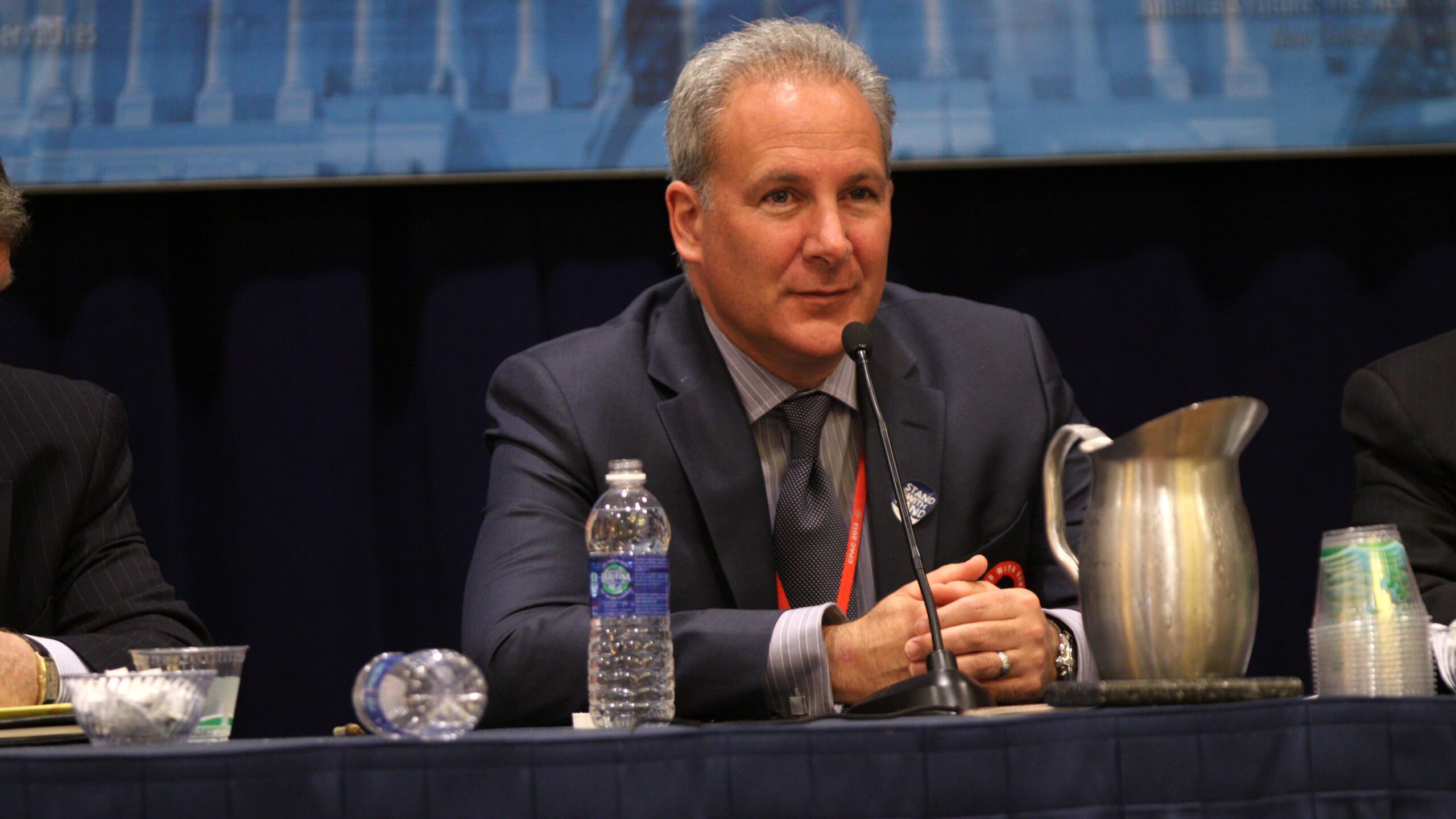
Economist Peter Schiff, who built his reputation on warning about the 2008 housing collapse before it happened, is now arguing that the United States faces a fiscal crisis that could exceed the severity of that downturn. His case rests on a combination of ballooning federal debt, rising interest payments that now rival defense spending, and household income data showing consumers losing ground to inflation. Official government projections lend weight to at least part of that argument, even if the timing and scale of any potential crisis remain contested.
Federal Debt Trajectory Points to Structural Strain
The foundation of Schiff’s warning is the federal government’s own math. The Congressional Budget Office published its regular budget outlook, which projects the debt-to-GDP trajectory, the deficit path, and the growth of net interest costs over the coming decade. Those projections describe an economy where the government borrows more each year to cover spending that outpaces revenue, with interest payments consuming a growing share of every dollar collected. The report does not use the word “meltdown,” but the trend lines it charts are the raw material Schiff and other fiscal hawks point to when they argue the current path is unsustainable and increasingly vulnerable to shocks such as recessions or higher borrowing costs.
What separates this cycle from earlier deficit debates is the compound effect of higher interest rates on a much larger debt base. When borrowing was cheap in the decade after 2008, large deficits carried relatively modest interest costs and could be more easily absorbed without crowding out other priorities. That math has shifted. The CBO’s projections on net interest costs over the budget window show those payments growing faster than most other categories of federal spending, a dynamic that squeezes room for everything from infrastructure to social programs and national security. Schiff’s thesis is that this squeeze will eventually force a reckoning, either through aggressive austerity, a currency devaluation, or a market-driven crisis that imposes discipline from the outside when investors demand higher yields or begin to question the safety of U.S. debt.
Interest Costs Now Outpace Defense Spending
One of the most striking data points in the current fiscal debate is the relationship between interest payments and military spending. House Budget Chairman Jodey Arrington, responding to the CBO baseline, stated that interest spending now exceeds defense through the outlook period. That comparison carries political weight because defense has historically been treated as the benchmark for “large” federal expenditures in budget fights. When debt service costs more than the entire Pentagon budget, the fiscal picture has changed in a way that is hard for either party to dismiss, and it becomes more difficult to claim that deficits can be managed indefinitely without trade-offs.
Arrington’s response to the CBO baseline included the slogan “We must Reverse the Curse!” and enumerated headline metrics to make the case for spending restraint and structural reforms. His framing aligns with Schiff’s broader argument, though the two come at it from different angles. Schiff tends to emphasize the risk of a dollar crisis and the failure of monetary policy, while Arrington focuses on legislative spending discipline and constraints on future Congresses. The shared concern is that interest costs are now self-reinforcing: higher debt leads to higher interest payments, which increase the deficit, which adds to the debt. Breaking that cycle requires either much faster economic growth, significant spending cuts, tax increases, or some combination of all three. None of those options is politically simple, particularly in a polarized environment where each side fears bearing the electoral cost of unpopular choices.
Household Income Data Signals Consumer Weakness
Schiff’s warnings gain traction partly because they connect to what ordinary households are experiencing. The U.S. Bureau of Economic Analysis published its August 2023 income report, which included the PCE price index monthly change and real disposable personal income movement. The PCE price index is the Federal Reserve’s preferred inflation gauge, and the report showed prices rising in a month when real disposable income moved in the opposite direction. That combination, rising costs and falling purchasing power, is the textbook definition of the squeeze Schiff describes when he talks about the erosion of living standards and the hidden tax of inflation on savers, retirees, and wage earners.
The latest publicly available BEA data in this reporting covers August 2023, so the consumer picture may have shifted in the months since, but the pattern it captured is central to the “worse than 2008” argument. In the lead-up to the last crisis, household balance sheets were stressed by mortgage debt and collapsing home values. This time, Schiff contends, the stress comes from a different direction: wages that do not keep pace with prices, savings rates that have fallen from pandemic highs, and credit card balances that have climbed as consumers borrow to maintain spending. Researchers can use the BEA’s interactive tables to track real income, savings, and consumption trends over time, and the trajectory through mid-2023 supported the case that consumers were drawing down buffers rather than building them, leaving them more exposed if unemployment rises or credit conditions tighten.
Why Schiff Says This Time Could Be Worse
The 2008 crisis was concentrated in the financial sector, with toxic mortgage-backed securities bringing down banks and freezing credit markets until extraordinary interventions restored confidence. Schiff’s argument is that the next crisis will be broader because the problem sits on the government’s own balance sheet rather than in private banks. A sovereign debt scare would affect Treasury yields, the dollar’s value, and the cost of borrowing for every business and household in the country simultaneously. The policy tools used in 2008 and 2009 (massive deficit spending and near-zero interest rates) would be harder to deploy when the deficit is already enormous and rates are already elevated, raising questions about how much room policymakers have to respond without amplifying the very concerns that triggered the crisis.
Congressional Democrats have also flagged fiscal risks, though they tend to emphasize different causes and solutions. The Democratic members on the House Budget Committee have pushed back on proposals they say would worsen deficits through tax cuts tilted toward higher earners and corporations, while Republicans like Arrington focus on mandatory spending growth and entitlement reform. This partisan split is itself part of Schiff’s concern: political gridlock makes it less likely that either side will act before a crisis forces action. The CBO’s detailed long-term projections provide a shared factual baseline for both sides, including estimates of debt, deficits, and interest costs under current law, but agreement on the numbers has not translated into agreement on a fix. Schiff reads that stalemate as evidence that the adjustment, when it comes, will be sudden and painful rather than gradual and managed.
What This Means for Consumers and Investors
For people trying to plan around these risks, the practical takeaway is that the macro picture (federal debt, interest costs, and inflation trends) can directly affect personal finances. If interest payments continue to climb relative to tax revenues, future policymakers may respond with higher taxes, reduced benefits, or both, altering the value of promised retirement income and the after-tax return on investments. Persistent inflation that runs ahead of income growth, as captured in the BEA’s August 2023 data and explored further through tools like the bureau’s public data access, erodes the real value of cash savings and fixed-income streams. That is the backdrop for Schiff’s frequent calls for investors to consider hard assets, foreign exposure, or other hedges against both inflation and potential dollar weakness.
At the same time, official projections stop short of endorsing an inevitable collapse. The CBO outlines risks and scenarios rather than certainties, and lawmakers across the spectrum cite its work to argue for their preferred mix of spending changes and tax policy. For consumers and investors, that means balancing Schiff’s dire warnings against the possibility that gradual policy adjustments could stabilize the trajectory before a full-blown crisis emerges. Diversifying income sources, avoiding overreliance on short-term borrowing, and stress-testing household budgets for higher interest rates or slower income growth are practical steps that do not require a specific forecast. Whether or not the next downturn proves “worse than 2008,” the combination of rising federal interest costs and pressured household finances suggests that resilience, at both the national and individual level, will depend on confronting trade-offs that have been easy to postpone but increasingly difficult to ignore.
More From The Daily Overview
*This article was researched with the help of AI, with human editors creating the final content.

Grant Mercer covers market dynamics, business trends, and the economic forces driving growth across industries. His analysis connects macro movements with real-world implications for investors, entrepreneurs, and professionals. Through his work at The Daily Overview, Grant helps readers understand how markets function and where opportunities may emerge.

