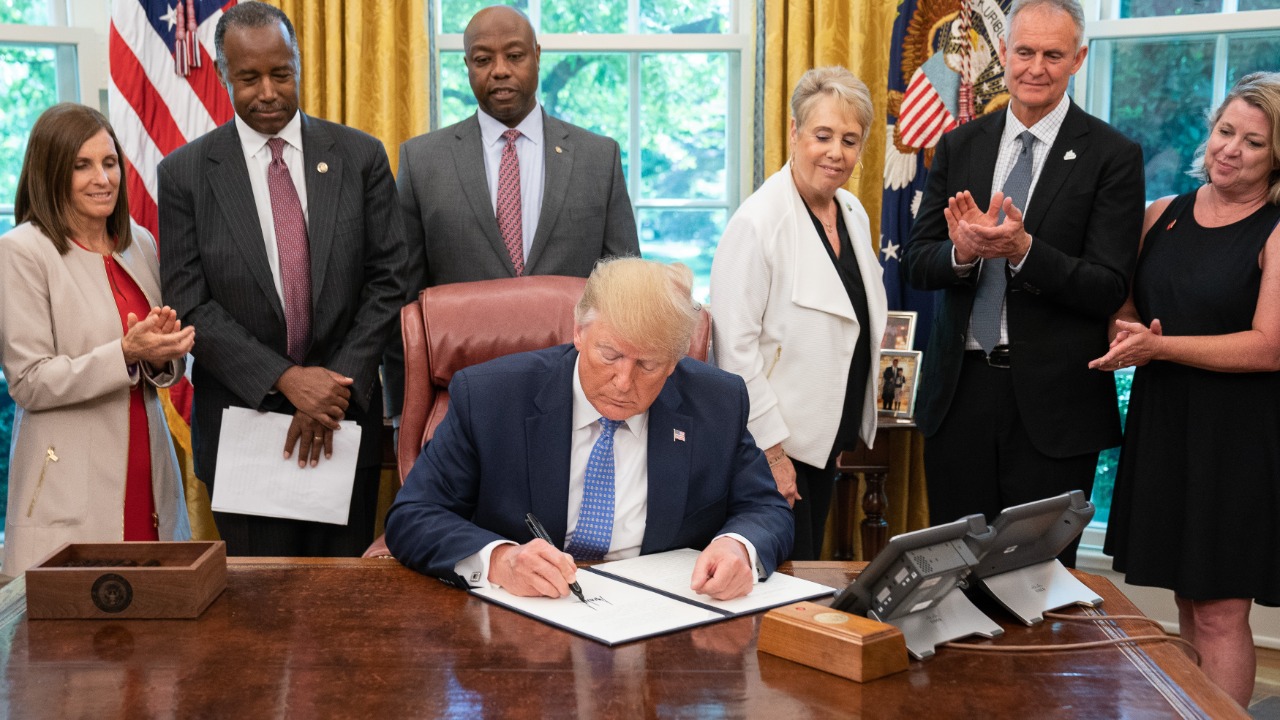
President Donald Trump is trying to reset the housing market in one stroke, pairing a push for cheaper mortgages with a crackdown on Wall Street’s role in single-family homes. The new executive order is framed as a way to drive down borrowing costs for Main Street buyers while sidelining deep-pocketed rivals that have been bidding up starter houses.
I see a coordinated strategy emerging: use federal power to lean on mortgage rates, then wall off institutional buyers so lower-cost loans translate into actual purchases for families rather than bigger portfolios for funds. Whether that combination truly “crushes” rates and competition, or simply rearranges who holds the leverage, will depend on how regulators and markets respond in the months ahead.
How Trump’s order rewires the rules for Wall Street landlords
At the heart of the shift is an executive order that targets large investors in single-family housing and tries to tilt the field back toward individual buyers. The White House describes institutional buyers with “vast resources” that have been competing directly with families for entry-level homes, and it casts the order as a way to put more money in Americans’ pockets by limiting that head-to-head fight. A companion description from The White House spells out that the policy is aimed at stopping big firms from buying or holding single-family homes, underscoring how central that restriction is to the president’s housing agenda.
Reporting on the order makes clear that this is not a symbolic gesture but a direct attempt to squeeze out some of the biggest players in the market. Coverage of President Trump notes that the directive is formally titled “Stopping Wall Street from competing with main street homebuyers,” a name that leaves little doubt about its target. Trade press accounts add that President Donald Trump signed the order on a Tuesday and that it is explicitly designed to prohibit large institutional investors from purchasing single-family homes, not just to nudge them at the margins.
A populist pitch: homes for families, not funds
Trump is pairing the legal mechanics with a populist message that casts the move as a defense of ordinary buyers. In coverage from WASHINGTON, the president is described as arguing that homes should be owned by families, not corporations, as he advances his effort to ban large institutional investors from the single-family market. Another account notes that Trump has framed the new order as a way to curb Wall Street’s grip on starter homes, with President Donald Trump arguing that big landlords are blocking families from building lifetime wealth through ownership.
The political branding is deliberate, right down to the language of Main Street versus Wall Street. The official fact sheet refers to President Donald Trump Stops Wall Street from Competing with Main Street Homebuyers, a phrase that is repeated across administration messaging. Separate coverage of Trump emphasizes that he has been touting policies aimed at blocking Wall Street from gobbling up single-family homes and competing with Americans for homes, reinforcing the idea that this is as much a political fight as a regulatory one.
The rate play: from social media promise to 5.99% mortgages
Alongside the investor crackdown, Trump is trying to engineer a break in borrowing costs that have weighed on buyers since the pandemic-era lows faded. Earlier this month, coverage of mortgage markets noted that President Donald Trump used his social media platform to announce that he had directed action aimed at mortgage rates, part of a broader debate over what will happen to mortgage rates in 2026 as policymakers weigh the role of hedge funds and other institutional investors. A separate analysis of a recent drop in borrowing costs reported that the average rate on the popular 30-year fixed mortgage fell 22 basis points to 5.99%, the lowest level in about three years, after the administration instructed Fannie Mae and Freddie Mac to adjust their approach.
Trump’s team has also floated a more structural plan to keep rates lower over time. A financial analysis of the president’s housing agenda explains that Mortgage Rates May, which is designed to change how American mortgage rates are set and thereby lower borrowing costs. The idea is to use federal levers to influence the spread between benchmark rates and consumer mortgages, so that when central bank policy eases, households see more of the benefit instead of watching it dissipate in fees and margins.
Can policy really “crush” mortgage rates?
The political promise is simple: if the president leans hard enough on the system, mortgage rates will fall and homeownership will become more affordable. Reality is more complicated. Local coverage of the housing push notes that Trump is pressing for lower rates and a ban on investor home purchases in a bid to make homes more affordable as borrowing costs climb from pandemic-era lows. Yet a separate report on the same initiative cautions that, while the president has expressed confidence in central bankers by saying “I think they’ll do a very good job,” Still, Fed rate cuts do not always translate into lower mortgage rates, as analysts at the Federal Reserve Bank of New York have pointed out.
There are also unresolved questions about how the new order will interact with broader financial conditions. A housing industry analysis notes that World Economic Forum attendees heard Trump mention his executive action while he addressed housing concerns, but experts said the order leaves key questions hanging about enforcement and the role of investors that have been blamed for driving up home prices. Another piece on 2026 borrowing costs stresses that American mortgage rates continue to be shaped by global capital flows and risk appetite, even as the administration tries to change the mechanics through which lenders set consumer rates, a tension that the Will It Help analysis highlights.
Regulators, rivals and the risk of unintended consequences
Even if the White House can limit direct purchases by big landlords, the order’s impact will depend heavily on how regulators and competitors respond. One account of the new policy explains that DOJ, FTC are expected to review large housing deals, signaling that antitrust and consumer protection agencies will be central to policing any attempt by Wall Street to route around the restrictions. At the same time, coverage of Wall Street reactions notes that funds and other institutional investors are already exploring alternative structures that could keep them in the single-family market without technically violating the new rules, a reminder that financial engineering rarely stands still.
There is also the question of how smaller investors and regional players will fill the gap if the largest firms pull back. Reporting on the administration’s messaging underscores that STOPPING WALL STREET FROM competing with Main Street Homebuyers is meant to free up inventory for families, but it could also open space for mid-sized landlords or private equity-backed local firms that are not yet large enough to trigger the strictest scrutiny. A separate report on how Wall Street has shaped starter-home markets suggests that any pullback by national giants could change pricing dynamics, but it also warns that local investors may step in quickly, limiting the relief for would-be owner-occupiers.
More From TheDailyOverview
*This article was researched with the help of AI, with human editors creating the final content.

Elias Broderick specializes in residential and commercial real estate, with a focus on market cycles, property fundamentals, and investment strategy. His writing translates complex housing and development trends into clear insights for both new and experienced investors. At The Daily Overview, Elias explores how real estate fits into long-term wealth planning.

