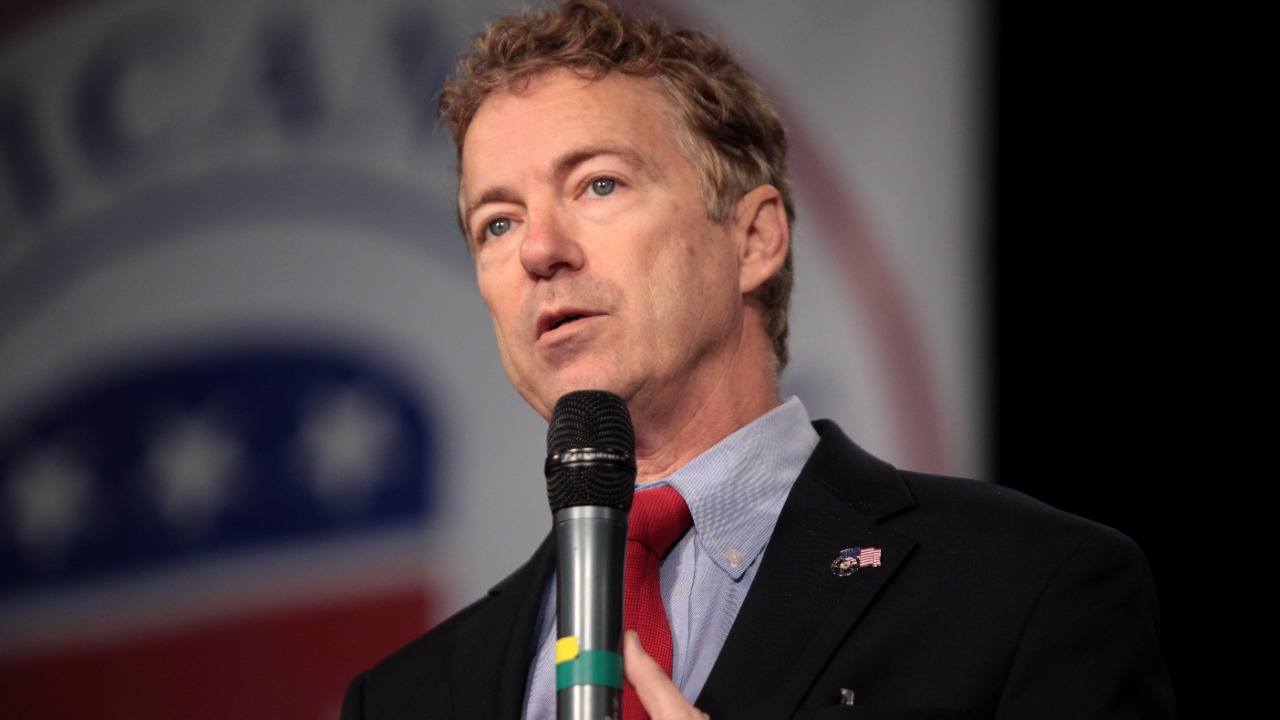
Senator Rand Paul is issuing one of the starkest warnings yet to President Donald Trump, arguing that a single misstep on economic and legal principles could cause the populist coalition around the president to fracture. At the heart of his critique is a belief that Trump’s movement is powerful but fragile, and that it depends on staying tethered to a consistent message about fairness, liberty and restraint in the use of government power. Paul is effectively telling Trump that if he trades those principles for short-term political advantage, the base that elevated him could walk away.
As I see it, Paul is not just sparring with Trump over another policy detail, he is sketching out a red line for the future of the Republican Party. His argument is that if Trump leans into what Paul views as “false nationalism or patriotism,” and abandons core limits on state power, the project that has reshaped conservative politics since 2016 could unravel from within.
Rand Paul’s stark warning about Trump’s future
Rand Paul’s latest broadside is built around a simple premise: Trump’s political brand only works if it is seen as defending ordinary Americans against a rigged system, not exploiting that system for allies and insiders. In an interview reported on Nov 20, 2025, Paul argued that if Trump embraces policies that look like special treatment for favored defendants or financial elites, “His Movement Will Dissolve,” a phrase that captures his view that the coalition around the president is conditional, not permanent. Paul’s warning is framed as a prediction that one “Decision Could Ruin Him,” and he ties that risk directly to how Trump handles questions of economic fairness and legal privilege for suspected criminals, which he sees as a test of whether the movement is about principle or personality.
Paul’s critique is not abstract. He links the subject of financial privilege for suspected criminals to broader concerns about the economy and the perception that some people get a softer landing than others. In the same Nov 20, 2025 context, he objected to what he saw as Trump’s willingness to blur the line between defending due process and offering cover to the well connected, warning that this could be read as a betrayal of the populist promise that powered Trump’s rise. That is why he framed his comments as a direct caution to Trump himself, not just to advisers or party strategists, and why he cast the stakes in existential terms for the president’s political project.
Economic populism and the risk of “false nationalism”
Paul’s economic critique cuts to the core of Trump’s appeal with working-class voters. He argues that if Trump’s policies start to look like protection for insiders rather than relief for families squeezed by inflation and high borrowing costs, the president’s claim to economic populism will ring hollow. In the same Nov 20, 2025 reporting, Paul’s warning came alongside coverage of how “Mortgage Rates Fall Off, Cliff,” a reminder that financial conditions can shift quickly and that voters are acutely sensitive to who benefits when they do. For Paul, the danger is that Trump’s movement could be recast as just another vehicle for those with access and leverage, rather than a shield for people living paycheck to paycheck.
That is why Paul has been so explicit about what he calls “false nationalism or patriotism,” a phrase he used when discussing how appeals to country can be twisted to justify policies that actually entrench privilege. In his view, if Trump leans on patriotic rhetoric to defend special breaks for certain defendants or to excuse heavy-handed economic interventions that favor a narrow slice of the market, the moral authority of his movement will erode. Paul’s comments on Nov 20, 2025, which tied the subject of financial privilege for suspected criminals to this broader critique, underscored his belief that economic fairness and legal equality are inseparable tests of whether Trump’s project is still rooted in the populist ideals it claims to champion, as reflected in his remarks about financial privilege and false nationalism.
A long-running clash over foreign policy and force
The tension between Trump and Paul is not new, and it extends well beyond economic questions. Earlier this year, the two clashed again over the use of American military power, with Paul criticizing the president’s willingness to authorize strikes on alleged targets abroad. In coverage dated Oct 22, 2025, “Trump and Republican Senator Ran Paul” were described as clashing over United States strikes on alleged adversaries, a dispute that highlighted Paul’s long-standing skepticism of intervention and Trump’s readiness to use force when he believes it serves national interests. For Paul, every such episode reinforces his concern that Trump’s instincts can drift away from the limited-government, restrained-foreign-policy vision that many libertarian-leaning conservatives share.
From my perspective, this recurring foreign policy rift is central to understanding why Paul’s latest warning carries extra weight. When he argues that one decision could cause Trump’s movement to dissolve, he is speaking as someone who has repeatedly watched the president test the boundaries of conservative orthodoxy on war and peace. The Oct 22, 2025 clash over strikes on alleged targets was only the latest in a series of disputes in which Paul has tried to pull Trump back toward a more cautious posture, while Trump has leaned into a commander-in-chief image that prizes decisiveness and strength. That pattern makes Paul’s current alarm about the future of the movement feel less like a one-off outburst and more like the culmination of years of ideological friction, as seen in the video of Trump and Sen. Rand Paul clash AGAIN.
From social media attacks to a debate over state power
Their disagreements have also played out in the domestic security arena, where Paul has pushed back on Trump’s most aggressive rhetoric. In an interview reported on Oct 18, 2025, Paul addressed a social media attack from Trump and used the moment to challenge the president’s suggestion that the United States should blow up ships suspected of carrying drugs. He warned that “If our policy now is to blow up every ship we suspect or accuse of drug running, that would be a bizarre world in which to live,” arguing that such an approach would abandon basic legal norms in favor of raw force. Paul’s response showed that he is willing to absorb personal criticism from Trump in order to defend what he sees as essential limits on state power.
I read that exchange as a microcosm of the larger argument Paul is making about the survival of Trump’s movement. If the president normalizes a posture in which suspicion alone justifies lethal action, or in which social media attacks substitute for careful policy, then the movement risks becoming a personality cult rather than a principled cause. Paul’s willingness to say that he does not “take it too seriously” when Trump lashes out at him personally, while still insisting on a substantive debate about the rules of engagement, underscores his belief that the real danger lies not in the insults but in the precedent they might set for how government wields power, a point he pressed in his critique of blowing up suspected drug ships.
Why Paul thinks the movement could “dissolve”
When Paul warns that Trump’s movement could dissolve, he is not predicting an overnight collapse so much as a gradual unraveling if core promises are broken. In his Nov 20, 2025 comments, he tied that risk to the perception that Trump might tolerate financial privilege for certain defendants or economic actors while presenting himself as a champion of the forgotten. If voters come to believe that the rules are still bent in favor of the powerful, even under a populist banner, Paul argues that the emotional bond between Trump and his base will weaken. The phrase “His Movement Will Dissolve” captures his belief that the coalition is held together by trust in Trump’s willingness to fight for ordinary people, and that this trust is not guaranteed.
Paul’s warning also reflects a broader anxiety inside the Republican Party about what happens after Trump, and whether the ideas that animated his rise can outlast his tenure in office. By insisting that one decision on legal or economic privilege could ruin the project, Paul is effectively saying that the movement’s durability depends on whether it can be reconciled with a consistent philosophy of limited government and equal treatment. His critique of “false nationalism or patriotism,” his objections to aggressive military strikes, and his pushback against proposals to blow up suspected drug ships all point in the same direction: a belief that if Trump’s populism is not anchored in restraint and fairness, it will eventually collapse under the weight of its own contradictions, a concern he sharpened in the Nov 20, 2025 coverage of how Rand Paul warns Trump that one decision could ruin him.
More From TheDailyOverview
- Dave Ramsey warns to stop 401(k) contributions
- 11 night jobs you can do from home (not exciting but steady)
- Small U.S. cities ready to boom next
- 19 things boomers should never sell no matter what

Grant Mercer covers market dynamics, business trends, and the economic forces driving growth across industries. His analysis connects macro movements with real-world implications for investors, entrepreneurs, and professionals. Through his work at The Daily Overview, Grant helps readers understand how markets function and where opportunities may emerge.