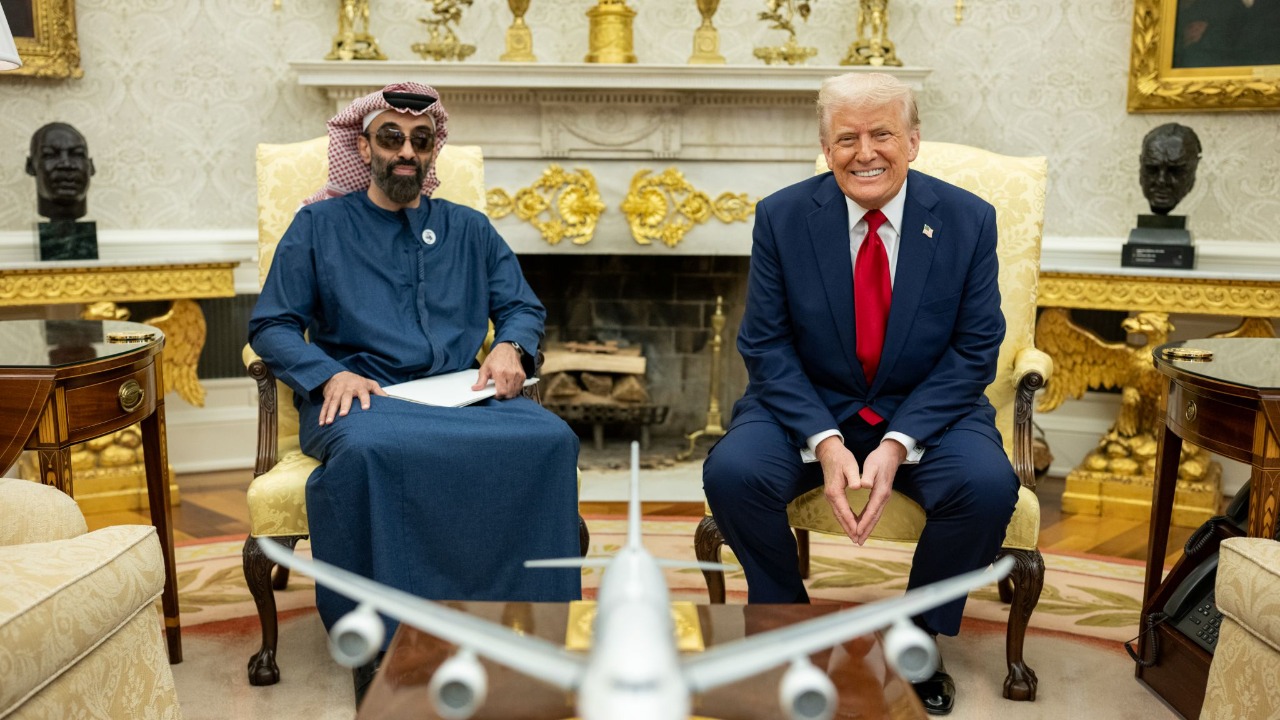
Foreign money has quietly poured into a Trump family cryptocurrency venture, tying the president’s business interests to a powerful security chief from the United Arab Emirates. The scale and secrecy of the investment have raised urgent questions about whether a sitting president is now financially entangled with a foreign government’s national security apparatus. At stake is not just one deal, but the broader integrity of how the United States polices foreign influence when the commander in chief is also a crypto entrepreneur.
The secret UAE stake behind Trump’s crypto push
At the center of the revelations is Sheikh Tahnoon bin Zayed Al Nahyan, a senior member of the Abu Dhabi royal family who serves as the Gulf nation’s national security adviser. Reporting indicates that an entity tied to Sheikh Tahnoon, sometimes described as the UAE’s “spy sheikh,” quietly agreed to buy a major stake in the Trump family’s crypto company, giving a foreign security chief a direct financial interest in a business closely associated with the president. The arrangement, routed through a UAE backed vehicle, was not disclosed to the public as it was being negotiated, even as the Trump brand was aggressively marketing digital assets to retail investors.
According to detailed accounts, the Sheikh Tahnoon linked entity committed hundreds of millions of dollars to the venture, with money flowing through structures that also involved payments to Witkoff family entities. Separate reporting describes the investor as a UAE backed entity tied directly to Sheikh Tahnoon bin Zayed, underscoring that this is not a distant sovereign wealth fund but a vehicle associated with the country’s top security official. The result is a crypto platform branded around the Trump name that is now partly financed by a foreign royal who helps oversee the UAE’s intelligence and security strategy.
A windfall for the Trump family’s crypto empire
The Trump family has spent the past year transforming its political celebrity into a sprawling digital asset business, and the UAE stake appears to have supercharged that effort. Overall, the Trump family’s crypto investments over the past year have increased the family’s net worth by more than 1 billion dollars, a staggering jump for a business line that barely existed before the latest boom. That surge reflects not only the appreciation of Trump branded tokens and platforms, but also the infusion of foreign capital that allowed the company to scale faster than domestic competitors.
Public records and corporate disclosures show that the Trump family’s crypto company, often described as part of a broader Trump family business network, has benefited from a UAE firm that quietly took a significant stake. That same reporting notes that the family’s digital asset ventures have added more than 1 billion dollars to its balance sheet, while also prompting scrutiny from agencies such as the Commerce and State departments that are tasked with monitoring foreign economic influence. The combination of a presidential brand, a lightly regulated crypto market, and a deep pocketed foreign security partner has created a financial engine whose incentives are now deeply intertwined with foreign policy.
Ethical alarms and calls for congressional scrutiny
The revelation that a UAE royal tied to national security has a hidden stake in a Trump crypto venture has triggered a wave of ethical concerns in Washington. Senator Elizabeth Warren, a leading critic of both crypto speculation and presidential conflicts of interest, is already demanding congressional hearings into the arrangement. She has framed the deal as a textbook example of why digital asset markets can become conduits for foreign influence, especially when the beneficiary is a sitting president who controls key decisions on sanctions, arms sales, and intelligence cooperation with the UAE.
In her push for oversight, Senator Elizabeth Warren has pointed to the need for committees to examine how a UAE intelligence chief’s investment intersects with Donald Trump’s policy decisions since his inauguration last year, and whether existing ethics rules are adequate for a president who runs a crypto business. Her concerns echo those of ethics lawyers who argue that a foreign backed stake in a presidential company could create pressure, subtle or otherwise, on issues ranging from military basing rights to export licenses. One detailed policy analysis notes that Senator Elizabeth Warren is specifically sounding the alarm about the UAE connection, warning that Congress cannot ignore a deal that fuses presidential power with opaque foreign crypto money.
How the UAE connection deepens conflict-of-interest risks
What makes this investment uniquely fraught is not just that it comes from abroad, but that it is rooted in the security establishment of a close but sometimes controversial ally. Sheikh Tahnoon bin Zayed is not a passive investor; he is the UAE’s national security adviser, a role that touches on intelligence sharing, counterterrorism cooperation, and regional military strategy. When a figure with that portfolio channels money into a president’s private crypto venture, it blurs the line between commercial partnership and geopolitical leverage in ways that traditional ethics frameworks were never designed to handle.
Analysts note that a UAE backed entity tied to Sheikh Tahnoon agreed to buy the stake at a moment when the Trump administration was weighing sensitive decisions involving the Gulf, from arms sales to diplomatic support in regional disputes. One detailed account by Vince Dioquino describes how the UAE linked investor did not respond to questions about the deal, adding to the opacity around its strategic motives. Another report emphasizes that the investor is part of a broader Abu Dhabi royal network, reinforcing that this is not a distant financial bet but a move by a core member of the ruling elite. The convergence of national security authority and private crypto capital raises the prospect that foreign policy choices could be influenced, or at least perceived as influenced, by the health of a presidential token price.
Regulators, agencies, and the road ahead
Regulatory agencies are now under pressure to determine whether existing tools are sufficient to police this kind of cross border presidential investment. The Commerce and State departments, which already monitor sensitive technology exports and foreign economic ties, are being pushed to examine how a UAE firm quietly took a stake in the Trump family’s crypto company without triggering earlier public scrutiny. Ethics advocates argue that the Committee on Foreign Investment in the United States, or CFIUS, may also need to assess whether a foreign national security adviser’s role as a major investor in a presidential business poses national security risks of its own.
Some watchdog groups are pointing to a bombshell report that a member of the Abu Dhabi royal family secretly backed a major investment in a Trump branded crypto venture affiliated with the Witkoff family, describing it as a stress test for the entire U.S. system of conflict-of-interest safeguards. That account, which details how a member of the royal family used a UAE linked vehicle to channel money into the project, has intensified calls for formal investigations. At the same time, broader coverage of how a UAE firm quietly took its stake, and how the Trump family’s crypto investments have added more than 1 billion dollars to its net worth, underscores that this is not an isolated transaction but part of a larger pattern of foreign capital flowing into a presidential business. With the president still in office and the crypto venture continuing to grow, the question now is whether Congress and regulators will move fast enough to untangle the financial web before it shapes policy in ways that cannot be unwound.
More From TheDailyOverview
*This article was researched with the help of AI, with human editors creating the final content.

Grant Mercer covers market dynamics, business trends, and the economic forces driving growth across industries. His analysis connects macro movements with real-world implications for investors, entrepreneurs, and professionals. Through his work at The Daily Overview, Grant helps readers understand how markets function and where opportunities may emerge.

