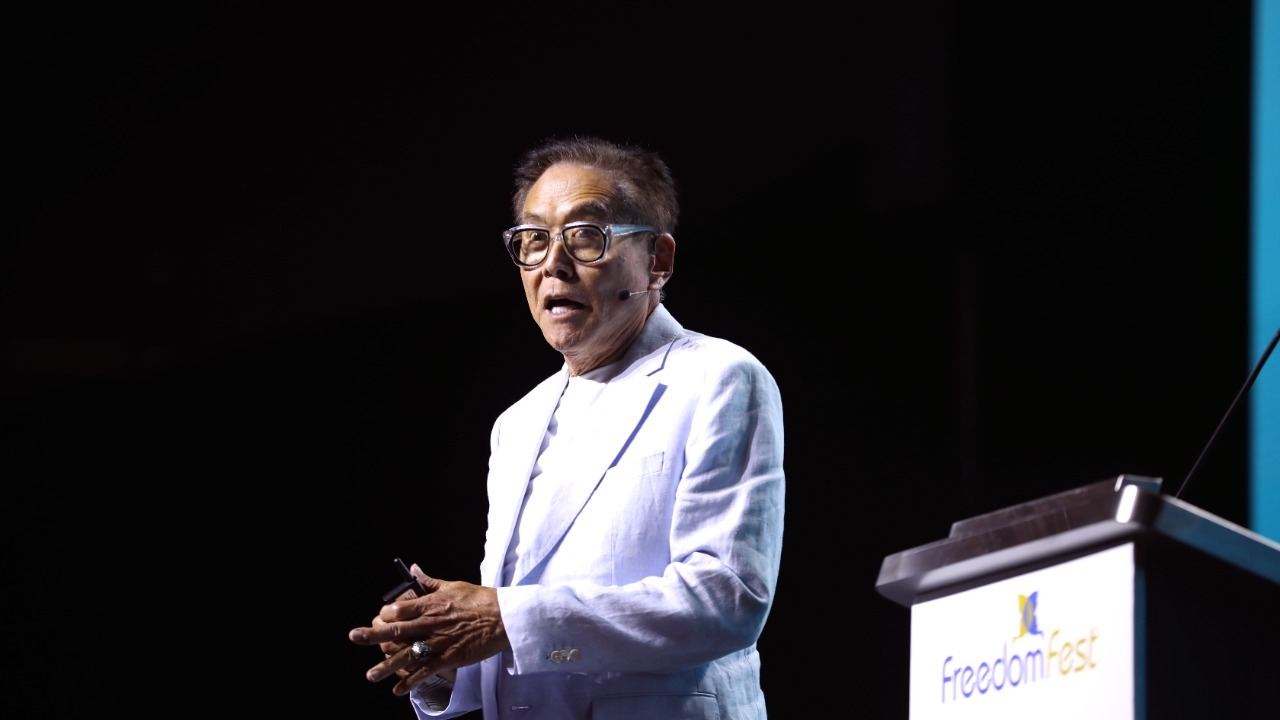
Robert Kiyosaki, the author behind “Rich Dad Poor Dad,” has spent years warning that the U.S. dollar faces a historic collapse, and his recent statements suggest he believes the tipping point is closer than ever. His calls to abandon paper currency in favor of hard assets like gold, silver, and real estate have drawn both loyal followers and sharp critics. What makes this moment different is that the Federal Reserve’s own assessment of the financial system, released in November 2025, identifies real vulnerabilities that lend at least partial credibility to concerns about systemic fragility, even if the central bank stops well short of predicting a crash.
The question for ordinary investors is not whether to pick a side between Kiyosaki and the establishment, but how to interpret the overlapping signals. The Fed’s analysis acknowledges risks in areas like asset valuations and leverage, while Kiyosaki translates those risks into an all-or-nothing narrative about the end of the dollar. Repairing that translation—keeping the useful parts of his skepticism while discarding the hyperbole—is essential for anyone trying to make rational decisions about savings, retirement, and long-term financial security.
What Kiyosaki Is Actually Claiming
Kiyosaki has built a brand around contrarian financial advice, and his latest warnings follow a familiar pattern: the dollar is being debased by government spending and Federal Reserve policy, and ordinary savers will pay the price. He has repeatedly urged his audience to move wealth out of cash and into tangible stores of value. Gold, silver, Bitcoin, and income-producing real estate top his list of recommended hedges. His argument rests on the idea that fiat currency loses purchasing power over time, and that the current trajectory of U.S. fiscal policy accelerates that decline.
The specific language around “the worst dollar crash” is dramatic, and Kiyosaki has used variations of this warning for years. Critics point out that similar predictions have not materialized on the timeline he has suggested in the past. The dollar, while subject to inflationary pressures, has remained the world’s dominant reserve currency and has at times strengthened against other major currencies during global stress episodes. That track record does not invalidate his broader thesis about currency debasement, but it does raise fair questions about the urgency and severity he implies when he frames every bout of volatility as the beginning of the end.
The Fed’s Own Vulnerability Assessment
Separate from Kiyosaki’s commentary, the Federal Reserve published its November 2025 financial stability overview, a primary regulatory assessment of U.S. financial-system vulnerabilities. The report, produced by the Board of Governors of the Federal Reserve System, reflects conditions through October 23, 2025, and covers asset valuations, borrowing, leverage, and funding risks. These are the exact categories that tend to flash warning signs before major market disruptions, which is why regulators track them closely and disclose their findings to the public.
The Fed’s assessment does not predict a dollar crash or anything close to one. What it does is catalog where pressure points exist in the financial system. Stretched asset valuations, for instance, mean that stocks, bonds, or real estate may be priced above levels justified by underlying fundamentals. High borrowing and leverage indicate that households, corporations, or financial institutions are carrying debt loads that could become unmanageable if interest rates rise or incomes fall. Funding risks refer to the possibility that short-term financing markets could seize up during periods of stress, much as they did during the 2008 financial crisis and briefly during the early months of the pandemic in 2020, forcing central banks to step in as lenders of last resort.
None of this amounts to a prediction of collapse. But it does confirm that the system is not without cracks. For someone like Kiyosaki, these findings serve as supporting evidence for a broader narrative about financial fragility. For more cautious analysts, they represent known risks that regulators are actively monitoring, which is precisely why the Fed publishes the report in the first place. The existence of vulnerabilities is an argument for vigilance, stress testing, and prudent regulation—not necessarily for abandoning the currency that underpins the system.
Where Kiyosaki’s Warning Overshoots the Evidence
There is a meaningful gap between identifying vulnerabilities and forecasting catastrophe. The Fed’s report is designed to be a diagnostic tool, not a crystal ball. It flags areas where risk is elevated so that policymakers, financial institutions, and the public can make informed decisions. The existence of elevated asset valuations or rising leverage does not mean a crash is imminent. These conditions can persist for years, and they can also resolve gradually through policy adjustments, market corrections, or changes in economic conditions without triggering a systemic event or a collapse in the currency.
Kiyosaki’s framing tends to collapse this distinction. By presenting every vulnerability as evidence of an approaching disaster, he creates a sense of urgency that may not match the actual probability distribution of outcomes. That urgency can lead followers to make binary choices—“all in” on gold or Bitcoin, “all out” of stocks or cash—when a more measured approach would serve them better. Fear-driven financial decisions, like liquidating a diversified portfolio to buy gold at peak prices, can cause real harm if the predicted crash does not arrive on schedule. The 2008 crisis was devastating, but investors who panic-sold at the bottom and moved entirely into hard assets missed one of the longest subsequent bull markets on record, illustrating how costly it can be to respond to every warning as if it were a certainty.
That said, dismissing Kiyosaki entirely would also be a mistake. His core insight, that holding all of your wealth in a single currency or asset class exposes you to concentrated risk, is sound. The Fed’s own work on funding risks and leverage supports the idea that diversification matters, especially during periods when valuations appear stretched and debt burdens are high. The challenge is to separate the useful skepticism about systemic risk from the theatrical predictions of imminent collapse, and to translate that skepticism into balanced, rather than extreme, portfolio choices.
Practical Steps That Actually Hold Up
If you strip away the apocalyptic framing, the actionable advice embedded in Kiyosaki’s message is not controversial among financial professionals. Diversification across asset classes, including some allocation to real assets like real estate or commodities, is a standard recommendation from wealth managers and institutional investors alike. The logic is straightforward: if one part of your portfolio suffers during a downturn, other parts may hold value or even appreciate, reducing your overall loss. That principle does not depend on a specific forecast about the dollar; it is simply a way to manage uncertainty.
Gold, one of Kiyosaki’s preferred assets, has historically served as a hedge against inflation and currency weakness. It does not generate income the way stocks or rental properties do, but it tends to retain purchasing power over long periods and often behaves differently from equities during crises. Silver and Bitcoin carry their own risk profiles and volatility characteristics, and treating them as safe havens requires a higher tolerance for price swings and the possibility of deep drawdowns. Real estate, particularly income-producing property, offers both a tangible asset and a cash flow stream, though it comes with liquidity constraints, geographic concentration risk, and management costs that purely financial assets do not. A thoughtful investor can incorporate some of these elements without betting everything on any single one.
The more useful takeaway is not that you should abandon dollars entirely, but that concentrated exposure to any single asset, including cash, carries its own form of risk. Inflation erodes the purchasing power of savings accounts and fixed-income holdings over time. Equities can experience sharp drawdowns when valuations are stretched and growth expectations are disappointed. Real estate markets can freeze or fall if financing dries up. The Fed’s assessment of elevated valuations and leverage across multiple sectors suggests that no single corner of the market is without risk right now. Building a portfolio that can absorb shocks from different directions is not a response to doomsday predictions. It is basic financial hygiene that remains valid whether or not Kiyosaki’s worst-case scenario ever materializes.
Separating Signal From Noise
Kiyosaki’s warnings generate attention because they tap into genuine anxieties about debt, inflation, and trust in institutions. Those anxieties are not unfounded; the Fed’s own vulnerability analysis acknowledges that the financial system is exposed to shocks and that certain markets look stretched. The signal in his message is the reminder that systems can and do fail, sometimes in ways that official forecasts underestimate. The noise is the insistence that collapse is both inevitable and imminent, and that only a narrow set of assets will survive it.
For individual savers and investors, the practical path lies between complacency and alarmism. Taking the Fed’s documented vulnerabilities seriously means stress-testing your own finances: limiting high-interest debt, maintaining an emergency fund, diversifying investments, and avoiding overreliance on any single employer, sector, or asset. Listening to Kiyosaki with a critical ear can sharpen your awareness of systemic risk, but treating his timelines and absolutes as destiny can be just as dangerous as ignoring risk altogether. The dollar may or may not face the kind of historic reckoning he envisions, yet the steps that genuinely improve financial resilience—prudence, diversification, and a long-term view—remain the same in either scenario.
More From The Daily Overview
*This article was researched with the help of AI, with human editors creating the final content.

Cole Whitaker focuses on the fundamentals of money management, helping readers make smarter decisions around income, spending, saving, and long-term financial stability. His writing emphasizes clarity, discipline, and practical systems that work in real life. At The Daily Overview, Cole breaks down personal finance topics into straightforward guidance readers can apply immediately.
