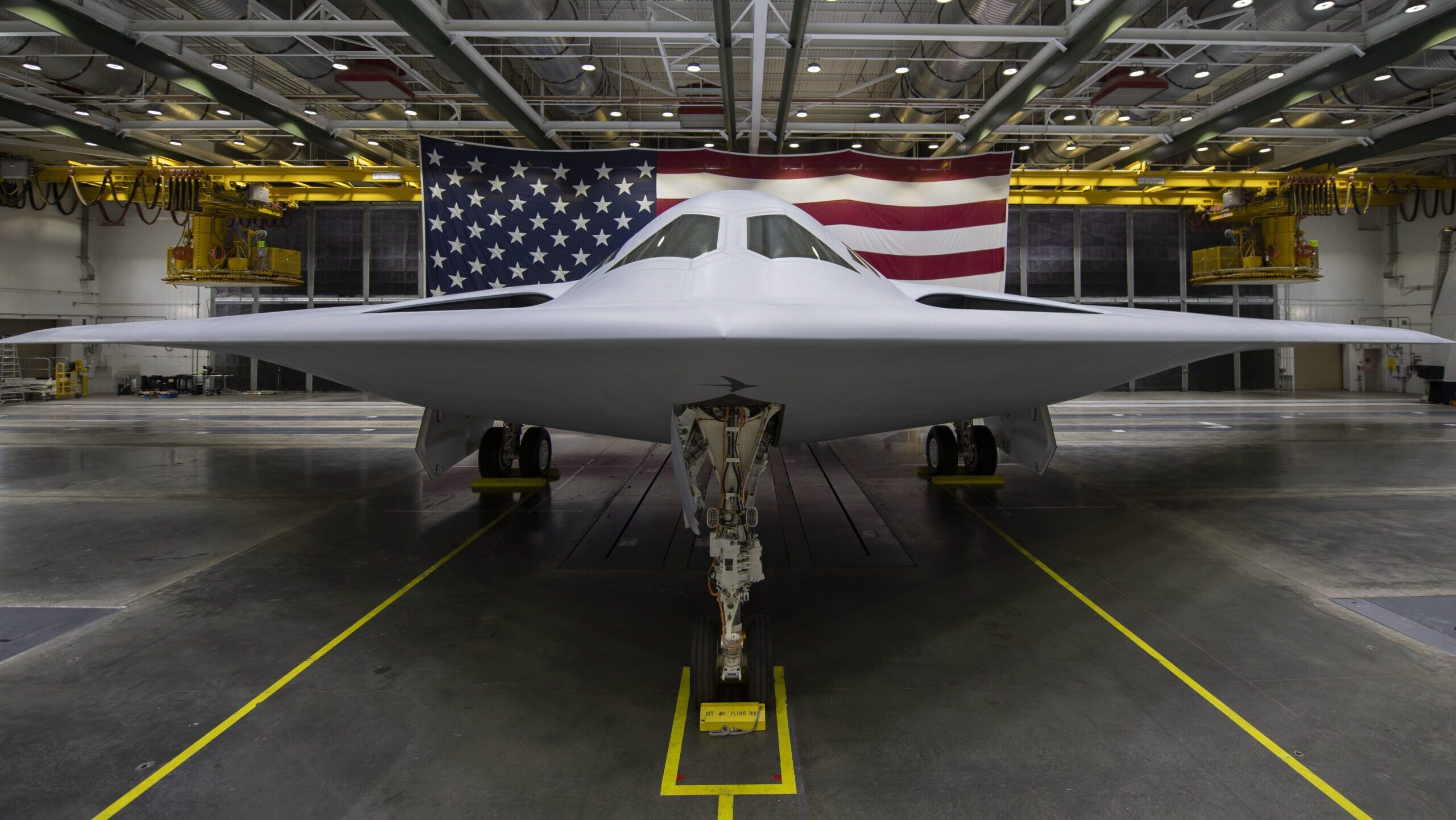
The shutdown-ending deal that reopened the federal government did more than avert missed paychecks and shuttered offices. It quietly steered nearly $1 billion in fresh money toward the US Air Force’s next-generation bomber and intercontinental ballistic missile, locking in new momentum for two of the Pentagon’s most expensive nuclear programs. The move underscores how budget brinkmanship is increasingly being used to hardwire long-term weapons investments into must-pass legislation.
By padding construction and procurement accounts for the B-21 bomber and the Sentinel ICBM, lawmakers signaled that strategic deterrence remains a top-tier priority even in the middle of a fiscal standoff. The result is a shutdown compromise that not only keeps the lights on, but also accelerates the physical build-out of facilities and infrastructure that will shape the nuclear force for decades.
Shutdown deal delivers nearly $1 billion for B-21 and Sentinel
The core outcome of the shutdown deal is straightforward: the US Air Force’s new strategic bomber and ICBM received almost $1 billion in additional funding on top of their existing budgets. Reporting on Nov 16, 2025 describes how the government shutdown agreement included nearly $1 billion more for the B-21 and the Sentinel, giving the Air Force a rare budgetary boost at the very moment Congress was struggling to keep the government open, and underscoring how central these nuclear programs have become to the broader defense spending picture. That same reporting notes that the US Air Force is treating the B-21 and Sentinel as cornerstone systems in its long-range strike and deterrence portfolio, a status now reinforced by the shutdown compromise.
Earlier coverage on Nov 13, 2025 details how negotiators carved out $850 million specifically for construction tied to the B-21 and Sentinel, describing how the Air Force framed these projects as essential to long-term operational success. In that account, the Air Force emphasized that the added money would accelerate facilities and infrastructure that must be in place before the bomber and ICBM can enter full service, a point that helps explain why lawmakers were willing to add $850 million even as they haggled over broader spending caps. Taken together, the Nov and Nov timelines show a clear pattern: as the shutdown dragged on, congressional leaders converged on a deal that paired government reopening with a substantial cash infusion for the Air Force’s nuclear modernization push.
How $850 million reshapes Air Force construction priorities
The $850 million earmarked for B-21 and Sentinel construction is not a generic plus-up, it is a targeted bet on the physical infrastructure that will host and support these systems. Reporting from Nov 13, 2025 explains that as lawmakers negotiated an end to the longest government funding lapse in recent memory, they added $850 million for B-21 and Sentinel construction projects that the Air Force had argued were critical to long-term operational success. In practical terms, that means money for hangars, maintenance facilities, weapons storage, and the specialized support buildings that allow a stealth bomber and a modern ICBM to be deployed, sustained, and secured over decades, rather than just bought off a production line.
The Air Force’s own statement, incorporated into that Nov 13, 2025 coverage, framed the construction surge as a way to avoid bottlenecks later in the decade, when the B-21 and Sentinel are expected to transition from testing into operational service. By front-loading $850 million into these projects, Congress is effectively locking in a schedule that makes it harder for future budget fights to slow the rollout of the nuclear force. It also signals that, within the Air Force, these programs now outrank other infrastructure needs that did not receive similar shutdown-era boosts, a prioritization that will ripple across base communities and competing modernization efforts.
Broader defense winners: Navy shipbuilding and beyond
The Air Force was not the only beneficiary of the shutdown-ending deal, which also delivered major gains for the Navy and other services. Coverage dated Nov 16, 2025 notes that the bill boosts the Navy’s shipbuilding spending by more than $1 billion, including another $510.4 million for specific programs that build on the $510.4 m the base received last year. Those figures show that, even as lawmakers argued over domestic spending and deficit levels, they were willing to expand the Navy’s shipbuilding accounts in parallel with the Air Force’s nuclear modernization, reinforcing a broader pattern of bipartisan support for big-ticket hardware.
That same reporting lists the B-21 and Sentinel alongside other marquee programs as major defense initiatives backed in the shutdown-ending deal, suggesting that the compromise functioned as a mini defense plus-up embedded inside a crisis bill. By pairing more than $1 billion in Navy shipbuilding increases with nearly $1 billion for the Air Force’s bomber and ICBM, Congress effectively used the shutdown resolution to advance a cross-service modernization agenda. The result is a package that not only keeps the government open but also cements higher baselines for some of the Pentagon’s most capital-intensive programs, making it harder to roll back those commitments in future budget cycles.
Critics see a windfall for the military industrial complex
Not everyone views the shutdown deal’s defense add-ons as prudent planning. A critical analysis published on Nov 13, 2025, with additional commentary on Nov 14, 2025, describes the reopening package as including more than $850 in what it characterizes as a bonus for military hardware, highlighting how Congress used the urgency of restarting the government on a Wednesday to funnel extra money into weapons accounts. That critique frames the B-21 and Sentinel funding as part of a broader pattern in which the military industrial complex benefits from crisis-driven legislation, with lawmakers reluctant to challenge defense increases while basic government services are at risk.
From that perspective, the nearly $1 billion in new money for the Air Force’s bomber and ICBM is less about strategic necessity and more about political convenience. By embedding the funding in a must-pass shutdown bill, Congress avoided a standalone debate over whether the B-21 and Sentinel should receive such a large midyear boost, and sidestepped questions about tradeoffs with domestic programs that did not see comparable increases. The critique also points to the way these add-ons normalize higher defense baselines, arguing that once $850 in extra funding is baked into a compromise, it becomes the new floor for future negotiations rather than a one-time exception.
What the nuclear funding surge signals for future budgets
For the Air Force, the shutdown deal’s nearly $1 billion infusion into the B-21 and Sentinel is more than a short-term win, it is a signal about where Congress intends to steer defense dollars in the years ahead. The Nov 16, 2025 reporting that details how the government shutdown deal included nearly $1 billion more for the B-21 and Sentinel makes clear that these programs now sit at the center of Washington’s nuclear modernization consensus. When lawmakers are willing to expand their funding even in the middle of a fiscal crisis, it suggests that future budget fights are more likely to focus on other parts of the Pentagon’s portfolio, leaving the bomber and ICBM relatively insulated.
At the same time, the Nov 13, 2025 account of the $850 million construction boost shows how that protection is being built into concrete and steel, not just line items. Once bases have broken ground on new B-21 hangars and Sentinel support facilities, local economies and political delegations will have a direct stake in keeping the money flowing, reinforcing the programs’ durability in Congress. Combined with the parallel increase of more than $1 billion in Navy shipbuilding, including the specific $510.4 million and $510.4 m figures cited for one shipbuilding account, the shutdown deal points toward a future in which large, hardware-centric projects continue to dominate defense spending debates, even as critics warn that crisis-driven budgeting is giving the military industrial complex an enduring advantage.
More From TheDailyOverview
- Dave Ramsey warns to stop 401(k) contributions
- 11 night jobs you can do from home (not exciting but steady)
- Small U.S. cities ready to boom next
- 19 things boomers should never sell no matter what

Grant Mercer covers market dynamics, business trends, and the economic forces driving growth across industries. His analysis connects macro movements with real-world implications for investors, entrepreneurs, and professionals. Through his work at The Daily Overview, Grant helps readers understand how markets function and where opportunities may emerge.


