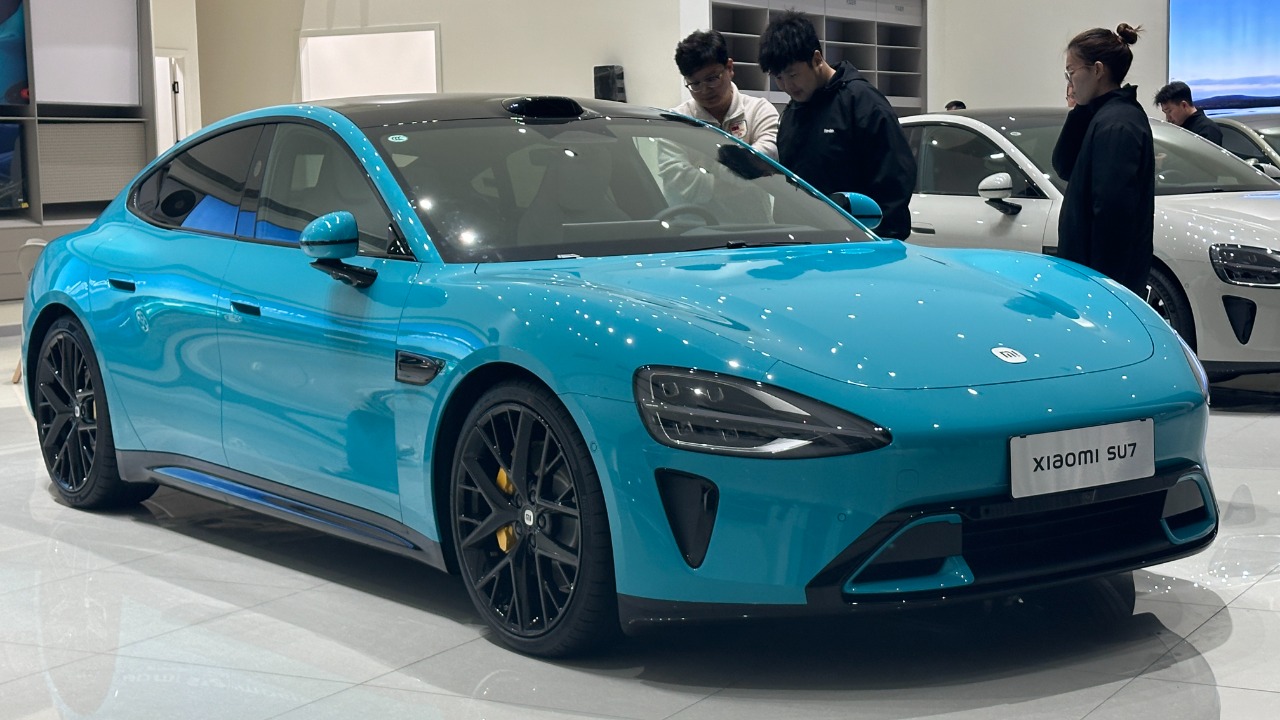
The Biden administration’s 100% tariff on Chinese electric vehicles is supposed to shield Detroit and its union jobs from a wave of low cost imports. Yet the most telling verdict on that strategy may have come not from a politician, but from a Wall Street Journal columnist who spent two weeks with a Xiaomi sedan and walked away convinced that American brands are already behind. After that test, the writer said they no longer wanted to buy U.S. cars, a reaction that exposes how far the technology and user experience gap has opened despite the tariff wall.
I see that reaction less as a hot take and more as a warning label on the current policy mix. If a seasoned reviewer, steeped in years of driving a Mustang Mach-E and a Tesla, can be converted in 14 days by a Chinese EV they cannot even buy in the United States, then the 100% tariff risks becoming a comfort blanket rather than a catalyst for change.
The Xiaomi shock: two weeks that rattled Detroit’s confidence
The core of the story is simple: after living with Xiaomi’s SU7 for about two weeks, the reviewer concluded that this Chinese EV felt smoother, quieter and more engaging than their own Mustang Mach-E and Tesla. They described how the car “sails along smoothly and quietly” while still feeling sportier than the Mustang Mach and the Tesla they already own, a combination that signaled not just parity but a leap in refinement and performance from a newcomer that has only just entered the auto business, as detailed in the test drive of what Xiaomi has built. For a U.S. audience used to thinking of Chinese cars as cheap knockoffs, the idea that a first generation sedan can outclass two of America’s flagship EVs is jarring.
What really unsettled the writer was not just the driving dynamics, but the sense that the SU7 is a well designed and well constructed vehicle that has been engineered around the way people actually use technology. The car’s cabin, software and controls felt like a cohesive product from a company that has spent years building phones and smart home devices, rather than a traditional automaker bolting a tablet onto a dashboard. That is why the verdict was so blunt: after this experience, they wrote that they did not want to buy American cars anymore, a line that appears repeatedly in the account of how the Xiaomi sedan changed their view of American made EVs.
Inside the SU7: software, hardware and the “With Xiaomi” advantage
Part of the SU7’s appeal lies in how it blends smartphone style customization with car grade reliability. The reviewer highlighted the way Xiaomi lets drivers tailor interiors, lighting and digital layouts in a way that feels more like setting up a new phone than configuring a vehicle. They wrote about missing the car’s adjustable color lighting at night and how their kids kept talking about the cabin on weekends, a reminder that design details can build emotional attachment, as described in the reflection that begins with “Now I don’t want to buy American cars anymore” and lingers on those lighting touches.
The most telling detail may be a small piece of hardware. With Xiaomi, drivers do not have to choose between a clean touchscreen only interface and the tactile reassurance of physical buttons. The company sells a slim control bar that magnetically snaps to the bottom of the central screen, instantly adding knobs and switches for climate and media. The reviewer noted how this accessory “just worked,” a sign of how tightly integrated the ecosystem is, and described how With Xiaomi the usual trade off between minimalism and usability disappears. That kind of modular thinking, familiar from phone cases and accessories, is still rare in U.S. cars, where owners often resort to aftermarket clips and mounts to fix what the factory software got wrong.
The price paradox: 299,900 Chinese Yuan versus a 100% tariff
Even more disruptive than the tech is the pricing. In China, Xiaomi launched the SU7 at 299,900 Chinese Yuan, which the reviewer translated to roughly $43,000, a figure that puts it squarely in the same bracket as a well equipped Mustang Mach-E or a mid range Tesla Model 3. That combination of premium feel and mainstream price is what makes the car such a threat, as laid out in the section on the global roadblock that notes how 299,900 Chinese Yuan converts to about $43,000. For U.S. policymakers, that is the nightmare scenario: a foreign EV that looks and feels more advanced than domestic rivals, yet sells for the same money.
The 100% tariff is designed to prevent exactly that kind of car from flooding the U.S. market, but it does not erase the underlying math. If a company like Xiaomi can profitably build a sedan at that price point while packing in long range batteries, high end interiors and sophisticated software, then American manufacturers will eventually have to match that cost structure or risk losing global share. The reviewer’s wistful hope that they and the SU7 “might be together again one day” underscores how artificial the current separation is, a sentiment that hangs over the description of how the Xiaomi SU7 Max, like other Chinese made cars, is effectively locked out of the United States even as it pressures Tesla and other EV rivals abroad.
Detroit’s 700-pound problem: Ford CEO Jim Farley and the “street fight”
U.S. executives are not blind to this threat. Ford CEO Jim Farley has been unusually blunt about the challenge, warning that Chinese manufacturers are the “700-pound gorilla” in the EV industry and that companies like his have to beat them in what he called a “street fight.” That phrase surfaced again in online discussions of the Xiaomi review, where EV enthusiasts shared a link to Farley’s comments under the heading “Ford CEO: We Have To Beat China In A ‘Street Fight’,” a reminder that even insiders see the competitive landscape as brutal, as captured in the Reddit thread that highlights how the Ford CEO framed the stakes. In the test drive piece itself, Farley is quoted describing Chinese players as that 700-pound force whose cost discipline and speed are reshaping the market.
Farley’s warning cuts against the comforting idea that tariffs alone can buy time. If the competition is a 700-pound gorilla that can launch a car like the SU7 every few quarters, then a 100% tariff risks trapping U.S. automakers in a protected but stagnant home market while the real fight plays out in Europe, Latin America and Southeast Asia. The reviewer’s conclusion that their time with the Xiaomi confirmed what experts have been saying about Chinese EVs being a superior take on the segment reinforces Farley’s point, as seen in the passage where Chinese brands are described as delivering a superior take on the EV. The danger for Detroit is that by the time tariffs are relaxed or circumvented through overseas plants, American companies may find that global consumers have already moved on.
The tariff trap: when protection dulls the urgency to improve
The Xiaomi test drive also exposed a psychological risk for U.S. policy. By keeping cars like the SU7 physically out of American showrooms, the 100% tariff reduces the day to day pressure that such products would otherwise exert on domestic brands. Yet the reviewer’s two week fling, chronicled in a first person account that has been shared widely on social media, shows that even a brief encounter can reset expectations. On Facebook, one repost of the story emphasized how the writer “Test Drove” a “Chinese EV” and “Now” they “Don’t” “Want” to go back, turning those words into a kind of shorthand for the experience of discovering a rival that feels a generation ahead, as seen in the social media summary that strings together those Test Drove reactions.
More From The Daily Overview
*This article was researched with the help of AI, with human editors creating the final content.

Grant Mercer covers market dynamics, business trends, and the economic forces driving growth across industries. His analysis connects macro movements with real-world implications for investors, entrepreneurs, and professionals. Through his work at The Daily Overview, Grant helps readers understand how markets function and where opportunities may emerge.

