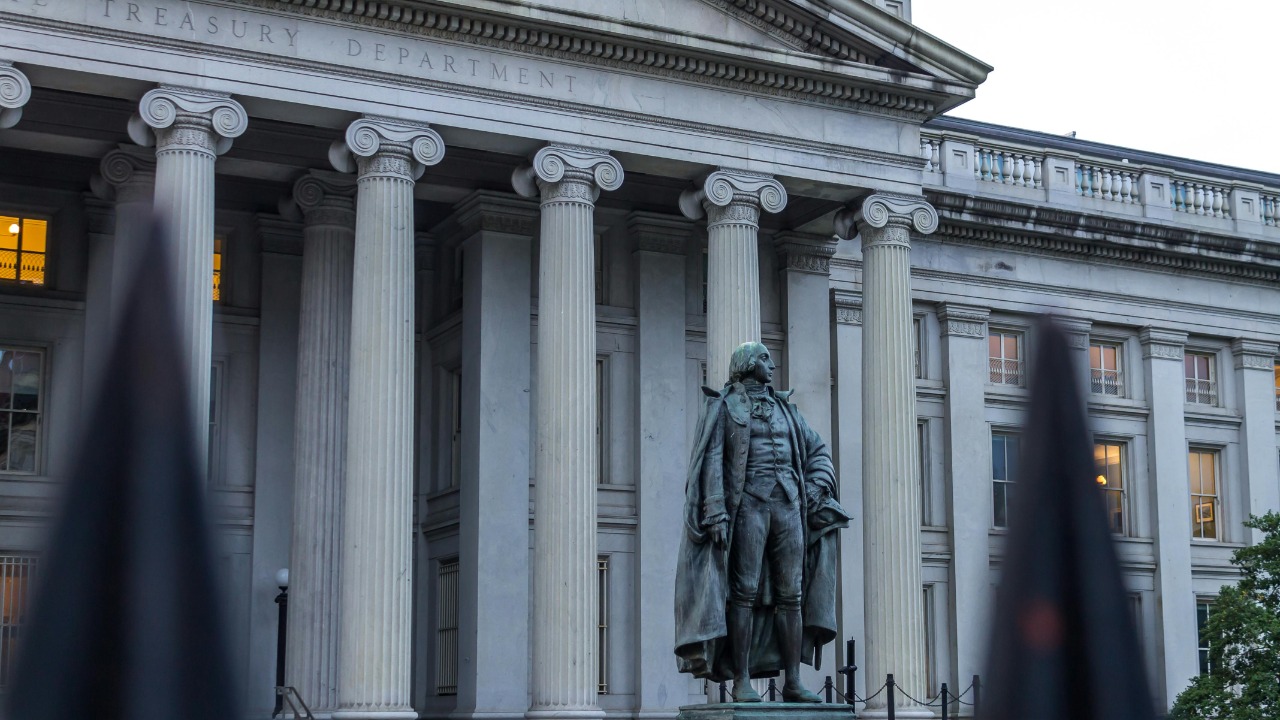
The safest asset in global finance is suddenly at the center of a geopolitical staring contest. With European investors sitting on roughly $8 trillion of U.S. Treasury debt, the threat that those bonds could be dumped in a political dispute is no longer an abstract academic exercise but a live bargaining chip in a widening rift with Washington. The result is a world in which Treasurys, once the ultimate refuge, are being recast as leverage in a high-stakes game that could rattle markets and ordinary savers alike.
At the same time, the United States faces a heavy refinancing calendar and a more volatile rate backdrop, which magnify the risk that any coordinated “sell America” move would collide with domestic funding needs. I see a convergence of structural debt pressures, political brinkmanship and shifting perceptions of U.S. reliability that together make the $8 trillion European position in Treasurys both a deterrent and a danger.
How Europe’s $8 trillion stash became a political weapon
For years, the sheer scale of European holdings of U.S. government debt was treated as a quiet vote of confidence in American institutions. European investors now hold about $8 trillion in U.S. Treasury securities, a concentration that reflects decades of deep financial integration and the central role of the dollar in global reserves and collateral markets. That stockpile is large enough that any hint of a coordinated selloff would instantly focus attention on the fragility of the Treasury market and the potential for a spike in yields, a risk underscored in recent analysis of bargaining chips embedded in cross-border bond portfolios.
The political context has shifted sharply. As President Donald Trump revives tariff threats and presses his ambitions around Greenland, policymakers in Europe are openly weighing how to respond if the United States treats the bloc more like a rival than an ally. One option on the table is a “sell America” strategy that would target U.S. debt and equities, using that $8 trillion as a pressure point rather than a passive investment. The mere discussion of such a move shows how far the relationship has deteriorated and how easily financial interdependence can be reframed as vulnerability.
From safe asset to leverage: the mechanics of a bond dump
Turning Treasurys into a tool of coercion would require more than a few angry statements in Brussels. The idea under debate is a coordinated European decision to reduce exposure to U.S. government bonds, either by refusing to roll maturing securities or by actively selling into the market. Reporting on European investors highlights that this is not a marginal position but a core component of the continent’s savings and banking system, which means any such move would have to be carefully calibrated to avoid self-inflicted damage.
Even talk of weaponizing those holdings has already fed into a broader narrative of bonds as bargaining in the standoff between Washington and its allies. Analysts warn that a large, sudden sale would push Treasury prices down and yields up, tightening financial conditions in the United States and potentially lifting inflation by measurable amounts. At the same time, European institutions would be crystallizing losses on their own portfolios, which is why some officials frame the threat less as a first-strike weapon and more as a mutually assured destruction scenario that is meant to deter aggressive U.S. trade or sanctions policy rather than to be used lightly.
Greenland, tariffs and the “Sell-America” movement
The geopolitical trigger for this shift is unusually specific. As Europe grapples with President Donald Trump’s renewed push to expand U.S. influence over Greenland, and the tariffs that could accompany that campaign, officials are exploring how best to respond without escalating into a full-blown financial war. Some in Europe see the bond market as one of the few arenas where the bloc can match U.S. power, given the scale of its holdings of American assets. The phrase “sell America” has migrated from fringe commentary into mainstream policy debate, reflecting a willingness to consider measures that would have been unthinkable when transatlantic relations were more predictable.
Market professionals are already bracing for the fallout. A recent assessment of Volatility around a potential Sell America Movement Will Complicate Bond Investing points to tariffs, uncertainty about the future of Federal Reserve policy and persistent U.S. deficits as forces that could already drive yields higher. Layering a politically motivated European exit from Treasurys on top of those pressures would amplify swings in prices and make it harder for long-term investors, from pension funds to insurance companies, to manage interest rate risk. In that sense, the Greenland dispute is less an isolated flashpoint than a catalyst for a broader repricing of political risk in fixed income markets.
Washington’s response: Bessent, Denmark and the refinancing crunch
Inside the United States, officials are trying to project calm even as they acknowledge how exposed the system is to foreign sentiment. Treasury Secretary Bessent has highlighted new commitments from allies as evidence that confidence in U.S. debt remains intact, pointing to a Treasury investment agreement with Denmark as a sign of enduring partnerships. Yet the scale of the market means even symbolic gestures are dwarfed by the overall funding need, and the question is whether such deals can offset the chill from a more confrontational stance toward Europe.
The details of that arrangement underscore both its importance and its limits. The $100 m commitment from Denmark, described as $100 million, makes up a very small portion of the $30.8 trillion U.S. Treasury market, and Denmark itself holds just under $10 billion in U.S. government debt as an ally that opposes the Greenland push. At the same time, Treasury Secretary Bessent is confronting what one analysis calls The Refinancing Crunch in 2026, with approximately $8 trillion of existing obligations needing to be rolled over at elevated yields. That maturity wall leaves Washington particularly sensitive to any sign that foreign buyers might step back just as the government is forced to issue more debt at higher rates.
What a coordinated selloff would mean for markets and savers
The most sobering assessments of a European bond dump focus less on diplomatic symbolism and more on the mechanics of market stress. Analysts warn that a coordinated sell-off of Treasurys by European institutions would significantly devalue the dollar, raise borrowing costs for the United States and act as a powerful, but mutually destructive, deterrent. If international investors became less willing to hold U.S. government debt, bond prices would fall, yields would rise and the impact would ripple from mortgage rates to corporate loans to government spending itself, as highlighted in analysis of the erosion of perceived U.S. reliability.
The timing could hardly be worse for households that rely on stable fixed income. Roughly $9.2 trillion in U.S. Treasury debt is set to mature this year, and Treasury auctions will play a critical role in determining how smoothly that rollover proceeds. Should demand from institutional investors, foreign governments or domestic buyers weaken, the government may have to offer even higher yields to move the debt, which would feed directly into the returns and risks facing retirees who hold bond-heavy portfolios. In that environment, I see Treasurys less as a one-way safe harbor and more as a contested asset whose price now reflects not just inflation and growth, but also the willingness of allies to keep politics out of their portfolios.
More From The Daily Overview
*This article was researched with the help of AI, with human editors creating the final content.

Grant Mercer covers market dynamics, business trends, and the economic forces driving growth across industries. His analysis connects macro movements with real-world implications for investors, entrepreneurs, and professionals. Through his work at The Daily Overview, Grant helps readers understand how markets function and where opportunities may emerge.

