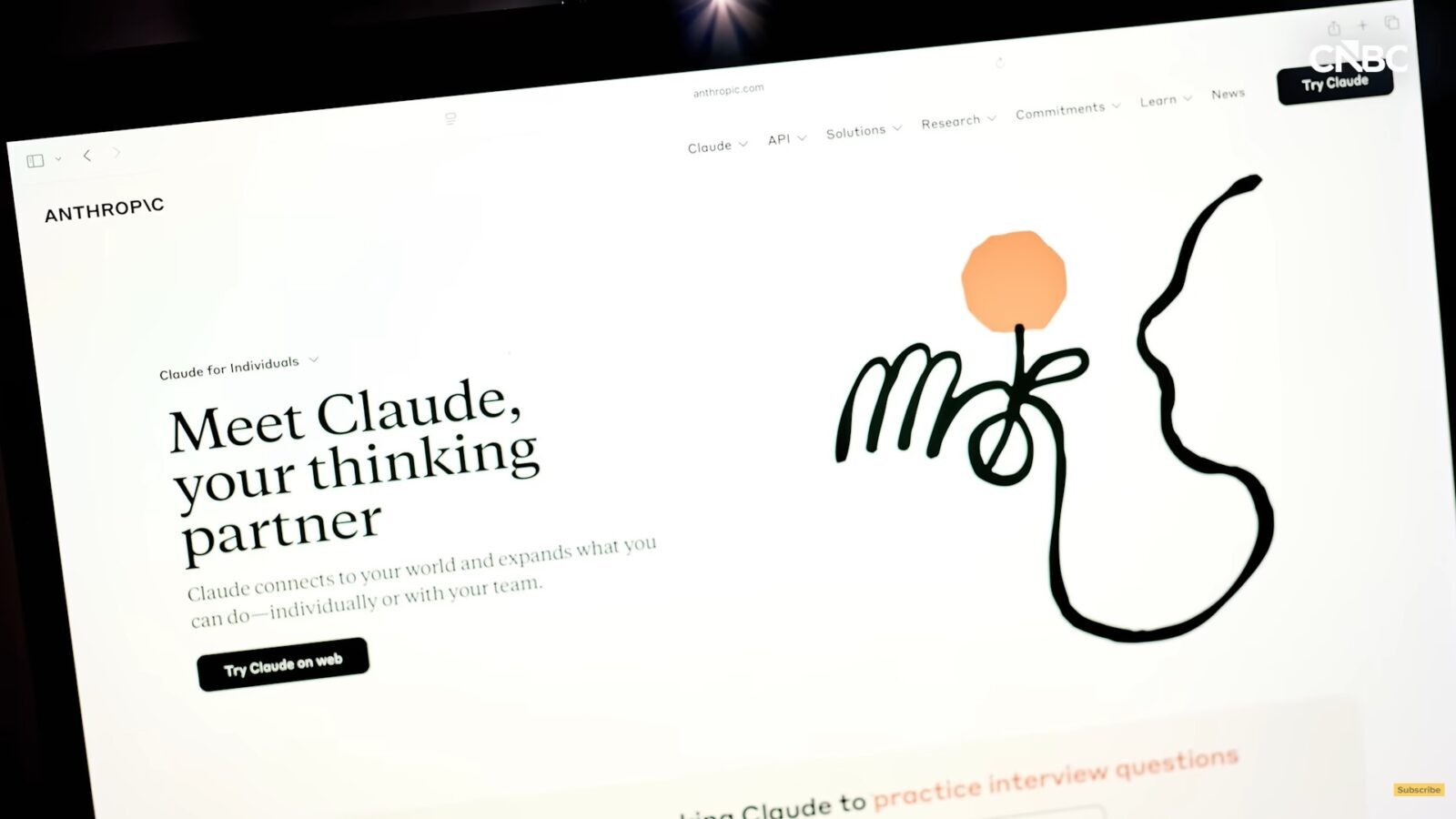
Anthropic spent one extraordinary week proving that in the age of generative AI, a single product update can erase hundreds of billions of dollars in market value and still leave investors clamoring to pour in more cash. Its latest Claude Opus upgrade rattled software, legal and IT services stocks around the world, even as the company moved toward a funding deal that would cement it among the most valuable AI players. The result was a rare moment when Wall Street, corporate IT chiefs and rival labs all had to recalibrate at once.
I see that week as a stress test for how far automation can reach into white collar work, and how quickly markets will try to price in that future. The selloff in enterprise software and services was not just about one model, it was a referendum on whether tools like Claude Opus can replace entire categories of business software and billable hours.
The trigger: a workplace AI that looks like a software suite
The immediate spark was Anthropic’s decision to turn its Claude assistant into a full workplace system that can sit inside corporate workflows rather than just answer ad hoc prompts. Reporting describes Anthropic’s AI tool as an adaptation of its core model into a white collar assistant that can draft documents, summarize research and interact with business data in ways that overlap with existing productivity and analytics platforms. In one account, the tool is shown working with information from a financial data company, FactSet, underscoring how deeply it can plug into professional research tasks that have long supported premium software licenses.
Another description of the same launch emphasizes that Anthropic’s AI tool the Claude assistant specifically for white collar industries, with the piece by Max Zahn noting that the system is pitched as a way to automate repetitive knowledge work. The report highlights that the tool can handle complex tasks across legal, consulting and financial analysis, which is exactly where many high margin software vendors and service firms have built their franchises. When investors saw a general purpose AI stepping directly into those domains, they started to rethink how defensible those franchises really are.
Claude Opus 4.6 and the rise of “agent teams”
Under the hood, the launch was anchored in a new version of Anthropic’s flagship model, Claude Opus 4.6, which is explicitly designed to sustain longer, more complex workflows. Coverage of the release notes that Anthropic launched Claude Opus 4.6 as a model that is better at coding, can keep tasks going for extended periods and can generate higher quality writing. That combination makes it more plausible to treat the system as a semi-autonomous colleague rather than a glorified autocomplete, which is why some executives have started talking about a “vibe working” era where AI agents coordinate entire projects.
The technical leap is even clearer in the description of new “agent teams” that ship with the latest Opus release. One report explains that Opus 4.6 can orchestrate multiple specialized agents that collaborate on tasks, while another notes that, on Thursday, Lucas Ropek described how these teams are being made available for API users and subscribers. The idea is that instead of one chatbot, a company might deploy a cluster of Claude instances, each tuned for roles like research, drafting or quality control, and let them coordinate. That structure looks a lot like a software suite, which helps explain why markets treated the launch as a direct threat to existing enterprise tools.
Markets in “seek and destroy” mode
Once the capabilities became clear, the reaction in equity markets was swift and brutal. One account of the selloff describes how Hadas Gold and John Towfighi chronicled a wave of selling that hit U.S. software names as investors tried to gauge how much Anthropic’s automation could hurt software companies’ bottom lines. The piece notes that traders were not waiting for detailed impact models, they were dumping stocks first and asking questions later, a pattern that often appears when a new technology looks like it could compress margins across an entire sector.
Another report on the same turmoil captures the mood more bluntly, quoting market participants who say the market is in “seek and destroy mode” for business models that look vulnerable to Claude. In that account, Video Unavailable Anthropic is described as one of the biggest and most influential tech companies in the world, launching a new model, Claude Opus 4.6, that is specifically scaring lawyers and legal firms. When a single AI upgrade is framed as an existential threat to billable hours in law, consulting and software all at once, it is not surprising that valuations across those sectors suddenly look fragile.
A trillion-dollar question for enterprise software
The scale of the damage to software valuations has been staggering. One analysis notes that Anthropic’s Claude triggered a trillion dollar selloff in technology stocks, as investors tried to price in the risk that AI assistants could replace or commoditize large chunks of the enterprise stack. That same report explains that Anthropic’s enterprise push with Opus 4.6 is explicitly aimed at overlapping with traditional business software, from project management to analytics, which is why the reaction was not limited to a handful of niche vendors.
Another account from India underscores just how global the shockwaves have been. Coverage there describes how Anthropic AI launched new “agentic AI” tools that became the catalyst for a sharp drop in Indian IT and BPO stocks, with the report stressing that the firm is backed by Amazon and Google. A separate market recap notes that Concerns about Anthropic were a central factor in the slump in Infosys, TCS and Wipro, as Investors digested reports that the new tools could automate work currently handled by software, legal and data companies. When a single AI vendor can move both Nasdaq software names and NIFTY IT in the same direction, it signals that the market now sees generative AI as a cross-border, cross-sector disruptor rather than a niche productivity boost.
From software rout to broader market jitters
What started as a software story quickly spilled into the wider market. One account of the turmoil describes how a new automation tool from Anthropic PBC sparked a selloff that spread from software to the broader market, with a video segment noting that ANTH and PVT were among the tickers in focus as traders reassessed AI winners and losers. Another report on the same theme explains that an Anthropic AI tool sparked selling that moved beyond pure tech into sectors that depend on software and data services, as investors tried to anticipate second order effects.
Broader market commentary reinforces that this is now a macro story, not just a tech one. One market wrap notes that on equity markets, investor caution remains high after Anthropic unveiled a tool that could be used by firms to carry out tasks that previously required multiple software products, raising fears that AI advances could render current technologies obsolete. Another piece on the selloff in U.S. and European markets notes that, by Chibuike Oguh, Samuel Indyk and Danilo Masoni, traders were reacting to Anthropic’s AI tools by dumping data analytics and business software stocks, with one source saying the market is selling first and asking questions later. That kind of behavior is typical when investors suspect a structural break in how profits will be generated across the economy.
Energy, funding and the cost of Anthropic’s ambition
Behind the market drama sits a more fundamental question about how much capital and energy it will take to build and run these systems. One analysis of the knock-on effects notes that Justin Worland has highlighted how Anthropic’s market disruption is tied to a surge in demand for power and infrastructure, as the company races to bring its product to market. The piece points out that tickers like CRM and ADBE are caught in the crossfire, as investors weigh whether incumbents can afford to match Anthropic’s training and deployment budgets while still delivering the margins public markets expect.
At the same time, Anthropic itself is on the verge of locking in a war chest that would let it keep scaling. One report details how Dario Amodei, co-founder and chief executive officer of Anthropic, is steering a funding round of more than $20 billion that could close as soon as next week, after the company’s valuation crossed $9 billion last summer. The same account notes that Photographer Chris Ratcliffe captured Amodei as he pitched investors on the scale of the opportunity, underscoring how the company is using the market chaos as proof that its tools are already reshaping entire industries. If that funding lands on the terms reported, it will give Anthropic the resources to keep training larger models and deploying more agent teams, even as rivals scramble to respond.
Rivals, regulators and the road ahead
The wild week of selling and fundraising has also sharpened questions for Anthropic’s competitors and for policymakers. One detailed account of the software rout notes that Enterprise software investors are watching closely as Anthropic, the AI startup whose workplace assistant wiped off nearly $300 billion from software stocks in one day, releases its new AI model. The report explains that the assistant is designed to help employees search internal documents, draft emails and find information online, which overlaps directly with features that companies like Microsoft and Salesforce have been building into their own platforms. For those incumbents, the question is whether to double down on in-house AI, partner with Anthropic, or risk being undercut on price and capability.
Regulators, meanwhile, are being forced to think about systemic risk in a new way. One market-focused piece notes that Bloomberg commentators have started to frame Anthropic’s tools as potential triggers for sudden repricing events, similar to how new financial instruments once created unexpected volatility. Another report on the broader selloff explains that Carmen Reinicke, Joe have chronicled how an Anthropic AI tool sparked selling from software to the broader market, raising the prospect that future AI releases could become macro events in their own right. If every major model upgrade can move trillions in market value, regulators will eventually have to decide whether AI disclosures should be treated more like earnings guidance or like the launch of a new derivative.
More From The Daily Overview
*This article was researched with the help of AI, with human editors creating the final content.

Grant Mercer covers market dynamics, business trends, and the economic forces driving growth across industries. His analysis connects macro movements with real-world implications for investors, entrepreneurs, and professionals. Through his work at The Daily Overview, Grant helps readers understand how markets function and where opportunities may emerge.

