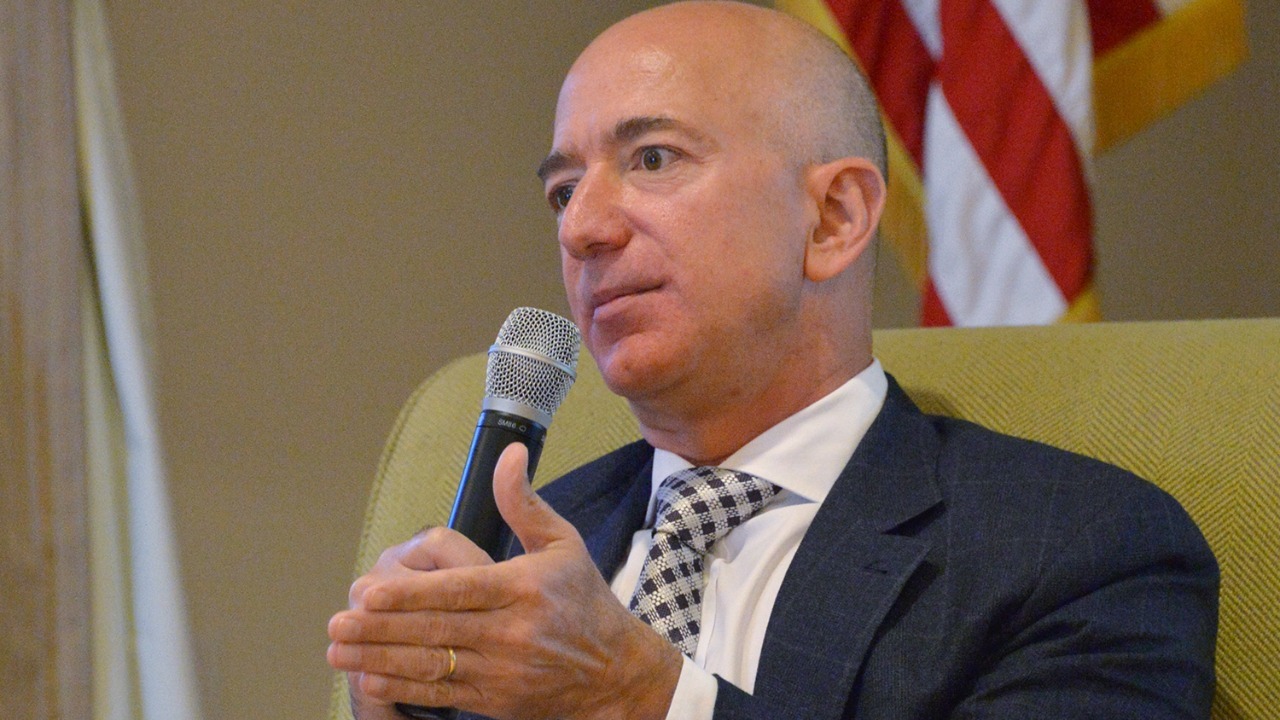
Plenty of people quietly decide that if they have not built serious wealth by their 30s, they have missed their shot. Jeff Bezos did not. He founded Amazon at 30, took it public at 33, and watched the company complete its IPO on May 15, 1997 at an initial share price of $18, proving that mid-career can be the starting line, not the finish.
His path was not a straight sprint to riches, and the early numbers show how much uncertainty he accepted along the way. Yet four lessons from that period answer the questions many mid-career workers ask themselves about timing, impact and risk when they wonder if it is already too late.
Lesson 1 – Embrace calculated risks like Bezos’ garage startup
Jeff Bezos launched Amazon in 1994 from a Bellevue garage, a choice that symbolized both constraint and intentional risk. The company’s early public filings describe a business that began with limited capital and relied on a patchwork of financing tools, including credit arrangements and other obligations detailed in exhibits to its first comprehensive Amazon SEC report. Those documents show a founder who did not wait for perfect funding conditions but instead structured agreements to keep the doors open while he tested whether people would really buy books online.
By the end of 1997, that experiment had clearly found traction. According to the same Primary Amazon filing, the company had more than $164 million in sales through Dec. 31, 1997 and approximately 1.5 million customer accounts, even as it remained unprofitable. The growth of those customer accounts, achieved in just a few years after Bezos’ mid-30s leap, shows how a calculated gamble backed by careful financing structures can create real scale before traditional measures of success like net income ever appear.
Lesson 2 – Focus on customer obsession over perfection
The same 1997 report makes clear that Amazon was not chasing tidy financial statements in its early years. The company generated more than $164 million in net sales through Dec. 31, 1997 yet still posted a net loss of $27.6 million for that year, figures laid out in detail in the Primary disclosure. Management framed those losses as the result of heavy spending on technology, marketing and infrastructure, a deliberate choice to prioritize growth and customer experience instead of short-term profitability.
Customer behavior suggests that approach had impact. The same filing states that more than half of orders came from repeat customers, a sign that the company’s early focus on selection and service was resonating with buyers. The 10-K does not provide a precise retention rate, and any exact percentage beyond that “more than half” threshold would be unverified based on available sources, but the repeat-order share cited in the Amazon 10-K shows that customer obsession can be a more powerful early metric than clean quarterly profits.
Lesson 3 – Scale internationally early despite losses
Even while the company was losing money in 1997, its management was already looking beyond the United States. The 10-K describes international sales as a meaningful and growing portion of revenue, although it does not break out precise figures for every geography, and any detailed country-by-country breakdown before 1998 would be thinly supported. That context frames the decision to expand abroad, including the launch of sites such as the United Kingdom operation, as part of a strategy to build a global brand while competitors were still treating e-commerce as a niche.
Public market investors responded strongly to that growth story. On its first day of trading, Reputable reporting on Amazon shows that the stock, priced at $18 in the offering, surged to close around $36, roughly doubling and raising about $54 million in the process. That first-day performance signaled that investors were willing to fund a company that was still unprofitable but pursuing international scale, a dynamic that remains relevant for founders today who are weighing whether to expand beyond their home markets before their income statements look tidy.
Lesson 4 – Build compounding wealth through public markets
The mechanics of Amazon’s IPO show how quickly public markets can translate a mid-career pivot into significant paper wealth. In its corporate announcement, the company said its IPO would offer 3,000,000 shares of common stock at $18 per share, with underwriters receiving an over-allotment option that could increase the total if demand warranted. That structure meant that the market was not only providing fresh capital to the business but also assigning a public valuation to the existing shares held by Bezos and early investors, turning years of private risk into an asset that could grow alongside the company’s market capitalization.
Bezos’ exact post-IPO stake and its value at various points in time require either detailed review of SEC ownership tables or wealth estimates from outlets such as Forbes, and any specific dollar figure beyond that would need to be attributed to those external calculations. What the Primary SEC index does make clear is that the IPO locked in a transparent share structure and created a liquid market for those shares, which allowed his wealth to compound in public view as the stock price moved. For mid-career professionals, the takeaway is that equity in a scalable business, once public, can become a far more powerful driver of net worth than salary alone.
Why age is no barrier – Applying lessons today
Bezos’ story resonates with anyone wondering if starting in their 30s or 40s is simply too late. He left a high-paying job around age 30 to launch a company that, at the time, had no guarantee of success, a point highlighted in mid-career wealth analyses that draw on his example, including coverage from AOL Finance. Those pieces emphasize that his breakthrough came after he had already built a conventional career, suggesting that experience and professional networks can become assets rather than anchors when someone decides to pursue a new venture.
The environment has also changed in ways that lower the barrier to entry. Commentators who revisit Bezos’ path, such as personal finance writers at GoBankingRates, point out that tools that did not exist in 1997 now make it easier to launch e-commerce businesses, from no-code website builders to global payment platforms. At the same time, they acknowledge that markets are more saturated than during Amazon’s early days, so replicating his exact trajectory is unlikely, but the underlying principle that age is not a hard ceiling on wealth creation still holds.
Uncertainties and next steps
Amazon’s own risk disclosures show how precarious that journey was, even after the IPO. The company’s press announcement about its IPO explicitly mentioned a lawsuit from Barnes & Noble, with Amazon disputing the claims yet still flagging the case as a material legal risk. That episode illustrates how quickly legal and competitive challenges can emerge once a business gains visibility, and how wealth tied to a single company can swing with outcomes that are partly outside a founder’s control.
For readers weighing their own moves, the filings and reports around Amazon’s early years offer a template for disciplined risk assessment. The Primary SEC index of exhibits, which lists credit agreements, warrants, leases and auditor consents, shows the level of documentation behind each financing and operational decision. Translating that mindset to a personal level means mapping out obligations, understanding the cost of capital, and recognizing that even a well-researched leap cannot guarantee Bezos-like results. The lesson is not that everyone can become a billionaire after 30, but that thoughtful, documented risks taken in mid-career can still change the trajectory of a life.
More From The Daily Overview
*This article was researched with the help of AI, with human editors creating the final content.

Cole Whitaker focuses on the fundamentals of money management, helping readers make smarter decisions around income, spending, saving, and long-term financial stability. His writing emphasizes clarity, discipline, and practical systems that work in real life. At The Daily Overview, Cole breaks down personal finance topics into straightforward guidance readers can apply immediately.
