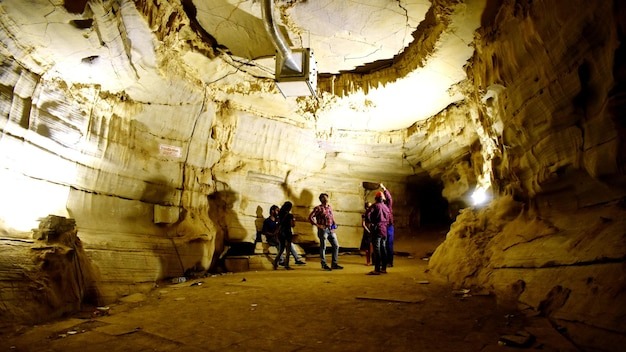
High on a rocky Arizona hillside, a onetime gold mine has been reborn as a fortified cave home with a price tag that hovers around $277K and a sales pitch built on surviving the worst the world can throw at you. The listing leans into the idea that thick stone walls and a remote location can blunt everything from nuclear fallout to a zombie apocalypse, while still delivering the basics of a comfortable mountain retreat. I see it as a vivid example of how fear, climate anxiety and real-estate opportunism are converging in the desert.
Instead of a typical suburban bunker buried in a backyard, this property is literally carved into the side of a mountain, marketed as both a novelty and a shield against modern threats. Its promoters frame it as a rare chance to buy into the prepper lifestyle without giving up running water, outdoor entertaining space or a view, all for less than many starter homes in big metro areas.
The old gold mine that became a bunker
The cave home started life as an industrial void, a former gold mine tunnel blasted into solid rock before being sealed and adapted as a private retreat. The listing describes it as an Old Gold Mine roughly $277K, a figure that instantly sets it apart from the multimillion dollar compounds that usually dominate doomsday fantasies. The structure sits partway up the slope, with the main living area recessed into the rock and a steel entry that reads more like an industrial portal than a front door.
Inside, the rough-hewn stone walls and arched ceilings have been partially tamed with basic finishes, turning what could have been a claustrophobic shaft into a surprisingly open-feeling series of rooms. A second reference to the same Old Gold Mine notes that the property has drawn intense curiosity, in part because it straddles the line between novelty listing and serious survival shelter. I read that dual identity as central to its appeal: it is both a conversation piece and a concrete response to a world that feels less stable.
From miners’ cave to mountain retreat
Photographs of the interior show how far the space has come from its days as a raw tunnel used by Gold Miners. The cave has been staged with furniture, lighting and decor that emphasize its transformation into a livable hideaway, with the stone backdrop treated almost like an exposed-brick feature wall. A dedicated gallery of the PICTURED $277K Gold Miners’ Cave In Arizona Turned Into Mountain Retreat highlights how the designers leaned into the natural curves of the rock, carving out niches for beds and seating rather than fighting the geology.
Outside, the parcel immediately beyond the bunker has been set up as an outdoor entertaining zone, with room for seating and gathering that contrasts with the enclosed feel of the interior. Reporting on the same Gold Miners’ Cave In Arizona Turned Into Mountain Retreat notes that Gates and chains guard the property, underscoring its bunker persona while still allowing for barbecues and stargazing when the world is not ending. I see that blend of security hardware and leisure space as a visual shorthand for the way many buyers now want to live: relaxed, but behind a locked gate.
Prepping for climate change, nukes and zombies
The marketing around this cave home leans heavily on the idea that it can keep an owner safe from a growing list of threats, from climate change to nuclear war to fictional hordes of the undead. One analysis of the listing frames it bluntly as a place that “could protect you from climate change, nuclear war or even a zombie apocalypse,” pointing out that there is one such cave home for sale for $277K in Arizona right now, a claim backed up in detail by Moneywise. The same reporting notes that Americans have disasters on their minds, with insurance companies and risk models increasingly focused on wildfire, flooding and severe storms.
Another breakdown of the property, headlined around the idea that there is a $277K cave home for sale in Arizona, ties the listing to a broader shift in the housing market as climate impacts intensify. It points out that an increase in wildfires, flooding and severe storms is driving up insurance premiums and even creating insurance deserts, where homeowners struggle to find coverage at all, a trend that makes a hardened, rock-encased dwelling look more rational than eccentric. That context is laid out in detail in a Jan report that links the cave home to rising climate risk.
Even the more playful coverage of the listing circles back to the same anxieties. One piece framed around the question of whether you would live in a cave notes that, Whether it is zombies, climate change or nuclear annihilation that keeps you awake at night, modern threats are pushing some buyers to consider unconventional shelters. That framing appears in a feature that opens with the word Would and quickly pivots to the word Whether, underscoring how the cave is being sold as a psychological balm as much as a physical refuge. I read that tone as a sign of the times: even tongue in cheek, the idea of needing a blast-proof hideout no longer feels entirely like science fiction.
How this bunker fits into Arizona’s survival real estate
Arizona has quietly become a showcase for extreme properties that promise security, from hillside bunkers to decommissioned military infrastructure. A striking example is a decommissioned nuclear missile silo in Arizona being sold as a private compound, with a Realtor giving an inside look at the hardened underground chambers that once housed strategic weapons. Compared with that silo, the cave home is smaller and less engineered, but it taps into the same appetite for structures originally built for something other than domestic life, then repurposed as private refuges.
At the other end of the spectrum, Arizona’s luxury market still revolves around panoramic views, resort-style pools and open-plan living, with buyers urged to explore property listings on reputable platforms like Zillow and Realtor to find homes that match their vision of elite living. The cave home effectively splices those two strands together, offering a mountain setting and outdoor entertaining area alongside a hardened, windowless core. In my view, that hybrid identity is what makes it newsworthy: it is both aspirational and defensive, a luxury retreat for an age of rolling crises.
Is a $277K cave home really practical?
For all the apocalyptic marketing, the cave home still has to function as a day to day residence, and that is where the practical questions begin. One analysis that asks whether you would live in this $277K Arizona bunker if it could keep you safe from climate change, nuclear war or even zombies points out that living in a cave means accepting trade offs in natural light, ventilation and access, even if the structure sits within a gated community. That tension is captured in a piece that starts with the word Jan, which frames the bunker as both a fantasy and a real housing option.
Another report on how a cave home could protect you from climate change, nuclear war or even a zombie apocalypse, and how there is one for sale for $277K in Arizona right now, notes that Americans have disasters on the brain and that some are willing to trade conventional comforts for perceived safety. That perspective is echoed in a separate Jan analysis that treats the cave as a case study in disaster driven demand. I see the practicality question as ultimately personal: for some, the trade offs will feel extreme, but for others, the combination of price, privacy and perceived protection will be exactly what they are looking for.
More From TheDailyOverview
*This article was researched with the help of AI, with human editors creating the final content.

Elias Broderick specializes in residential and commercial real estate, with a focus on market cycles, property fundamentals, and investment strategy. His writing translates complex housing and development trends into clear insights for both new and experienced investors. At The Daily Overview, Elias explores how real estate fits into long-term wealth planning.

