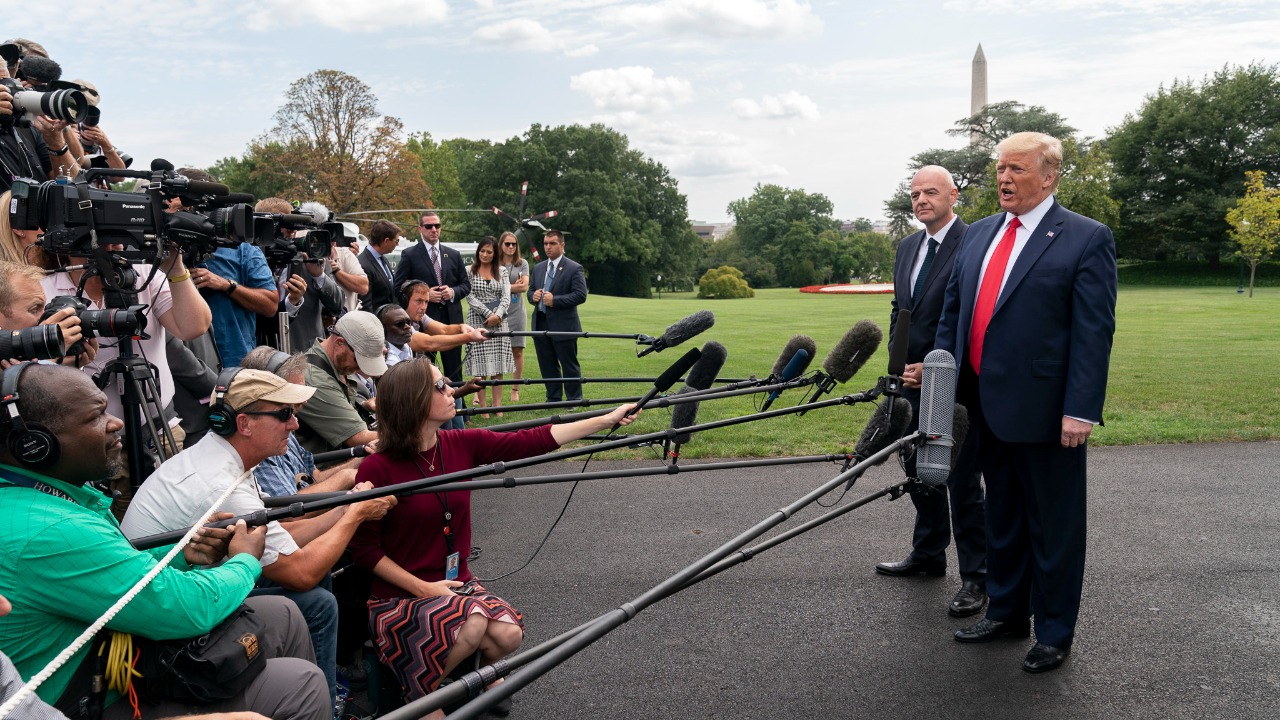
At a recent rally, Donald Trump told supporters, “You saw today we have 4.5% inflation,” slurring his way through a jumble of economic talking points that blurred basic concepts like prices and unemployment. The line was meant to dramatize the cost of living, but it clashed sharply with official data and with his own repeated claim that he has already “defeated” inflation. The disconnect between the numbers and the narrative now sits at the center of his economic message.
Trump’s speeches have increasingly leaned on sweeping boasts and improvised statistics, even as government figures show a more complicated picture. Inflation has cooled from its post‑pandemic peak but remains above the Federal Reserve’s preferred level, and economists warn that the fight against rising prices is not over. The gap between Trump’s rhetoric and the data is becoming a political story in its own right.
The 4.5% line that never matched the data
When Trump told a crowd in North Carolina that “you saw today we have 4.5% inflation,” he presented the number as if it came straight from fresh government releases. The remark, delivered During a political rally in North Carolina, cast the economy as spiraling again on his watch. Yet official figures show that the annual inflation rate in the United States was 2.7% for the 12 months ending December, not 4.5%, according to data compiled for the United States. That 2.7% figure has been echoed in broader coverage of price trends, which notes that inflation has cooled but not disappeared.
Video of the same event shows Donald Trump repeating “4.5% inflation” in slurred remarks at a MAGA rally, where he appeared to mix up unemployment and inflation while insisting “We have 4.5% inflation,” a moment that critics seized on as a sign of confusion. One clip, circulated by Trump critics, shows him leaning heavily on the 4.5% line while the crowd listens in silence. Another segment from the same North Carolina appearance, shared with the caption that he “routinely flubs his remarks,” underscores how the 4.5% claim has become shorthand for his habit of making up random economic data in the middle of a MAGA riff, as highlighted in footage featuring During that rally.
Trump’s self‑declared victory over inflation
The 4.5% riff sits awkwardly beside Trump’s other favorite line on prices, his insistence that he has already beaten inflation. Nearly a full year into his second term, President Trump visited a Ford auto plant in Michigan and declared that inflation was “defeated,” even as he acknowledged a 2.7 percent rise in prices, according to coverage of his remarks at Ford in Michigan. He has repeated that theme on the world stage, telling leaders at the World Economic Forum in Davos that he had “defeated” inflation, a boast that came even as domestic price indices showed ongoing pressure on household budgets, as noted in accounts of his appearance as President Donald Trump at Davos.
Independent assessments have been more cautious. One analysis notes that But the numbers tell a more modest story, pointing out that While inflation has indeed cooled, it is far from the ideal rate, coming in at 2.7% in December and averaging 2.4% over the past year, a reminder that prices are still rising faster than the Federal Reserve’s 2 percent goal, as detailed in a review of his Davos claim that begins with the phrase But the. Another breakdown of the same data stresses that the December 2025 annual inflation rate of 2.7 percent was roughly in line with the pace of price growth when Trump first took office, and still above the central bank’s target, even as The December figures were used by Trump to argue that inflation was “essentially gone,” according to a detailed look at The December data.
What the economists actually see in the numbers
Professional forecasters have not embraced Trump’s victory lap. The consensus view, summarized in one economic blog’s Body section, is that inflation is likely to continue a gradual descent toward the Federal Reserve’s 2 percent target, but that there is still a risk of renewed price pressure if expectations drift upward, a warning laid out in an analysis that explicitly references the Body of research on inflation expectations and the Federal Reserve. A separate survey of economists, conducted as part of a regular outlook on growth, found that concerns about runaway prices have eased but not vanished, with many respondents expecting moderate expansion in 2026 while still watching inflation as a key risk, according to a survey summarized by Harriet Torry and Anthony DeBarros that notes how inflation expectations have shifted.
Fact‑checkers have also pushed back on Trump’s framing. In one widely cited review, analysts noted that Trump’s claim that “Inflation has stopped, wages are up, prices are down” was only partially accurate: Wages are up, but Inflation has not stopped and Prices, which are measured by consumer indexes, are still rising, even if more slowly than at the peak, a point spelled out in a detailed breakdown of Inflation, Wages and Prices under his administration. Another examination of his Davos remarks noted that But the numbers tell a more modest story than his rhetoric, stressing again that While inflation has indeed cooled to 2.7% in December, it remains above target and continues to erode purchasing power, as laid out in a follow‑up analysis that repeats the phrase While to frame the caveats.
From Pennsylvania rallies to Davos boasts
Trump’s economic messaging has followed a consistent pattern across venues, from domestic rallies to global summits. In Pennsylvania, President Trump used a campaign‑style speech to tout his economic policies and promise relief on the “number one issue” of the cost of living, leaning on anecdotes and applause lines rather than detailed statistics, as seen in footage of President Trump speaking in Pennsylvania. At Davos, he shifted to a triumphal tone, telling fellow leaders that his administration had “defeated” inflation even as domestic data showed a 2.7% annual rate and lingering pressure on essentials like housing and food, a contrast highlighted in coverage of his appearance at the World Economic Forum.
Financial reporters Greg Iacurci and Jessica Dickler have noted that while Trump describes the United States as having “virtually no inflation,” many economists disagree, pointing to the 2.7% rate and warning that declaring victory too early could undermine the Federal Reserve’s efforts to keep expectations anchored, a tension explored in a piece that lists the bylines of Greg Iacurci and Jessica Dickler. A related version of that analysis, which notes that the piece was Published Wed, Jan and later Updated Wed in the afternoon EST, underscores how Trump’s claim that inflation is “defeated” sits uneasily with the reality that prices are still climbing, as detailed in a follow‑on segment that repeats the “Published Wed, Jan” and “Updated Wed” EST timestamps.
Political stakes of a muddled economic message
Trump’s habit of mixing up figures has political consequences. His approval ratings have fluctuated as voters weigh their own experience of prices against his upbeat narrative, with one tracker noting that Net approval rating, measured in percentage points, has moved within a band that reflects both strong support among his base and deep opposition among critics, a pattern illustrated in an interactive chart that follows Donald Trump through his second term. For supporters, the claim that inflation is “defeated” reinforces a story of economic competence; for skeptics, the 4.5% slip and similar flubs feed doubts about his command of the details.
More From The Daily Overview
*This article was researched with the help of AI, with human editors creating the final content.

Grant Mercer covers market dynamics, business trends, and the economic forces driving growth across industries. His analysis connects macro movements with real-world implications for investors, entrepreneurs, and professionals. Through his work at The Daily Overview, Grant helps readers understand how markets function and where opportunities may emerge.

