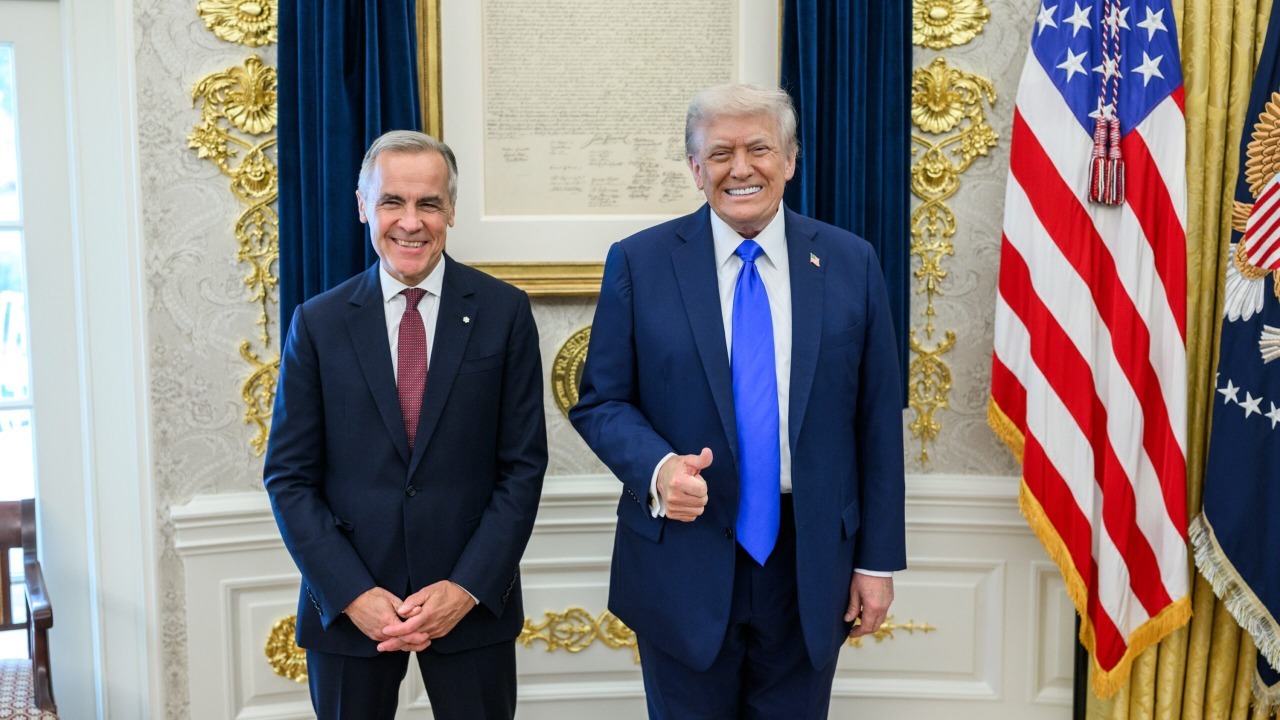
Canada’s corporate establishment has delivered a rare and very public slap at Canadian Prime Minister Mark Carney, challenging his approach to managing relations with President Donald Trump. At the heart of the clash is how far Canada should go in hedging against U.S. pressure without jeopardizing an economic relationship that still underpins national prosperity. The pushback from top chief executives turns what had been a largely theoretical debate about diversification into a live test of political and business power.
The dispute is not just about tone toward Trump, it is about whether Carney’s long game of shifting trade and investment away from the United States can be squared with the realities of geography and supply chains. With some 70% of Canadian goods exports still flowing south, any strategy that hints at distancing from Washington lands as a direct challenge to the way many of the country’s biggest companies actually make their money.
The CEOs’ revolt and what is really at stake
When the head of a group representing leading Canadian chief executives publicly questioned Mark Carney’s approach to Trump, it crystallized months of private unease in boardrooms. The organization, often described as speaking for Top Canada executives, is effectively accusing the prime minister of flirting with a risky attempt to separate Canada from its No. 1 market. In their view, any hint that Ottawa is preparing for a more arm’s length relationship with Washington could provoke exactly the kind of retaliation they fear most from Trump.
The CEOs’ argument rests on a blunt structural fact: Canada is more exposed to U.S. leverage than almost any other advanced economy. Some 70% of its goods exports are shipped to the United States, a figure that underscores why the business lobby sees talk of strategic distance as more than academic. By stressing that Canada is more to U.S. pressure than most, they are effectively warning Carney that even calibrated moves to diversify could be read in Washington as economic defiance.
Carney’s diversification gamble
Carney has made no secret of his ambition to rewire Canada’s trade profile, arguing that the country cannot remain so dependent on a single buyer in an era of weaponized tariffs and supply chain shocks. He has set a goal of doubling Canada’s non-U.S. exports within a decade, framing the target as a way to attract foreign investment and build resilience rather than as a step toward decoupling from the United States. In his telling, the country can deepen ties with Europe and Asia while still treating the U.S. market as central, a both-and strategy rather than a zero-sum pivot.
Critics in the executive class hear something different, especially when Carney links diversification to a more assertive stance on critical minerals, clean technology, and digital regulation. They worry that the political logic of promising to double non-U.S. exports will, over time, pull policy toward choices that complicate cross-border integration. The fact that the prime minister insists he is not advocating decoupling has not fully reassured executives who must plan investments on decade-long horizons and who see Trump’s unpredictability as a constant risk factor.
Davos bravado meets Trump’s tariff threats
The clash with CEOs comes on the heels of a high-profile performance on the world stage that helped define Carney’s posture toward Trump. On January 20, Canadian Prime Minister Mark Carney used a major address at the World Economic Forum in Davos to argue that democracies must stand firm against economic coercion, a message widely interpreted as a veiled rebuke of Trump’s tariff threats. He cast Canada as a champion of rules-based trade and highlighted critical minerals as a test case for whether smaller economies can withstand global pressures without capitulating to larger powers.
Following that Davos speech, Carney received a standing ovation from other attendees, an unusual reaction at the World Economic Forum that reinforced his image abroad as a leader willing to confront Trump’s rhetoric. Yet applause in Switzerland does not automatically translate into confidence at home, especially among executives who must navigate the day-to-day reality of U.S. customs checks and regulatory alignment. For them, the question is whether Davos bravado helps or hinders the delicate task of keeping trade flowing smoothly under a U.S. president who has already shown a willingness to weaponize tariffs.
Free trade talks, Chinese EVs, and a history of defiance
The immediate policy backdrop to the CEOs’ revolt is a new round of free trade talks with Washington, where Trump has again floated the prospect of punishing tariffs if Canada does not make concessions. Carney has publicly dismissed some of these tariff threats as bluster, signaling that he will not be easily rattled as negotiations unfold. He has also pointed to the initial cap on Chinese EV imports, which he said was about 3% of the 1.8 m vehicles sold in Canada annually, as evidence that Ottawa can calibrate industrial policy without triggering a full-scale trade war.
Carney’s willingness to stare down Trump is not new, and it has been central to his political brand. Earlier in his tenure, he told the U.S. president that Canada is not for sale, a moment that public policy expert Asa McKercher later cited as a key reason voters saw him as someone prepared to stand up to Washington. That history of defiance, captured in Carney’s willingness to confront Trump directly, now cuts both ways: it reassures some Canadians that their leader will not fold under pressure, while making others fear that personal brinkmanship could spill over into economic retaliation.
Business Council anxieties and the politics of competition
The current dispute over Trump strategy also taps into a deeper pattern of friction between Carney’s government and corporate Canada. When the federal government introduced proposed changes to Canada’s Competition Act, the Business Council of Canada reacted with outrage, accusing Ottawa of moving too aggressively on antitrust enforcement. That episode signaled that many large firms already saw the government as willing to disrupt established business models in the name of long-term resilience and consumer protection.
Against that backdrop, the CEOs’ broadside against Carney’s Trump strategy looks less like an isolated disagreement and more like the latest front in a struggle over who sets the terms of Canada’s economic future. The same Business Council of Canada that bristled at competition law reform is now effectively warning that efforts to diversify trade and stand up to Trump could backfire on exporters. For Carney, the challenge is to convince both markets and voters that a more assertive, diversified Canada can coexist with the hard reality that some 70% of its goods exports still depend on access to the United States, even as he insists that Jan, Canada, Some and Unite can chart a more independent course without triggering the very crisis everyone wants to avoid.
More From TheDailyOverview
*This article was researched with the help of AI, with human editors creating the final content.

Grant Mercer covers market dynamics, business trends, and the economic forces driving growth across industries. His analysis connects macro movements with real-world implications for investors, entrepreneurs, and professionals. Through his work at The Daily Overview, Grant helps readers understand how markets function and where opportunities may emerge.

