Nvidia’s breakneck ascent from gaming chip specialist to the world’s most valuable listed company has collided with a White House that is explicitly betting on artificial intelligence as a strategic industry. The result is a rare alignment of corporate ambition and presidential policy, with Trump-era incentives, export decisions, and tariffs all shaping how the company’s historic growth unfolds. I see Nvidia’s latest numbers and market milestones as the clearest evidence yet that Washington’s AI gamble is already reshaping both Wall Street and geopolitics.
The company’s financials now read like a case study in what happens when a single supplier sits at the center of an AI arms race. Record quarterly revenue, a multitrillion dollar valuation, and a stock that keeps defying gravity are all arriving just as President Donald Trump leans into AI as a pillar of US industrial and foreign policy. The question is no longer whether the bet has paid off, but how sustainable this new balance of power will be.
Nvidia’s numbers show what “historic growth” really means
When Nvidia talks about historic growth, it is not exaggerating. The company recently reported quarterly revenue of $57.0 billion, a record haul that was up 22% from the previous quarter and up 62% from a year earlier. Those figures, disclosed as NVIDIA Announces Financial Results for Third Quarter Fiscal 2026, underscore how quickly demand for its AI accelerators has moved from niche to systemic infrastructure. In a single year, tens of billions of dollars in incremental revenue have materialized as cloud providers, enterprises, and governments race to build out AI capacity.
The earnings power behind that top line is just as striking. In its Most Recent Earnings for NVDA, Nvidia reported expected EPS of $1.22 and actual EPS of $1.30, a clean beat that highlights how margins have expanded alongside volume. Company materials describing NVIDIA, NVDA and its Period ending Q3 2026 frame this as part of a broader surge in profitability, not a one-off spike. When I look at the full set of financial reports, the throughline is clear: Nvidia has become the default supplier for AI compute, and its income statement now reflects that dominance.
Data centers and the AI boom are the engine
Behind those headline numbers sits a business mix that has been radically reshaped by artificial intelligence. Nvidia’s most powerful growth engine is its Data Center segment, which has been transformed by what one analysis describes as an AI Boom Keeps Driving and its Data Center Business. That report notes that NVIDIA’s Data Center revenue has become the primary driver of overall growth, as hyperscale cloud platforms and enterprise customers standardize on the company’s GPUs for training and inference. In practical terms, every new generative AI model deployed by a major platform is likely to be running on racks of Nvidia hardware.
Independent analysis of Nvidia’s Q3 FY 2026 performance points to Record Data Center and a Higher Q4 Guide, reinforcing how central this segment has become. The same breakdown of What is Covered in that assessment highlights that Nvidia is not just selling chips, but full-stack systems and software that lock in customers. When I connect those dots with the company’s own description of thousands of NVIDIA GPUs powering AI supercomputers, it is clear that the data center business is no longer a cyclical add-on. It is the core of Nvidia’s identity and the main conduit through which Trump-era AI policy now flows.
Trump’s AI industrial strategy and the “American-made chips boom”
President Donald Trump has been explicit about wanting AI hardware to be designed and built in the United States, and Nvidia has become the flagship for that ambition. In a White House account of the so‑called American-made chips boom, officials highlighted that, For the first time ever, For the chipmaking giant NVIDIA will manufacture its AI supercomputers entirely in the U.S. That decision, framed as part of a broader Trump effect on domestic manufacturing, aligns with the administration’s push to onshore critical technology supply chains and reduce reliance on fabrication in Asia.
This industrial strategy sits within a wider geopolitical context in which the United States is doubling down on exporting its own technology stack as the backbone of allied AI systems. One analysis of how AI will shape geopolitics in 2026 notes that the United States intends to make its tech stack the cornerstone of its international AI strategy, even as China holds some key advantages. Nvidia’s decision to build AI supercomputers domestically, while exporting finished systems and chips abroad, fits neatly into that template. From my vantage point, the company has become both a beneficiary and an instrument of Trump’s attempt to fuse industrial policy with AI-era diplomacy.
Tariffs, export controls, and the China tightrope
The Trump administration’s AI strategy is not just about subsidies and photo ops, it is also about hard-edged trade tools that directly affect Nvidia’s business. Earlier this month, the White House imposed a 25% tariff on AI chips made in places such as Taiwan, a move that explicitly named Nvidia as one of the companies affected. The measure, described as part of a broader Trump push to pressure overseas manufacturing, raises the cost of importing certain accelerators into the US market. It also signals that even companies central to the AI boom are not exempt from the administration’s tariff-first instincts.
At the same time, Trump has been recalibrating export controls that determine how much of Nvidia’s cutting-edge technology can reach China. One report on US foreign policy notes that the Biden administration previously banned the Asian nation’s purchase of America’s most advanced chips to slow China’s advances, limiting what companies in America could sell. Trump has since moved in a different direction, easing some of those restrictions while layering on new conditions. The result is a complex tightrope for Nvidia, which must navigate between Washington’s desire to contain Chinese AI capabilities and its own interest in serving a vast Chinese customer base.
H200 export drama: lobbying, limits, and a partial win
Nowhere is that tightrope clearer than in the saga of Nvidia’s H200 AI chips. After months of behind-the-scenes outreach, Nvidia has successfully lobbied the Trump administration to approve sales of its H200 artificial intelligence chips to China, according to one detailed account. That same report notes that Nvidia has had to accept a new national security order that caps shipments and imposes strict end‑use monitoring. For Nvidia, the compromise preserves access to a critical growth market while acknowledging Washington’s concerns about advanced AI being used in military or surveillance applications.
A separate description of the policy shift underscores how significant the decision was for the company. For Nvidia, Tuesday’s decision to again ease restrictions on H200 chip exports represented another win after months of seeking favour with US President Donald Trump. The same account notes that Until China reaches certain thresholds, the US will allow the export of up to hundreds of thousands of these processors, reportedly as many as 700,000 units. I read that as a clear signal that Trump is willing to trade some diffusion of AI hardware for the economic and strategic leverage that comes from keeping Nvidia at the center of China’s AI build‑out, rather than ceding that role to domestic Chinese chipmakers.
From $4 trillion milestone to $4.51T market cap
The market’s response to this mix of explosive earnings and political tailwinds has been extraordinary. Nvidia has just made financial history by becoming the first company ever to reach a staggering Nvidia valuation of $4 trillion, surpassing other US tech giants in the process. That milestone, described as an unprecedented achievement on Wall Street, cemented Nvidia’s status as the market’s primary AI proxy. It also raised fresh questions about concentration risk, given how much of the S&P 500’s recent gains are now tied to a single stock.
More recent data suggests the rally has not stopped there. According to one market-tracking service, Nvidia reported $4.51T in Market Capitalization this January of 2026, reflecting the latest stock price and the number of outstanding shares. Another trading update notes that The NVIDIA stock price ended at $183.18 on Wednesday after gaining 2.87%, with The NVIDIA share price moving from $178.40 to a day high of $185.38. For investors, those figures are a reminder that the company’s valuation is not just a static headline, it is a live barometer of how the market prices Trump-era AI policy.
Trump, Jensen Huang, and the politics of Nvidia’s success
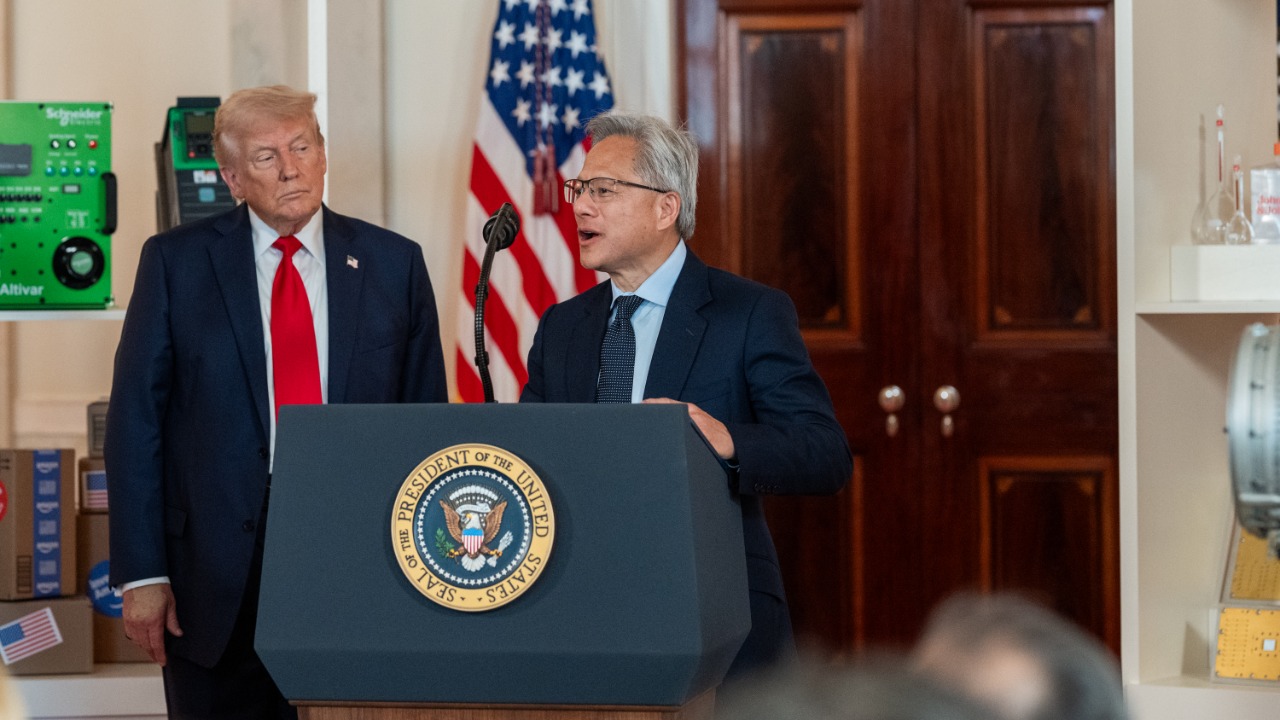
Personal relationships have also become part of the story. One account of Nvidia’s rise notes that Nvidia CEO Jensen Huang met with Nvidia CEO Jensen and President Donald Trump at the White House on a Thursday, a meeting that came as the company’s market value surged toward $4 trillion. That encounter, reported alongside commentary on Market Cap Growth to $4 Trillion, underscored how closely the administration has tied itself to Nvidia’s success. It also gave Trump a high-profile platform to present himself as the architect of America’s AI leadership.
Huang has reciprocated by publicly crediting Trump-era policy for creating the conditions for Nvidia’s current boom. In a recent Fox Business Video, the Nvidia CEO appeared alongside Trump and described how a Trump-era AI push pays off as Nvidia hits historic growth. A separate clip shows Nvidia founder and CEO Jensen Huang joining a morning show segment titled Mornings, where he again linked Nvidia’s trajectory to a broader national effort to lead the next industrial revolution, with Trump and Nvidia mentioned together. I read those appearances as more than flattery. They are part of a feedback loop in which political capital and market capital reinforce each other.
More From TheDailyOverview
*This article was researched with the help of AI, with human editors creating the final content.

Grant Mercer covers market dynamics, business trends, and the economic forces driving growth across industries. His analysis connects macro movements with real-world implications for investors, entrepreneurs, and professionals. Through his work at The Daily Overview, Grant helps readers understand how markets function and where opportunities may emerge.

