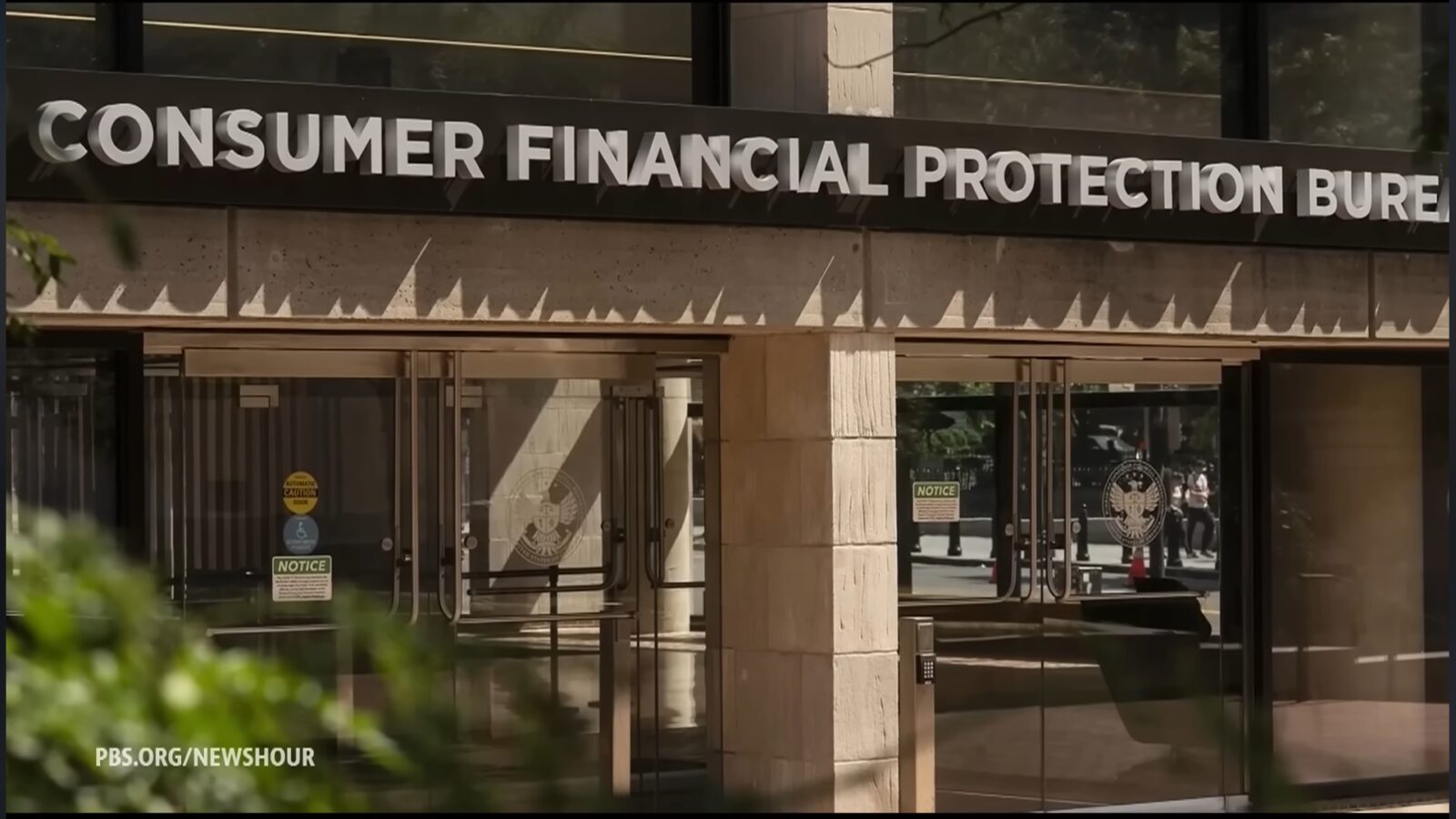
The Consumer Financial Protection Bureau was created to keep financial companies from quietly siphoning money out of household budgets. A new analysis now argues that when Trump officials pulled back that watchdog, the result was a roughly 19 billion dollar hit to Americans’ wallets. The finding lands at a moment when families are already straining under higher prices and rising bills, sharpening the debate over how aggressively Washington should police banks and lenders.
At its core, the report contends that changes to the CFPB during the Trump administration weakened rules and enforcement in ways that directly raised costs for borrowers and account holders. The figure, tied to specific policy reversals and stalled initiatives, turns an abstract fight over regulation into a concrete price tag for Americans.
How a little-known bureau became a political lightning rod
When Congress created the Consumer Financial Protection Bureau after the financial crisis, it handed a single agency broad power over mortgages, credit cards, payday loans and other products that touch nearly every household. The CFPB’s mandate was simple but sweeping: stop deceptive practices, force clearer disclosures and claw back ill-gotten gains when companies crossed the line. Supporters saw it as a long overdue counterweight to Wall Street, while critics warned that concentrating so much authority in one director risked arbitrary rulemaking that could choke off credit.
Those critics have not been quiet. One prominent argument holds that, in the case of the CFPB, the rule of law has been supplanted by what opponents describe as “regulatory whim,” with the agency accused of limiting consumers’ choices of financial products and services through aggressive enforcement and expansive interpretations of its mandate. That view, laid out in detail by advocates who want to get rid of the Consumer Financial Protection Bureau, set the stage for a sharp shift once Trump officials took control of the agency’s leadership.
The 19 billion dollar allegation against Trump-era changes
The new report at the center of the current fight focuses squarely on what happened after Trump appointees moved to remake the CFPB’s agenda. According to that analysis, changes pushed through during the Trump administration, including decisions to scale back enforcement and slow or halt certain rulemakings, collectively cost Americans about 19 billion dollars. The estimate, which has been highlighted in coverage of the bureau’s trajectory, frames the Trump-era shift not just as a philosophical pivot but as a measurable transfer of wealth from consumers to financial firms.
Accounts of the report emphasize that there is no single smoking-gun policy that explains the entire 19 billion dollar figure. Instead, the cost is tied to a series of moves that, taken together, reduced pressure on banks, card issuers and other lenders. Coverage in outlets such as the Troy Record and the Red Bluff Daily underscores that the report explicitly links Trump, the CFPB and the financial hit to Americans, turning what might seem like bureaucratic tweaks into a pocketbook issue.
Overdraft fees and the cost of a softer enforcement posture
One of the clearest examples of how CFPB policy can move real money involves overdraft fees, the charges banks impose when customers spend more than they have in their checking accounts. Before the Trump years, The Consumer Financial Protection Bureau had taken an aggressive approach to these charges, scrutinizing how banks marketed overdraft “protection” and pushing for changes that would reduce surprise fees. At one point, the agency’s work helped spur a wave of banks to cut or eliminate certain overdraft penalties, a shift that advocates say saved households billions.
That momentum slowed when the Government paused on pursuing banks for overdraft fees, a change that critics tie directly to the Trump-era pullback at the CFPB. Analysts have noted that overdraft and related charges had been generating roughly 15 billion dollars annually in what they describe as excess fees, a figure that illustrates how lucrative the status quo was for large institutions. Reporting on banks that cut or eliminated these fees makes clear that, when the Government and The Consumer Financial Protection Bureau ease off, the financial incentive to keep charging customers remains powerful.
Abandoned rules, from interest caps to “cheated” customers
The 19 billion dollar estimate also reflects what did not happen, particularly rules that were drafted but never fully implemented once Trump officials took over the CFPB. One prominent example involves a proposal to rein in certain high-cost lending practices that the Bureau’s own economists projected would save consumers about 5 billion dollars a year. That projected savings never materialized after the rule was weakened and delayed, leaving borrowers exposed to the same costly terms that regulators had flagged as problematic.
Recent enforcement actions show what is at stake when oversight is robust. Earlier this year, a settlement required Capital One to pay 425 million dollars in what regulators described as “cheated” interest to affected customers, a reminder that even large, well-known institutions can run afoul of consumer protection laws. Coverage of the 425 million dollar notes that the same Bureau that once projected 5 billion dollars in annual savings from tougher rules also continues to uncover schemes that drain money from household accounts. When rules are shelved or softened, the report’s authors argue, those kinds of losses simply never get prevented in the first place.
“Debanking,” access to credit and the Trump-era philosophy
Supporters of the Trump-era shift at the CFPB argue that pulling back on aggressive regulation was not about helping banks, but about preserving access to credit and financial services. They point to concerns about “debanking,” the practice of closing accounts or cutting off services to certain customers or industries, as evidence that heavy-handed oversight can have unintended consequences. An opinion analysis from NEW YORK, for example, links the rise of debanking to a mix of congressional choices and regulatory pressure, and notes that One year after the Trump administration’s changes to the CFPB, the landscape for some customers had already begun to shift in ways that critics blamed on Washington.
That same commentary stresses that Trump, the CFPB and Americans are all entangled in a broader fight over who gets to decide which risks banks can take and which customers they can serve. It argues that Congress helped create the conditions for debanking and lays out proposals for how to fix it, including clearer guardrails on when regulators can pressure banks to cut ties with lawful businesses. The piece, which appears in an opinion essay and is also accessible through a separate link, underscores that the 19 billion dollar figure is emerging in a debate where some lawmakers see the CFPB itself as part of the problem.
Trump’s broader economic message and the politics of pain
The clash over the CFPB is unfolding against a larger backdrop in which Trump, now back in the White House, is under pressure over the cost of living. As utility bills, credit card balances and other expenses climb, the president maintains that any troubling data on inflation is false and that Democrats are simply trying to hurt his administration by highlighting the squeeze on household budgets. That posture has shaped how the White House responds to reports that show more consumers falling behind on payments, including research from the California Consumer Credit Panel that tracks delinquencies and debt loads.
For Trump’s critics, the new 19 billion dollar estimate fits into a pattern in which policy choices favor lenders over borrowers, even as the president publicly downplays economic pain. They argue that weakening the CFPB during his earlier term made it easier for companies to raise fees and interest charges, compounding the strain families now feel. Reporting on inflation and utility captures how Trump has framed the issue as a partisan attack by Democrats, even as independent data sets document the mounting pressure on household finances.
What the fight over 19 billion dollars means for consumers now
The stakes of the 19 billion dollar allegation are not limited to past decisions. They are shaping current debates over how far the Government and The Consumer Financial Protection Bureau should go in policing banks, credit card issuers and other financial firms. As some institutions voluntarily scale back overdraft charges and other fees, often under the shadow of potential regulation, others are testing the limits of what they can charge, betting that a more business-friendly climate will shield them from aggressive enforcement. The tug of war is visible in everything from checking account terms to the fine print on buy now, pay later plans.
At the same time, Trump is pursuing a broader deregulatory agenda that extends well beyond financial services, including efforts to speed up infrastructure and housing projects. In one high-profile move, he has aimed to fast-track rebuilding in Los Angeles with an executive order that would bypass certain environmental reviews, a step his allies say will allow more manufactured homes and other construction to move forward quickly. That approach, described in coverage of his push to fast-track LA, reflects the same skepticism of regulatory friction that underpinned his team’s changes at the CFPB. For Americans now confronting the legacy of those financial policy choices, the 19 billion dollar figure is a reminder that the cost of deregulation is not just measured in growth statistics, but in the quiet line items on monthly bank statements.
More From The Daily Overview
*This article was researched with the help of AI, with human editors creating the final content.

Silas Redman writes about the structure of modern banking, financial regulations, and the rules that govern money movement. His work examines how institutions, policies, and compliance frameworks affect individuals and businesses alike. At The Daily Overview, Silas aims to help readers better understand the systems operating behind everyday financial decisions.

