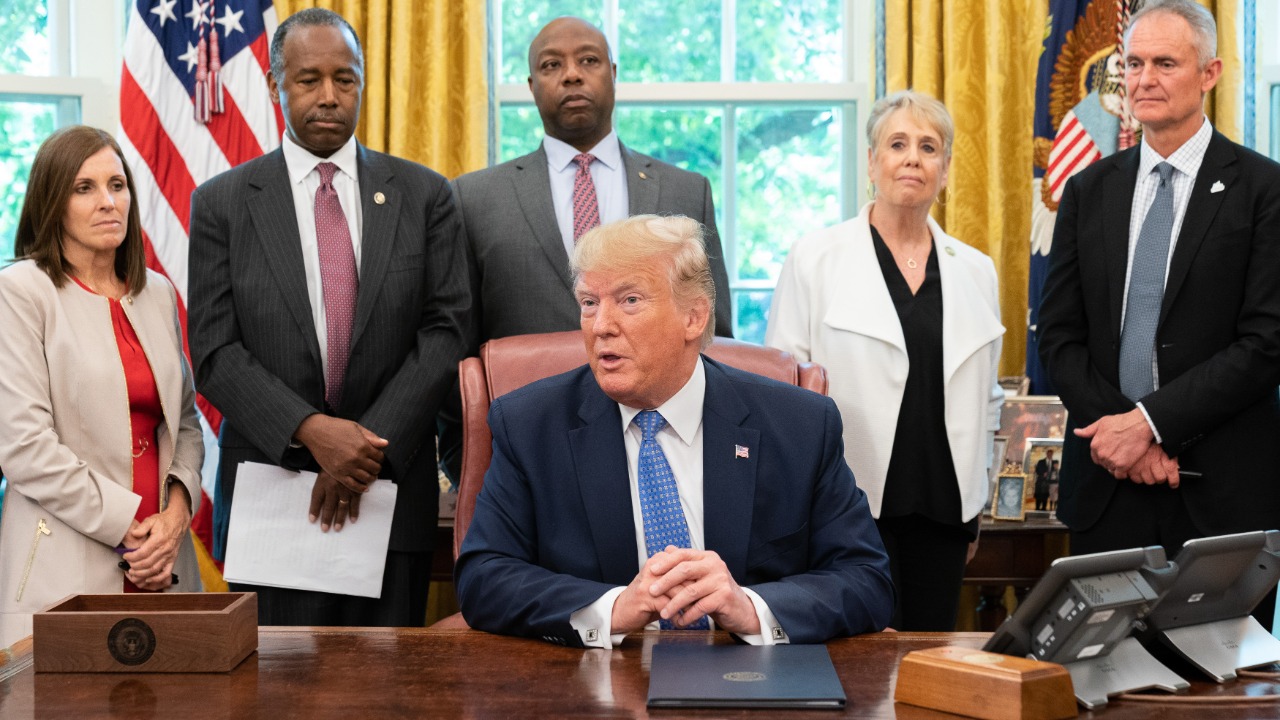
Housing policy debates usually hide a hard truth: making homes cheaper for buyers often means making existing owners poorer on paper. President Donald Trump has now put that tension in plain language, warning that a real drop in prices would wipe out housing wealth for millions of Americans. I want to unpack what that admission really means for your net worth, your ability to buy, and the political choices that shape both.
Trump’s blunt warning about falling home prices
Trump has started spelling out a basic but politically explosive reality, saying that if housing prices fall, homeowners lose wealth and the country faces a painful reset in its biggest asset class. In his framing, the family that already owns a house is sitting on a nest egg that should be protected, while the renter trying to get in is implicitly being asked to accept high prices as the cost of stability. That is the “quiet part” many politicians prefer to gloss over, and it is now central to how Trump talks about affordability, as reflected in coverage that notes Trump explicitly linking lower prices to a direct hit on household wealth and asking, in effect, what this means for you.
In parallel reporting, Trump is quoted repeating the same core idea, that if housing prices drop, homeowners lose wealth, and that this puts the interests of current owners and would-be buyers at odds. That second account underscores how Trump is not just acknowledging a trade off but leaning into it, describing owners and aspiring buyers as groups whose goals are “at conflict” when it comes to price direction. The repetition across outlets, including a separate piece that again highlights Trump’s line that if housing prices drop, homeowners lose wealth and asks what that means for ordinary families, shows that this is not a stray remark but a deliberate message.
Lower rates, not lower prices: the core of Trump’s housing strategy
Trump’s solution to this tension is to promise cheaper monthly payments without touching the underlying price of the house. He has made clear that he wants lower mortgage rates, not cheaper houses, arguing that the way to make homes more affordable is to cut borrowing costs while keeping valuations high for existing owners. Analysts describe this as a strategy that tries to square the circle by boosting demand through cheaper credit, while avoiding the politically toxic outcome of a broad price correction that would shrink home equity, a stance detailed in reporting on how President Donald Trump is pushing for lower mortgage rates as a way to make housing more affordable without causing significant declines in home values, with Key Takeaways that spell out his preference.
That approach fits with a broader pattern in which One of President Trump’s most vocal demands has been for lower interest rates, including public pressure on the Federal Reserve to cut. In the housing context, this means leaning on the central bank and other levers to bring down Mortgage costs, while leaving the supply side of the market largely untouched. Critics argue that this focus on cheaper money, rather than more homes, risks repeating past cycles where low rates inflated prices further, a concern laid out in analysis of why Trump’s initiatives may not deliver lasting relief without deeper supply side and local reforms.
Who wins and who loses when prices are protected
When a president openly says he does not want home prices to fall, he is choosing sides between current owners and future buyers. Trump has been unusually explicit about that choice, arguing that he does not want lower housing prices so “somebody who did not work very hard” can buy a home more cheaply. That line, delivered at President Trump’s cabinet meeting and reported alongside data from The National Association of Realtors, makes clear that in his view, protecting the equity of existing owners is a higher priority than making it easier for newcomers to buy, even as the same report notes that The National Association of Realtors recorded a seasonally adjusted annual rate of home sales of 4.35 m in December.
That framing has sparked a backlash among people who see themselves on the wrong side of the trade. On social media, critics have seized on the idea that Donald Trump has a plan for home prices that keeps values high for existing owners while leaving renters and first time buyers squeezed. One viral post bluntly summarized the sentiment as “Hates poor and middle class. Cool.” and highlighted a quote in which Trump praised the fact that People that own their homes have seen their values rise, while warning against any move that might “undermine existing home values,” a contrast captured in a widely shared clip that also references President Donald Trump signing housing related measures.
The “fatal flaw” in the rate cut fix
Financial analysts are increasingly skeptical that Trump’s preferred fix of lower rates without lower prices can hold together. Research from Morgan Stanley, cited in detailed coverage of Trump’s housing market plan, describes a “fatal flaw” in the idea that cutting borrowing costs alone can restore affordability. The argument is straightforward: if rates fall sharply while supply remains tight, cheaper mortgages simply bid up prices further, leaving first time buyers no better off and potentially inflating a new bubble. That critique, laid out by Morgan Stanley and reported by Nick Lichtenberg and Nick Lichtenb, warns that Trump’s approach leans on financial engineering rather than a genuine market cure, a concern summarized in analysis of why Trump’s housing plan faces multiple obstacles.
There is also a political risk embedded in this strategy. If Trump succeeds in pushing rates down but prices keep rising, renters and younger households may conclude that the system is rigged to protect older, wealthier owners at their expense. That perception is already visible in partisan commentary that accuses Trump of wanting to “drive housing prices up” for the rich while making it harder for working families to buy their first home. One widely circulated post framed it as BREAKING news, quoting Trump as saying he wants to drive housing prices up and accusing Donald of effectively “screwing everyone else,” a charge that reflects growing anger in online communities where people share stories of being priced out despite doing everything right, as seen in a group discussion focused on families struggling to buy their first home.
What Trump’s housing stance means for your next move
For current homeowners, Trump’s message is reassuring on the surface. A president who openly says he wants to protect high prices is signaling that he sees your home equity as a political priority, not a variable to be sacrificed in the name of affordability. That stance is consistent with his broader push for lower mortgage rates, which, if successful, could make refinancing more attractive and keep monthly payments manageable for those already in the market, a pattern described in coverage of how President Donald Trump views rate cuts as “good for everybody.” If you own a home and plan to stay put, that combination of policy goals may feel like a safety net under your largest asset.
If you are on the outside looking in, the implications are harsher. Trump is effectively telling renters and first time buyers that the federal government will not pursue policies that materially lower prices, even if that would make ownership more attainable. Instead, the focus will remain on cheaper credit and incremental measures that do not “undermine existing home values,” a posture that critics argue locks in today’s divide between owners and non owners. Analysts who warn that One of President Trump’s most vocal demands has been for lower interest rates, without matching supply side reforms, caution that this path is unlikely to deliver a real break in affordability pressures, a point underscored in assessments of why long run relief will require more homes, not just cheaper loans.
More From TheDailyOverview
*This article was researched with the help of AI, with human editors creating the final content.

Grant Mercer covers market dynamics, business trends, and the economic forces driving growth across industries. His analysis connects macro movements with real-world implications for investors, entrepreneurs, and professionals. Through his work at The Daily Overview, Grant helps readers understand how markets function and where opportunities may emerge.

