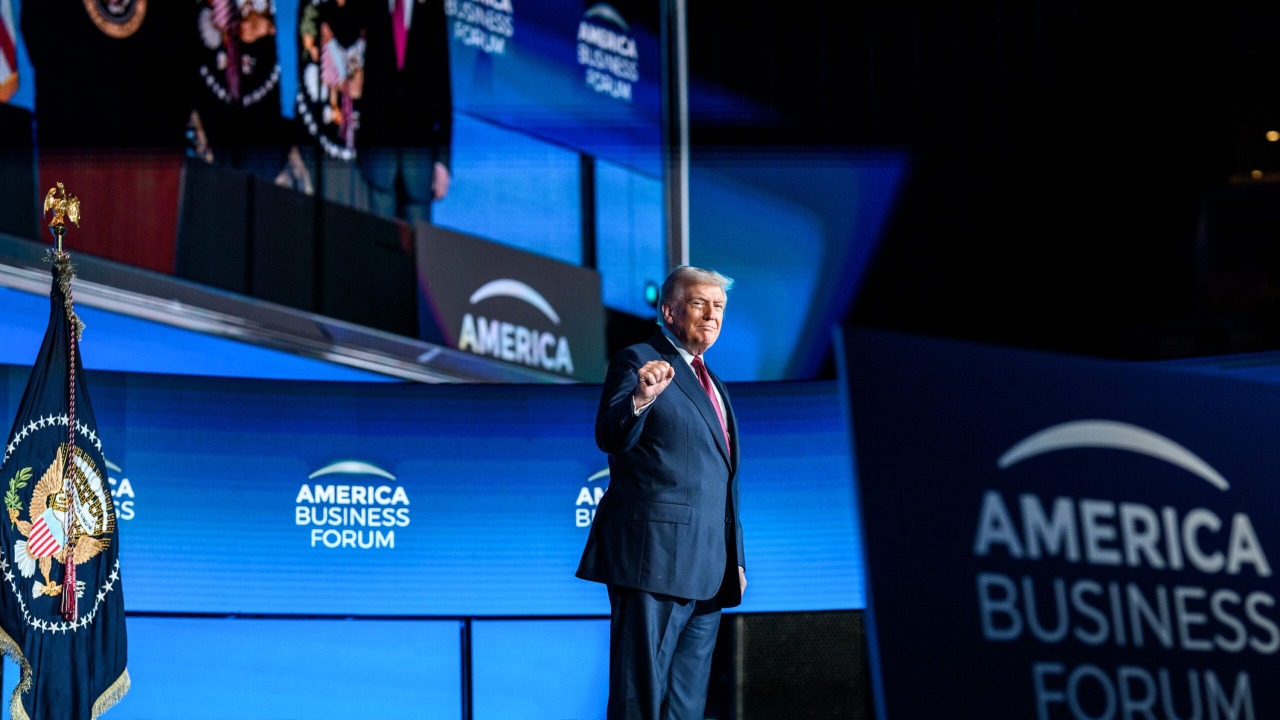
President Donald Trump has put defense investors on notice, signaling that the era of easy cash returns from Pentagon contractors may be ending. His push to curb dividends and stock buybacks at major arms makers threatens a core pillar of the sector’s appeal to income-focused shareholders. If the policy hardens into a broad ban, many investors who treated defense payouts as sacrosanct could find themselves exposed.
The stakes are unusually high because defense stocks have long traded as quasi-utilities, with reliable government revenue and steady distributions. Trump’s new posture reframes those payouts as a tradeoff with military readiness, and it introduces a political risk that many portfolios have not fully priced in.
Trump’s hard line on defense payouts
I see the current shift starting with Trump’s blunt public warning that he “will not permit” dividends and stock buybacks for defense companies if they come at the expense of military needs. In those remarks, President Donald Trump tied shareholder rewards directly to the pace of weapons production and stockpile replenishment, and defense shares dropped about 3% after his comments, underscoring how central these payouts are to valuations built on predictable cash flows from the Pentagon’s budgeted contracts, as reflected in the immediate market reaction.
The rhetoric was quickly backed by policy. Trump followed up with a formal directive that major defense contractors should no longer conduct stock buybacks or issue dividends “at the expense of accelerated procurement and delivery” of critical systems, a standard that effectively subordinates shareholder distributions to the pace of building up U.S. arsenals and that signals a willingness to intervene in corporate capital allocation if he believes the warfighter is being shortchanged, as spelled out in the language on major contractors.
The executive order that changes the rules
The policy backbone of this shift is an executive order that President Donald Trump issued earlier this year, which puts stock buybacks, dividends, and executive compensation for the U.S. defense industrial base under direct scrutiny by the federal government. Under that order, the Secretary of defense (the Secretary) is instructed to evaluate whether contractors are prioritizing shareholder returns over the needs of the armed forces, and the document explicitly frames capital returns as a potential drag on the buildup of United States stockpiles and capabilities, according to the detailed description of the executive order.
The order also sets a clear timetable for tightening the screws. Within 60 days of its issuance, the Secretary is directed to take steps to ensure that any future contract with any new or existing defense contractor includes conditions that align payouts with the goal of strengthening United States stockpiles and capabilities, a requirement that effectively bakes policy risk into every new deal and gives the administration leverage to press companies that rely on Pentagon revenue, as laid out in the section beginning “Within 60 days” that details the contract conditions.
How defense contractors actually use their cash
To understand why investors could be blindsided, I look at how central buybacks and dividends have become to the defense business model. Spending a company’s money to buy back its own stock is a strategic move that can boost a share’s value by making it harder to get, and large Pentagon suppliers have leaned heavily on this tactic to support earnings per share even when topline growth is modest, a pattern that is visible in charts showing how much cash has gone into Spending on buybacks.
Dividends, the cash that public and private companies shave off of their profits to reward investors, are an equally important perk in this sector, and many defense names have built their reputations on steadily rising payouts that signal confidence in long term Pentagon demand and the perceived safety of supplying the United States Military. That culture of regular distributions has trained investors to treat defense stocks as income vehicles, a mindset that could be upended if Washington now insists that every dollar sent out the door is a dollar not spent on missiles, ships, or aircraft, as illustrated by the focus on Dividends policy.
Underperformers in the crosshairs and the risk of a broader ban
The first companies to feel the pinch are likely to be those that the government deems to be lagging on performance. Under the January 7 EO, defense contractors determined to be underperforming will no longer be permitted to conduct stock buybacks or issue dividends, and the government will provide notice to those contractors, a structure that effectively ties capital returns to report cards on schedule, cost, and delivery metrics and that could quickly separate favored suppliers from those forced to conserve cash, as described in the section beginning “Under the January” that outlines the underperformer penalties.
Legal analyses of the order note that on 7 January 2025, President Donald Trump set out to limit and prevent certain large defense contractors from engaging in stock buybacks and dividends when those actions are seen as conflicting with national security priorities, and they emphasize that the framework gives the administration wide discretion to define which companies fall under the stricter regime. That flexibility means a policy that starts with “underperforming” firms could, in practice, expand to cover a much broader swath of the industry if the White House decides that more aggressive constraints are needed, as highlighted in commentary on how President Donald Trump structured the order.
Market fallout and which investors are most exposed
The market has already offered a preview of how painful a full scale clampdown could be. Defense stocks fell sharply Wednesday after President Donald Trump ordered contractors to halt dividends and buybacks, with a range of names sliding in a single session as investors reassessed the value of companies whose appeal has long rested on predictable cash returns, a move captured in coverage under the banner “Defense Stocks Sink After Trump Orders Contractors To Halt Dividends, Buybacks” that detailed how Defense stocks reacted.
More granular trading data show that the initial market reaction and price action reflected uncertainty and volatility, with defense stocks falling sharply after Trump’s comments and then partially recovering as investors tried to handicap how far the administration would go, and analysts warned that the sector could face further losses tied to payout restrictions if the policy tightens. That pattern suggests that many shareholders had not fully modeled the risk that Washington might directly target their dividends, and it underscores how sensitive valuations are to any hint that the cash spigot could be turned off, as seen in the breakdown of Market Reaction and Price Action.
More From The Daily Overview
*This article was researched with the help of AI, with human editors creating the final content.

Grant Mercer covers market dynamics, business trends, and the economic forces driving growth across industries. His analysis connects macro movements with real-world implications for investors, entrepreneurs, and professionals. Through his work at The Daily Overview, Grant helps readers understand how markets function and where opportunities may emerge.

